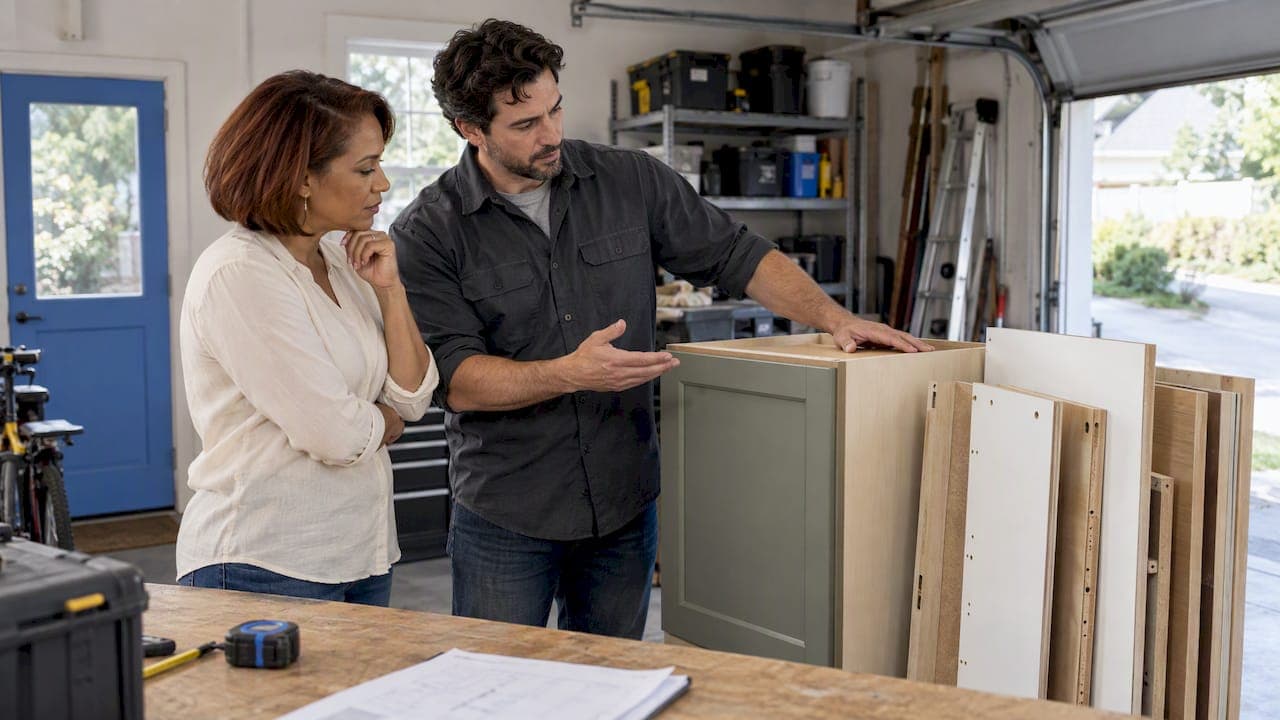
Assembled cabinets cost more than ready-to-assemble (RTA) cabinets and far less than custom cabinetry. The difference over RTA is mostly the factory labor, plus some extra freight because a built box takes up more space on a truck. For most US kitchens, your final number depends on the construction, the door style, the layout and whether you pay someone to install. Below we break down each of those parts so you can build a real budget before you order.
We sell both RTA and assembled kitchen and bathroom cabinets, so we see how buyers weigh the two. We have not published a fixed price for assembled cabinets on this page. The ranges below come from public cost data and the sources linked in each section. For current pricing on your layout, check our assembled cabinets page.
TL;DR
- Assembled cabinets sit between RTA and semi-custom on price. Fully custom cabinetry is commonly quoted at $500 to $1,200 per linear foot, which is where costs climb fastest.
- Paying for assembled cabinets means paying for factory labor. Assembling RTA yourself saves that labor, and hiring it out is typically $204 to $520 per cabinet.
- Cabinets usually take 30% to 40% of a kitchen remodel budget, and installation is a separate line.
- Count freight, filler strips, trim, hardware and old cabinet removal before you compare quotes.
Table of Contents
- What "assembled cabinets cost" really covers
- Price ranges by cabinet type
- What pushes the price up or down
- Assembled vs. RTA: where the money goes
- Installation, removal and the other costs
- How to budget for your kitchen
- Our view: where assembled cabinets earn their price
- Get an assembled cabinet quote
- Mistakes that raise the final bill
- FAQ
- Sources
What "assembled cabinets cost" really covers
When a quote says "assembled," it means the box arrives built: sides, back, bottom and face frame or panels joined, doors hung and drawers in place. You unbox, level and fasten them to the wall. That is the whole difference from RTA, where the same parts arrive flat.
So the price of assembled cabinets has four parts:
- The cabinet itself. Box material, door construction, finish and hardware.
- Factory assembly. Labor that you would otherwise do at home or pay a person to do.
- Freight. Built boxes are bulkier, so shipping costs more than for flat-packed cabinets.
- Extras. Fillers, toe kicks, crown, end panels and accessories, which are almost never in a headline price.
Installation on your wall is not in any of these. We cover it in its own section below, because it is the line buyers forget most often.
Price ranges by cabinet type
Per-linear-foot pricing is how most US sellers and remodelers compare cabinets. One linear foot is one foot of a cabinet run, measured along the wall. A kitchen with 15 feet on one wall and 10 feet on another has 25 linear feet.
Here is how the main categories compare in broad terms.
| Cabinet type | How it arrives | Where the cost comes from | Typical use |
|---|---|---|---|
| RTA | Flat-packed, you assemble | Lowest labor cost, lowest freight | Budget remodels, rentals, builders with crews |
| Assembled (pre-built) | Built box, ready to hang | Factory labor and bulkier freight | Homeowners and contractors who want to save time on site |
| Semi-custom | Built to order from set options | More sizes, finishes and modifications | Layouts that need non-standard sizes |
| Custom | Built to your drawings | Design, one-off fabrication, hand finishing | Unusual spaces, high-end finishes |
For the top of the market, custom cabinetry is quoted at roughly $500 to $1,200 per linear foot, which puts a 20-foot kitchen around $16,000 in cabinets alone at $800 per foot. For the low end, our own guide to RTA cabinet costs per linear foot puts U.S. RTA pricing at $100 to $300 per linear foot. Assembled cabinets from a direct-to-consumer seller fall between those two ends, closer to RTA than to custom when the construction is comparable.
We suggest you treat any single national average with caution. A figure that blends particleboard boxes with plywood boxes, or thin doors with solid wood doors, tells you little about what you will actually receive.
What pushes the price up or down
The installation pros at Thumbtack list the main cost drivers for cabinet projects: cabinet type, layout complexity, wall and floor condition, removal of old cabinets and local labor rates. For the cabinets themselves, these are the choices that move your total most.
Box construction
Plywood boxes are more resistant to moisture and hold screws better than particleboard, which matters under a sink and around a dishwasher. Plywood costs more to make, and this is a main reason cheap assembled cabinets are cheap. When you compare two quotes, ask what the box, the back panel and the drawer boxes are made from.
Our cabinets use plywood boxes and solid wood doors, so a comparison with our line should be made against sellers using the same materials, not against the lowest number on the page.
Door style and finish
A flat slab door is simpler to make than a five-piece Shaker door, and a painted finish costs more than a clear one. In our range, the Shaker, Classic and Slim series cover the most requested looks. You can see them on our RTA cabinets page, and the same styles are available assembled.
Layout complexity
Islands, corner units, tall pantries and wall ovens add cost because they need special cabinets and more filler and finishing pieces. A straight 10-foot galley is cheaper per foot than an L-shaped kitchen with a diagonal corner sink base.
Hardware
Soft-close hinges and full-extension drawer slides raise the price of a cabinet, but they are the parts you touch dozens of times a day. Check that soft-close is standard rather than an upgrade before you compare totals.
Where you live
Labor is the regional variable. Thumbtack's page notes that, according to CostReno, major metros such as New York City and San Francisco run about 1.35 times the national baseline for installation. The cabinet price barely changes by region, but the installer's price can.
Assembled vs. RTA: where the money goes
The real comparison is not box against box. It is who does the assembly, and what that costs you in dollars and days.
Assembling RTA cabinets by a hired handyman or carpenter is priced at about $204 to $520 per cabinet in current national estimates, and that excludes installation on the wall. A standard kitchen has roughly 12 to 20 cabinets, so paying someone to build all of them can add several thousand dollars to an RTA order. Do the math with your own cabinet count before you decide that RTA is the cheaper route.

That is the fair case for assembled cabinets. If you would pay for assembly anyway, the factory build is often the better value: it is done in a controlled setting, squared and tested, and you avoid scheduling another trade.
If you or your crew will assemble, RTA stays cheaper. Our own guide to RTA assembly for homeowners puts it at 30 to 60 minutes per cabinet for a first-timer working with basic tools.
A worked example
Take a kitchen with 16 cabinets.
- Assembled route: you pay the assembled price for 16 cabinets, plus freight and installation.
- RTA, hired assembly: you pay the RTA price for 16 cabinets, plus freight, plus 16 cabinets times the assembly rate. At the $204 to $520 range, that is $3,264 to $8,320 for assembly alone.
- RTA, self-assembly: you pay the RTA price plus freight, and spend roughly 8 to 16 hours at 30 to 60 minutes each.
The figures for assembly come from the national estimate linked above. Your local rate may be lower or higher, so get a written quote before you assume a saving.
Installation, removal and the other costs
Buying cabinets is one purchase. Putting them in is another. Our guide to what it costs to install kitchen cabinets covers the full range, and the short version is that you should budget for these items.
- Installation labor. Hanging, leveling and fastening, usually quoted per cabinet or per linear foot.
- Removal and disposal. Taking out the old cabinets, and often patching the wall behind them.
- Wall and floor prep. Uneven walls and floors take time to shim and level. Thumbtack lists this as one of the main drivers of cost.
- Fillers, trim and toe kicks. These finish the run. We stock items such as the Shaker toe kick for white cabinets.
- Countertops, plumbing and electrical. Not part of the cabinet price, but they often have to be coordinated with it.
- Cleaning after the work. Dust from demolition and install is real, and some owners hire a cleaner at the end.
Hire an installer or do it yourself?
DIY installation saves labor but takes precision. Thumbtack's pros warn that misaligned doors and weak wall fastening are expensive to fix and can be a safety hazard. Wall cabinets are the real risk, because they carry the weight of dishes and are fixed into studs.
If you do hang them yourself, step-by-step cabinet assembly tips on avoiding cracks and misaligned parts are a good general reminder of why slow, careful fastening pays off. For wood cabinets, see our guide to installing kitchen cabinets on a wall.
A simple rule: if you have hung wall cabinets before and have a helper, DIY can work. If this is your first kitchen, or you have uneven walls, hire a licensed installer and ask for a written scope that names who levels the run and who patches the wall.
How to budget for your kitchen
The question "what is the 1/3 rule for cabinets" comes up often. We are not aware of a single official rule by that name. What public remodeling guidance does show is that cabinets are the largest single line: 30% to 40% of a typical kitchen remodel budget, with labor at 25% to 35%. So "about a third" is a reasonable planning figure for cabinets, not a code or a standard.
Here is a way to use it.
- Set the total kitchen budget.
- Reserve 30% to 40% for cabinets, including freight and trim.
- Reserve another 25% to 35% for labor, which covers installation and trades.
- Keep a contingency of your own on top, for surprises behind the walls.
- Compare cabinet quotes on the same basis: same cabinet count, same materials, same extras.
If the cabinet share is running well above that range, the usual levers are door style (a simpler profile costs less), fewer specialty units and choosing RTA with your own or your crew's assembly.
Our view: where assembled cabinets earn their price
We are a women-owned and veteran-owned business, and we build our catalog around the buyers we hear from most: homeowners on a budget, contractors, builders, designers and property managers. The questions are different, but the concern is the same: how long will it take, and what will it really cost?
Here is what we tell them.
- Assembled makes sense when time on site costs more than the price gap. A contractor paying a crew by the day, or a property manager turning over several units, usually comes out ahead with built cabinets.
- RTA makes sense when labor is free or cheap. A homeowner who enjoys the work, or a builder with an in-house crew, can keep the saving.
- Material matters more than the label. Plywood boxes and solid wood doors cost more to make than the thinnest alternatives. We build with them because kitchens and bathrooms are hard on cabinets.
- Order a sample first. A door sample shows color and finish in your own light, and it costs far less than a wrong order. See our sample doors.
- Measure twice, then confirm the cabinet list. Most of the expensive mistakes we see are ordering errors, not product defects. Our cabinet ordering checklist is built for this.
Our aim is a cabinet that arrives quickly, hangs square and holds up for years, at a price that does not force you to compromise on materials.
— Nathan
Get an assembled cabinet quote
We offer assembled cabinets and RTA cabinets for kitchens and bathrooms, with plywood boxes, solid wood doors, soft-close hardware and fast shipping. We also offer bulk ordering and trade pricing for contractors, builders and property managers.
To start, pick your style and compare the two build options side by side: Shop Now for assembled cabinets or Shop Now for RTA cabinets. Not sure of your layout? Our guide to buying cabinets online with samples and measurements walks you through it.
Mistakes that raise the final bill
A lower sticker price can still end up as the higher total. These are the common reasons.
- Comparing cabinet counts, not cabinet quality. Two 20-foot quotes are not equal if one uses a thinner box.
- Leaving out fillers and trim. They can add up, and a run without them looks unfinished.
- Assuming freight is flat. Built boxes ship differently from flat-packs. Ask for the delivered price.
- Skipping the sample. A returned or reordered door costs more than the sample would have.
- Underbudgeting walls and floors. Out-of-level surfaces turn a one-day install into two.
For a longer list, read our 10 kitchen cabinet mistakes to fix before you order.
FAQ
How much does it cost to have a cabinet assembled?
National estimates put the labor for assembling an RTA cabinet at about $204 to $520 per cabinet, excluding installation. A full kitchen has many cabinets, so the total adds up quickly. If you want to avoid the line altogether, buying cabinets already assembled moves that labor into the factory.
Can you buy cabinets already assembled?
Yes. Many online sellers and cabinet shops offer fully built cabinets that you only need to hang and level. We sell both options: see our assembled cabinets for kitchens and bathrooms.
Is it cheaper to buy premade cabinets or build your own?
Building from raw lumber is usually the most time-consuming route and takes tools and skill. For most buyers, RTA is the cheapest ready-made route if you will assemble it, and assembled cabinets are the cheaper route if you would otherwise pay for assembly. Custom cabinetry sits well above both, at $500 to $1,200 per linear foot in recent estimates.
What is the 1/3 rule for cabinets?
There is no official rule by this name that we know of. A useful planning figure is that cabinets take 30% to 40% of a kitchen remodel budget, so about a third is a sensible starting point for your cabinet line.
Sources
- 2026 Cabinet Installation Cost: Prices & Factors, Thumbtack
- Cost to Assemble RTA Cabinet, Homewyse
- How Much Do Custom Kitchen Cabinets Cost in 2026?, Kitchen Search
- Kitchen Remodel on a Budget: Where to Save and Splurge, Lars Remodel
- Assemble a Plastic Cabinet Fast With Keter Tips