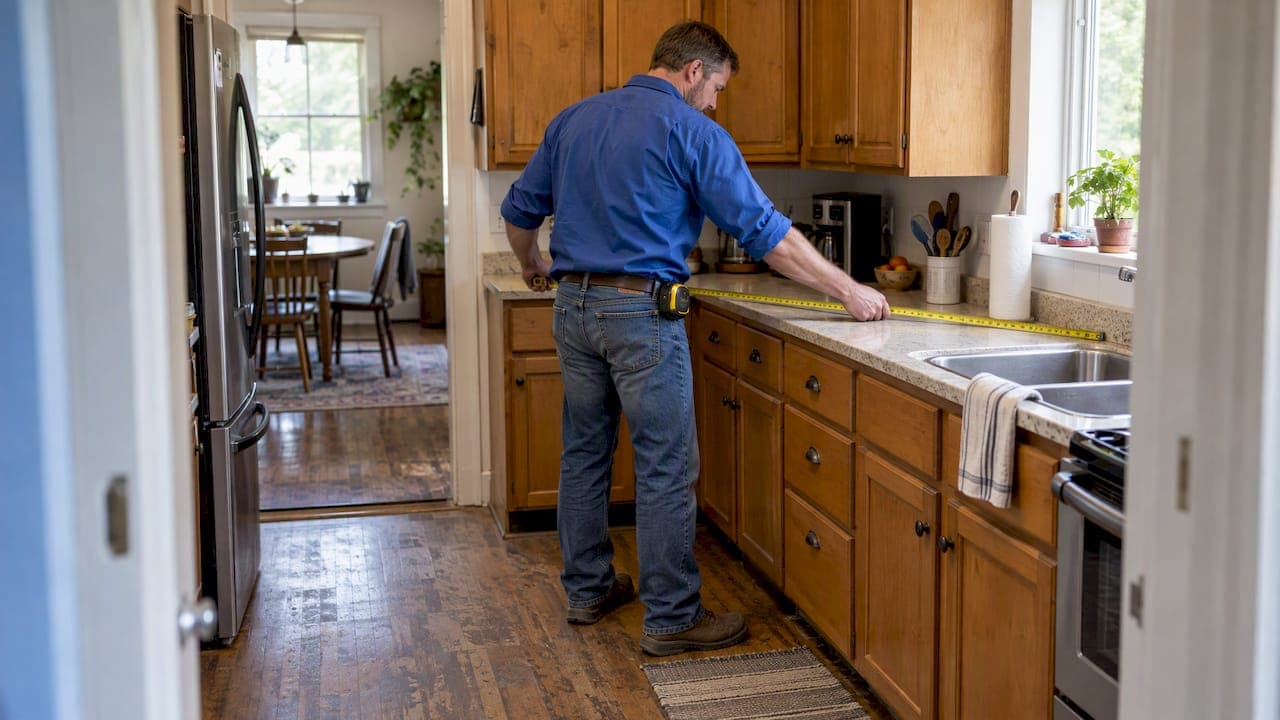
The single most important thing you can do before you order cabinets is lock your measurements, confirm every material and hardware spec in writing, and set a realistic delivery timeline. Skipping any one of these steps is the root cause of most cabinet ordering mistakes. The NKBA publishes clearance standards for exactly this reason, and some suppliers build their process around helping you get these details right the first time.
TL;DR:
- Confirm all measurements at multiple points and verify appliance clearances to prevent fit issues and awkward gaps in the final installation.
- Order long-lead items first and obtain written shipping dates to avoid project delays caused by supply chain or freight issues.
- Insist on plywood construction, dovetailed drawers, and full-extension soft-close hardware to ensure durability and reduce costly early replacements.
- Cross-check rough-in locations for plumbing and electrical fixtures before ordering to avoid expensive modifications after installation begins.
- Lock all specifications, finishes, and hardware details in writing before signing the order to prevent costly changes and budget overruns later.
Table of Contents
- The most common cabinet ordering mistakes at a glance
- Measuring, clearances, and layout mistakes to avoid
- Underestimating lead times and scheduling conflicts
- Choosing the wrong materials or hardware
- Storage, workflow, and functional planning mistakes
- Budgeting mistakes and the cost of change orders
- Delivery, inspection, and warranty claim mistakes
- Practical pre-order checklist and questions to ask suppliers
- Why Best Cabinet Specialist helps you avoid these mistakes
- Ignoring compatibility with existing plumbing and electrical fixtures
- Overlooking hardware finish and style coordination with existing kitchen design
- Not accounting for installation challenges from wall irregularities or ceiling slopes
- How Best Cabinet Specialist helps you avoid these mistakes
- Small changes that pay off
- Sources
- FAQ
The most common cabinet ordering mistakes at a glance
Before your order goes in, these are the mistakes that cause the most rework and the most frustration.
- Wrong measurements: cabinets arrive that do not fit, forcing costly modifications. Fix: verify twice, order once.
- Rushed lead-time planning: your install stalls while you wait on boxes. Fix: order long-lead items first.
- Weak materials: particleboard boxes sag and swell. Fix: insist on plywood construction.
- Poor storage planning: wasted cabinet space and awkward workflow. Fix: map storage to how you cook.
- Late-stage changes: small tweaks balloon your budget. Fix: lock specs before signing.
- Skipped delivery inspection: damage goes unclaimed past the return window. Fix: inspect and photograph immediately.
- Plumbing and electrical conflicts: cabinets block outlets or supply lines. Fix: cross-check rough-in locations first.
- Mismatched hardware finish: new pulls clash with existing fixtures. Fix: sample finishes before ordering.
Measuring, clearances, and layout mistakes to avoid
Bad measurements cause more cabinet ordering mistakes than any other single factor, and most of them trace back to a handful of overlooked details. The NKBA kitchen planning guidelines recommend a minimum work aisle of 42 inches for single-cook kitchens and 48 inches where multiple people cook at once. Ignore those clearances and you end up with drawers that cannot open fully or a walkway that feels cramped the moment two people are in the kitchen.
Standard counter depth runs about 25.5 inches, and many homeowners forget to account for appliance reveal, soffit depth, or toe-kick height when translating a rough sketch into an order. A cabinet that looks right on paper can bump into a refrigerator door or leave an awkward gap under a soffit.
Before you finalize anything, run through this list:
- Confirm wall-to-wall dimensions at three heights, since walls are rarely perfectly straight.
- Check appliance widths and required side clearances against the cabinet plan.
- Verify upper cabinet height against your ceiling line and range hood requirements.
- Measure toe-kick depth and height to match your flooring transition.
Our guide on how to measure a kitchen for new cabinets walks through each of these steps in more detail, and our upper cabinet height breakdown covers the exact clearance numbers to check.
Underestimating lead times and scheduling conflicts
Lead time is where a lot of otherwise well-planned projects fall apart, so our custom kitchen renovation basics guide can help builders and contractors plan effectively. Stock cabinets can ship in days, semi-custom lines often take several weeks, and fully custom orders can take months once you factor in production queues and freight. A single delayed shipment can stall your contractor, push back your countertop template appointment, and leave your kitchen unusable far longer than planned.
Scheduling around construction milestones, not just the cabinet order date, is what keeps a project on track. Appliances, countertops, and cabinets all need to land in a sequence that matches your installer's calendar, not the other way around.
A few habits make this easier to manage:
- Order long-lead items like custom cabinetry or specialty finishes first.
- Get a written ship date from your supplier, not just an estimated range.
- Build a buffer of one to two weeks before your installer's scheduled start.
- Confirm appliance delivery dates line up with cabinet arrival, not ahead of it.
Vendor communication is one of the simplest, highest-leverage habits in this entire process. Request written ship dates and update your project schedule the moment anything shifts.
Choosing the wrong materials or hardware
Cabinet construction quality is easy to overlook when you are focused on style, but it is where cheap orders turn into expensive regrets. Consumer Reports' buying guidance outlines what separates a durable box from one that will sag or swell within a few years: solid plywood construction, dovetailed drawers, and full-extension guides.
Stock cabinets typically start around $70 per linear foot, semi-custom runs $150 to $250 per linear foot, and custom cabinetry starts at $500 and up, according to the same Consumer Reports guidance. Price alone does not tell you what you are getting, so read the spec sheet line by line.
When you review a quote, insist on these details in writing:
- 3/4 inch plywood boxes rather than particleboard or thin MDF panels.
- Dovetail joinery on drawer boxes, not stapled or glued corners.
- Full-extension, soft-close drawer slides rated for repeated daily use.
- Soft-close hinges specified by brand or model, not just "soft-close" as a vague claim.
Ask for a physical sample of the box material and drawer joint before you commit to a full order.
Storage, workflow, and functional planning mistakes
A kitchen can look beautiful on a rendering and still be frustrating to cook in if the storage does not match how you actually use the space. Deep drawers work better than shelves for pots and pans, while narrow pull-outs make sense next to a range for oils and spices. Skipping this kind of planning is one of the more common cabinet ordering mistakes, because it is invisible until you are living with it.
Door swings are another overlooked detail. A cabinet door that opens into a walkway or collides with the dishwasher door creates daily friction that no amount of nice finish work fixes.
Before finalizing your layout, check for these:
- Match drawer and shelf types to what you store most, not a generic default.
- Add pull-outs near cooking zones and a charging station near the counter you use for devices.
- Confirm no cabinet or appliance door swing conflicts with another.
- Review our cabinet accessories list for upgrades that solve specific storage gaps.
According to Consumer Reports, accessory upgrades like pull-out trash bins can add about 20% to cost, but they often solve a workflow problem that a plain cabinet box cannot.
Budgeting mistakes and the cost of change orders
Unclear specs are expensive. Consumer Reports found that indecision and change orders during a remodel are a leading driver of budget overruns, adding roughly 10% to project costs when decisions are made mid-project instead of locked in advance.
The fix is contractual, not just conversational. Write the exact product SKUs, finishes, and quantities into your order confirmation before signing, so there is no ambiguity about what you agreed to.
Your contract or order confirmation should include:
- Exact SKUs and finish codes for every cabinet and hardware piece.
- Confirmed delivery dates in writing, not verbal estimates.
- A clear returns and damage policy in case items arrive incorrect.
- A defined approval process for any change made after the order is placed.
Locking these details early is what keeps your budget matching your original estimate instead of drifting upward with every small adjustment.
Delivery, inspection, and warranty claim mistakes
The moment cabinets arrive is not the time to relax. Consumer Reports' guidance on product defects recommends documenting everything immediately: quantities, finishes, visible damage, and missing hardware, all captured in photos with dates attached.

Acting quickly matters. Many retailers only accept returns or replacement claims within a 15 to 30 day window, so a delayed inspection can cost you the chance to fix a problem at no charge.
When cabinets arrive, work through this list before the delivery crew leaves:
- Count every box against your order confirmation before signing for delivery.
- Photograph any dents, scratches, or finish flaws on the spot.
- Open at least one box per style to confirm interior hardware matches the spec sheet.
- Start with the retailer, then escalate to the manufacturer if the issue goes unresolved.
Pro Tip: Store cabinets flat, indoors, and away from direct sunlight or moisture until installation day to avoid warping that has nothing to do with the original shipment.
Practical pre-order checklist and questions to ask suppliers
Run through this list before you place a single order.
- Verify every measurement twice, including wall height at three points.
- Request a full material spec sheet, not just a product name.
- Confirm the exact hardware code and finish for hinges, slides, and pulls.
- Get a written lead time estimate and a hard ship date.
- Ask about the damage and return policy before you pay.
- Compare the written quote against your original design plan line by line.
When you call a supplier, ask direct questions: what is the box material, is it plywood or particleboard, what is the drawer joinery, and what happens if something arrives damaged. A supplier who answers clearly and in writing is one you can trust with the rest of the order. For door-specific measurements, our guide to measuring for new cabinet doors covers overlay and clearance details worth confirming before you finalize.
Why Best Cabinet Specialist helps you avoid these mistakes
Some cabinet suppliers build cabinets with plywood boxes and solid wood doors, designed to address long lead times and inconsistent quality. Some companies focus on project-ready cabinetry with fast shipping for homeowners, contractors, and builders who need dependable specs and dependable timelines. Author Nathan covers cabinet lead times and specification planning as part of this ongoing series, helping readers translate industry standards into order-ready decisions.
Ignoring compatibility with existing plumbing and electrical fixtures
Cabinets do not exist in isolation. Sink bases have to align with existing drain and supply lines, and cabinets near a range or dishwasher need to clear gas lines, outlets, and shutoff valves. Ordering a cabinet configuration without checking these rough-in locations is one of the more expensive cabinet ordering mistakes, because fixing it after installation usually means cutting into a finished box or relocating plumbing.
Before you finalize your order, confirm the exact location of every supply line, drain, and electrical outlet behind the planned cabinet run. A sink base cabinet, for example, needs a back panel cutout sized to your actual drain and shutoff positions, not a generic template. Under-cabinet lighting and outlet placement for small appliances also need to be planned against the cabinet's interior layout, since a full-height pantry cabinet installed over an outlet makes that outlet useless.
If you are working with a contractor, share your cabinet spec sheet with your plumber and electrician before rough-in work is finalized, not after cabinets arrive. Retrofitting an electrical box or moving a drain line after cabinets are installed adds both cost and delay, and it is entirely avoidable with a single coordination conversation early in the process. This is especially relevant for kitchen islands, where plumbing and electrical runs are less visible and easier to misjudge during initial planning.

Overlooking hardware finish and style coordination with existing kitchen design
Hardware finish is one of the last decisions many homeowners make, and it shows. A brushed nickel faucet paired with matte black cabinet pulls can look intentional in some kitchens, but when it clashes with existing lighting fixtures, plumbing fixtures, or appliance finishes, the mismatch becomes obvious the moment the room is finished.
Before ordering hardware, take stock of every metal finish already present in the kitchen: faucet, lighting, appliance trim, and any exposed plumbing fixtures. Matching or intentionally contrasting these finishes is a design decision, but making it by accident is a common cabinet ordering mistake that is expensive to reverse once handles are drilled and installed.
Style coordination goes beyond finish. A shaker-style cabinet door with an ornate traditional pull can feel disconnected, while a sleek slab-front cabinet with an overly rustic handle sends a mixed signal about the kitchen's overall style. If you are ordering online or from a catalog, request a physical hardware sample against a cabinet door sample before committing to a full order. Seeing the finish and style together under your kitchen's actual lighting prevents a mismatch that photos alone can hide.
Not accounting for installation challenges from wall irregularities or ceiling slopes
Few walls are perfectly straight, and few ceilings are perfectly level, especially in older homes. Ordering cabinets based on a single measurement point, without checking for bows, slopes, or out-of-square corners, is a common source of installation delays and unexpected filler requirements.
Before you order, check your walls for irregularities at multiple heights, not just at counter level. A wall that bows outward near the ceiling can mean your upper cabinets need extra filler strips or scribe moldings to sit flush, and a sloped ceiling can affect how a cabinet run terminates at the end of a wall. Corners are another common trouble spot: an out-of-square corner can throw off an entire run of base cabinets if it is not caught during measuring.
Discuss these conditions with your installer before placing your order, not after cabinets arrive. Ordering slightly undersized cabinet runs with room for scribe strips or filler panels gives your installer room to adjust for real-world wall conditions without forcing a cabinet to fit a wall it was never designed for. This single planning step prevents one of the more frustrating on-site surprises in any cabinet installation.
How Best Cabinet Specialist helps you avoid these mistakes
To avoid the ordering mistakes above without guessing at specs, some suppliers offer RTA and assembled cabinets built with plywood construction, solid wood doors, and soft-close hardware, often with fast shipping timelines that help reduce scheduling risks.

A homeowner juggling a tight renovation schedule, for example, can choose assembled cabinets to skip build time entirely, or select RTA cabinets when faster shipping and easier freight handling matter more. Every product line includes clear material specs up front, so you can confirm construction details before you order instead of discovering them after delivery. Browse the full range at Best Cabinet Specialist to compare styles and confirm what fits your project.
Small changes that pay off
The one habit that consistently saves a project is locking specs before you order, not adjusting them after. Every costly mistake in this article traces back to a decision made too quickly or a detail left unconfirmed. Slow down at the ordering stage, and the rest of the project moves faster.
— Nathan
Sources
FAQ
What are the most common kitchen design mistakes to avoid?
The most common mistakes are inaccurate measurements, ignoring NKBA clearance guidelines for aisles and appliances, and choosing finishes or hardware without checking them against existing fixtures. Poor storage planning and skipping written specs before ordering also rank high, since both lead to costly changes later.
Is $30,000 enough for a kitchen remodel?
It depends on scope, but Consumer Reports cites an average kitchen remodel cost around $28,000, making that a reasonable starting budget for a moderate project.
What are some outdated kitchen trends that will be fading in 2026?
This article does not track design trend forecasts, so a specific answer is not available here. Focus instead on durable construction and clear specs, which keep a kitchen functional regardless of which finish trends shift over time.
What makes a kitchen look cheap?
Mismatched hardware finishes, particleboard cabinet boxes instead of plywood, and visible gaps from unaddressed wall irregularities are common culprits. Choosing dovetailed drawers, full-extension slides, and coordinated hardware finishes, as outlined in Consumer Reports' buying guidance, helps avoid that look.