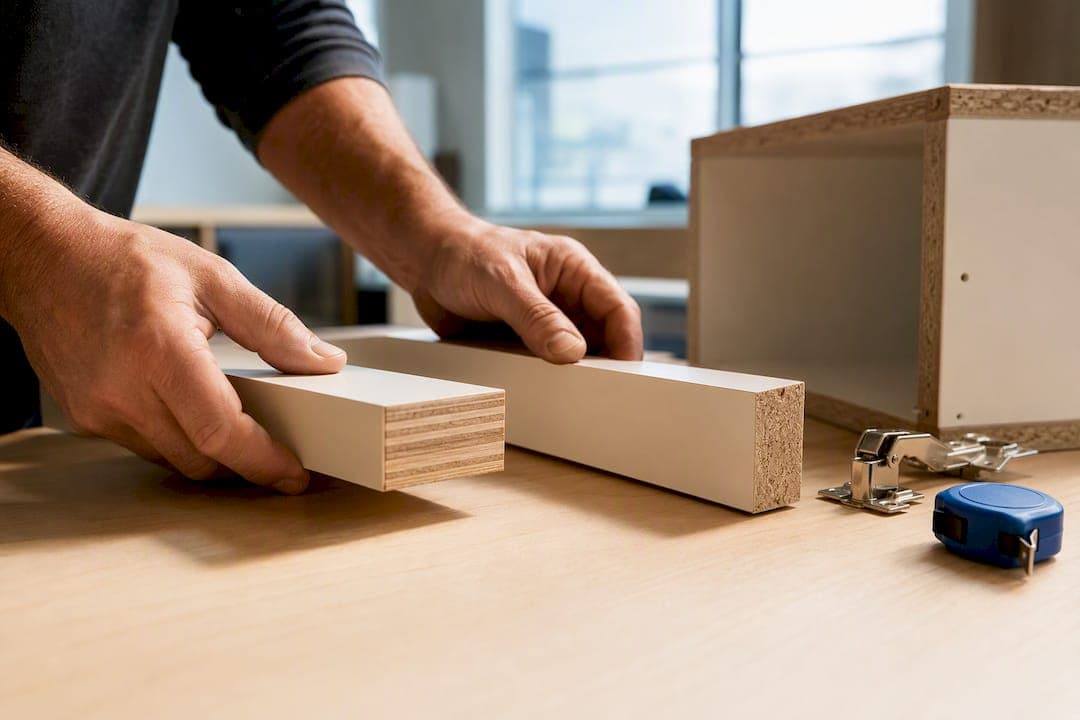
RTA cabinets typically run from about $100 per linear foot for entry-level lines to $300 or more per linear foot for higher-end lines, with a full kitchen often landing within the typical market range for stock or RTA installs, based on published installation reporting. RTA works best for homeowners who accept standard sizing and want to control labor costs. Keep reading for tiered budgets, material tradeoffs, and DIY versus professional installation math.
TL;DR:
- Plywood boxes with high-quality finishes cost more but offer better moisture resistance and durability, especially in water-prone areas like sinks and dishwashers.
- Standard RTA cabinet prices range from $100 per linear foot for entry-level models to over $300 for premium lines, with total project costs heavily influenced by size and finish choices.
- Installation costs typically start at about $4,000 for small projects and can reach $9,000 for larger or more complex kitchens, excluding countertops and additional plumbing or electrical work.
- Buying certified, moisture-resistant plywood cabinets and sticking to standard sizes can extend the lifespan and reduce long-term costs of kitchen cabinets.
- DIY assembly usually takes 30 to 60 minutes per cabinet, but projects over 20 linear feet or with plumbing/electrical modifications may require professional help to avoid costly delays.
Table of Contents
- What do RTA cabinets cost per linear foot in the U.S.?
- What drives the price of RTA cabinets up or down?
- Is plywood or particleboard the better long-term buy?
- Should you hire a pro or assemble RTA cabinets yourself?
- Where should you spend, and where can you save?
- Why this guide reflects real U.S. buying conditions
- What the price tag on RTA cabinets doesn't tell you
- See RTA and assembled cabinet options built for U.S. kitchens
- Sources
- FAQ
What do RTA cabinets cost per linear foot in the U.S.?
Pricing for RTA cabinets breaks down into three rough tiers, and knowing where your project falls helps you set a realistic number before you start browsing options. Entry-level RTA lines start around $100 per linear foot, while mid-range and higher-end lines climb to roughly $150 to $300 or more per linear foot depending on the box material, door style, and finish, according to industry price observations. For a deeper breakdown by cabinet type and size, this per-linear-foot pricing guide walks through the math in more detail.
Here is what that looks like across common kitchen sizes:
- A small kitchen (10 to 15 linear feet) typically runs from $1,000 to $4,500 in cabinet-only costs at entry to mid-range pricing.
- A medium kitchen (20 to 30 linear feet) typically runs from $2,000 to $9,000 in cabinet-only costs, before installation.
- A large kitchen (40 or more linear feet) typically runs from $4,000 to $12,000 or higher in cabinet-only costs, depending on finish and hardware choices.
Total installed projects, which fold in labor, generally start around $4,000 for straightforward stock or RTA installs and can reach $9,000 for larger or more detailed jobs, per the same installation cost reporting. That figure usually covers removing old cabinets, mounting new boxes, and hanging doors and drawer fronts. It does not usually cover countertops, backsplash tile, plumbing relocation, electrical work, or permit fees, all of which get quoted separately and can add thousands more depending on scope. If you want to see how those add-on costs stack up in real project budgets, this installed-cost breakdown covers ranges from smaller updates to full remodels.
What drives the price of RTA cabinets up or down?
A handful of choices account for most of the price swing between a budget kitchen and a higher-end one, and understanding them lets you spend where it counts instead of guessing.
Box construction is the biggest factor. Plywood boxes with dovetail or dowel drawer joinery cost more upfront than particleboard boxes with stapled joints, but they hold up better under moisture and repeated use. Door type and finish come next: a flat-panel thermofoil door costs less than a painted solid wood door, and a stained hardwood door with a custom profile sits at the top of the price range. Hardware and accessories add up fast too. Soft-close hinges, pull-out trays, and integrated organizers all raise the per-unit price but also raise how the kitchen feels day to day.
Shipping and lead time matter more than most buyers expect. Standard sizes ship faster and cheaper, while custom dimensions or rush orders often carry added fees.
- Ask suppliers whether quoted prices include soft-close hardware or charge it as an add-on.
- Ask whether the box is plywood or particleboard, since that single spec changes both price and lifespan.
- Ask about lead time for your exact door style and finish, since some finishes take longer to produce.
Pro Tip: Request a written, itemized quote broken down by box material, door style, and hardware so you can compare suppliers on equal terms instead of a single bottom-line number.
Is plywood or particleboard the better long-term buy?
Plywood boxes generally cost more than particleboard or MDF boxes, but they resist moisture and hold screws and hinges better over years of daily use, which matters most under sinks and in humid climates. Particleboard and MDF are lighter and cheaper to produce, which keeps entry-level RTA prices low, but they can swell or weaken faster when exposed to water.
Two U.S. standards help buyers judge quality regardless of material:
- KCMA A161.1 is the national performance standard for kitchen cabinets, testing resistance to heat, moisture, and staining when a cabinet is properly installed and maintained.
- CARB Phase 2 compliance confirms that composite wood products meet low-formaldehyde emissions limits, which matters for indoor air quality in a finished kitchen.
KCMA A161.1 certification signals that a cabinet line has been tested against a recognized U.S. performance benchmark rather than relying on marketing claims alone, and export inspection reports show that many RTA lines shipped to the U.S. are checked against this exact standard before they reach buyers.
If your budget allows one upgrade, spend it on plywood boxes in high-moisture zones like the sink base and dishwasher cabinet, then save on particleboard or MDF in areas that see less water exposure, such as upper cabinets.
Should you hire a pro or assemble RTA cabinets yourself?
Deciding between DIY assembly and professional installation comes down to your available time, tools, and tolerance for a multi-day project; for more on installation costs and savings, see Montage meuble IKEA : prix, options et conseils pratiques. DIY assembly on RTA cabinets generally takes 30 to 60 minutes per cabinet for a homeowner working with basic tools, according to assembly time guidance, which means a modest kitchen can take a full weekend once you account for leveling and adjustments.
- Confirm you have a drill, level, clamps, and a stud finder before you start, since missing tools slow the job down fast.
- Budget 2 to 4 hours total for a small remodel once you include unboxing, sorting hardware, and fitting doors, per the same assembly guidance.
- Plan for a helper on base cabinets and uppers, since holding a cabinet level while securing it solo is difficult.
Hidden installation costs catch a lot of homeowners off guard: removing old cabinets, leveling an uneven floor, rerouting electrical for under-cabinet lighting, adjusting plumbing for a new sink base, and adding trim or filler strips to close gaps. Each of those can add cost whether you hire a pro or do it yourself.
Pro Tip: If your kitchen has more than 20 linear feet of cabinets or any electrical and plumbing changes, budget for at least partial professional help. DIY savings shrink fast once a delay turns into a week without a working kitchen.
Where should you spend, and where can you save?
Smart budgeting means putting money where it shows and where it works hardest, then economizing everywhere else. Prioritize the island, the sink wall, and any run of cabinets visible from the main living space, since those get the most use and the most visual attention. Save on cabinets in a pantry, laundry nook, or garage, where a simpler finish and particleboard box do the job fine.
- Order door and finish samples before committing to a full kitchen, since finishes look different under real lighting than they do on a screen.
- Stick to standard cabinet widths and heights to avoid custom-cut fees that inflate a quote quickly.
- Check for KCMA and CARB Phase 2 certification before buying, since a non-certified line can create costly problems down the road with durability or air quality.
- Watch for seasonal promotions, trade pricing for contractors, and bundled installation offers that reduce the total project cost.
Buyers who order samples and measure carefully before placing a full order tend to avoid the most common budget-busting mistake: ordering the wrong size and paying for a redo.
Why this guide reflects real U.S. buying conditions
This guide draws on published U.S. installation cost reporting, the KCMA A161.1 performance standard, and CARB Phase 2 emissions requirements, the same benchmarks a careful buyer would check before ordering. Author Nathan writes on cabinet pricing and materials for Best Cabinet Specialist, a women-owned and veteran-owned business that builds RTA and assembled cabinets with plywood boxes and solid wood doors.
Assembly guidance based on internal testing across some RTA lines points to 30 to 60 minutes per cabinet for a homeowner assembling cabinets at home, a number that shaped the DIY time estimates used throughout this guide. That combination of published U.S. cost data and hands-on assembly experience is what grounds the ranges and recommendations here in real buying conditions rather than rough guesswork.
What the price tag on RTA cabinets doesn't tell you

The conventional advice on RTA cabinets treats price per linear foot as the whole story, and that undersells the decision. A $100-per-linear-foot particleboard cabinet and a $250-per-linear-foot plywood cabinet can look similar in a showroom, but they age very differently under a leaking sink or a humid summer. The real comparison isn't RTA versus custom cabinetry: it's construction quality versus sticker price, and too many buyers optimize for the second number without checking the first.
If you take one thing from this guide, prioritize certification over finish photos. A KCMA-tested, CARB Phase 2 compliant plywood box in a plain white shaker style will outlast a beautifully finished particleboard box in a trendy color. Assembly time and installation labor are real costs, but they are one-time costs. Material quality is the cost you live with every time you open a drawer for the next decade.
— Nathan
See RTA and assembled cabinet options built for U.S. kitchens
If you want the cost control of RTA without guessing at supplier quality, Best Cabinet Specialist builds its RTA Cabinets, Shaker Series, and Classic Series with plywood boxes and solid wood doors, shipped fast so your project stays on schedule.

If DIY assembly is not the right fit for your timeline, the Assembled Cabinets line delivers the same plywood and solid wood construction ready to install. Browse the RTA collection or request samples and a quote to see real pricing for your kitchen's exact dimensions.
Sources
- KCMA A161.1-2022
- How much does it cost to install kitchen cabinets in 2025? – WFTV
- Quality Inspection Report of RTA Kitchen Cabinets (Export to the USA)
FAQ
Are RTA cabinets actually cheaper than custom or pre-built options?
RTA cabinets are typically cheaper upfront because they skip factory assembly labor and ship flat, with entry-level pricing starting around $100 per linear foot. The savings come from standard sizing and self-assembly, so costs rise if you need custom dimensions or professional installation.
Are RTA cabinets better value than big-box store cabinets?
Value depends on construction, not the retail channel. Look for KCMA A161.1 certification and CARB Phase 2 compliance regardless of where you buy, since those standards indicate durability and safe emissions levels more reliably than the store name.
Who offers competitive pricing on quality RTA cabinets?
Pricing varies by construction quality, so compare suppliers on plywood versus particleboard construction, door material, and whether soft-close hardware is included before comparing bottom-line numbers. Some suppliers price their RTA lines with plywood boxes and solid wood doors as standard features, which affects how their per-linear-foot pricing compares to lower-cost particleboard alternatives.
Are RTA cabinets made in the USA?
Many RTA cabinets sold in the U.S. are manufactured overseas, though reputable suppliers certify their lines to U.S. standards like KCMA A161.1 and CARB Phase 2 before export. Checking for these certifications matters more than country of origin when judging quality and safety.