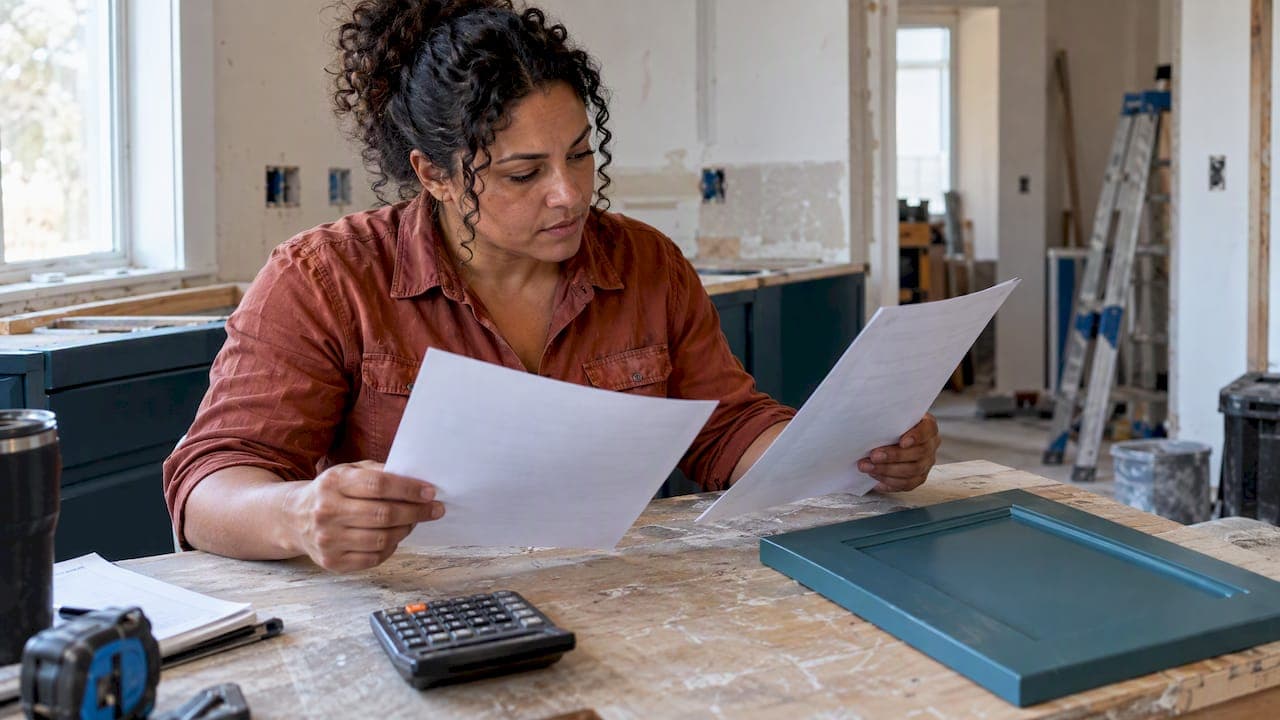
Bulk cabinet pricing is built from three things: the cost per linear foot of the line you choose, the discount you earn by ordering a full project at once, and the extras that quietly change the total, such as freight, fillers, trim and hardware. Quotes that look far apart often differ on those extras more than on the cabinets themselves. This guide shows how to read a bulk quote, what drives it up or down, and how to compare suppliers on equal terms.
It is written for contractors, builders, property managers and homeowners buying a full kitchen or several bathrooms in one order.
TL;DR
- Bulk and trade pricing is usually quoted per linear foot or per cabinet, and the discount grows with the size and completeness of the order, not only the quantity.
- Compare quotes on the same basis: construction (plywood or particleboard box), door material, soft-close hardware, freight, and whether accessories are included.
- Tariffs on imported cabinets are a real price driver. Ask any supplier how current duties are reflected in the quote and how long it is held.
- Ready-to-assemble (RTA) cabinets cut cost and shipping volume. Assembled cabinets save labor time on site. Choose by your crew's schedule, not only by sticker price.
- Order once from a full cabinet list, with a contingency for fillers and trim, so you do not pay a second freight bill.
Table of Contents
- How bulk cabinet pricing actually works
- Typical price ranges to benchmark against
- What pushes bulk cabinet prices up
- RTA or assembled: which saves more on a bulk order
- How to compare bulk cabinet quotes
- Planning the order to protect your discount
- Our perspective on bulk pricing
- Where to buy: shop our cabinet lines
- Mistakes that raise the final cost
- When the lowest bulk price is the right one
- FAQ
- Sources
How bulk cabinet pricing actually works
Retail cabinet pricing is a price tag on each box. Bulk pricing is a negotiated or tiered price on a whole project. Three mechanisms sit behind it.

Volume tiers. Many suppliers set price breaks by order size, for example a standard rate for a single kitchen and a lower rate for several kitchens or a multi-unit building. Tiers differ by supplier, so ask for the break points in writing.
Trade pricing. Contractors, builders and designers often qualify for a separate rate regardless of order size. Our own breakdown of trade discounts and cost ranges explains what typically separates trade from retail pricing.
Package pricing. A kitchen sold as a complete list of bases, wall cabinets, a pantry, a corner unit and accessories usually costs less per piece than the same items bought one at a time, because the supplier ships and picks one order instead of many.
The rest of the quote is logistics. A lower unit price with high freight and a long lead time can cost more than a slightly higher price delivered quickly. On a rental turnover or a new-build schedule, waiting weeks for cabinets means paying for idle crews.
Typical price ranges to benchmark against
Know the ranges before you ask for quotes. Published figures vary by source, region and what is included, so treat them as a sanity check rather than a promise.
| Cabinet type | What you are buying | How it is usually priced |
|---|---|---|
| Stock, RTA | Flat-packed boxes, standard sizes, you or your crew assemble | Per linear foot or per cabinet; lowest cost tier |
| Stock, assembled | Same sizes, delivered built | Higher than RTA, saves on-site labor |
| Semi-custom | More sizes, finishes and modifications | Mid to high per linear foot |
| Custom | Built to your drawings | Highest, longest lead time |
For RTA specifically, our guide to U.S. RTA cabinet costs, KCMA and CARB puts the common range at $100 to $300 per linear foot, and explains why the spread is so wide. For a whole-kitchen view, see the kitchen cabinet price per linear foot guide. If you want the homeowner replacement budget, the page on what most U.S. homeowners pay to replace kitchen cabinets covers the $7,000 to $15,000 band.
A quick way to turn a linear-foot rate into a budget: add up the feet of base cabinets along each wall, add the feet of wall cabinets, and multiply by the rate. Many sellers count only the base run, and others count base and wall together. Ask which, because that single assumption can double or halve the apparent price.
A worked example
Take a 10 by 10 kitchen, a standard size used for quoting. It might have 20 feet of base cabinets and 20 feet of wall cabinets. A seller that quotes per foot of base run at $150 gives you $3,000 for the bases. A seller that counts both runs at $100 per foot gives you $4,000 for 40 feet. The second rate looks cheaper but the total is higher, until you check that it also includes the wall cabinets the first quote prices separately. Always convert every quote to a full line-item total before you compare.
These figures are an illustration of the arithmetic, not our prices. Our current pricing is on each product page and in your cart.
What pushes bulk cabinet prices up
Tariffs on imported cabinets
The biggest recent factor is trade policy. According to the NAHB's report on the Section 232 action, the U.S. Commerce Department imposed an additional 25% tariff on kitchen cabinets and furniture, alongside a 10% tariff on timber and lumber imports. The NAHB noted this raises housing costs for both new construction and renovation.
The schedule for further increases has been moving, so do not rely on a date you read months ago. When you request a bulk quote, ask three questions:
- Does this price already include current duties, or can it change before delivery?
- How long is the quote held?
- Is the stock already in a U.S. warehouse, or still in transit?
Stock that is already domestic is priced on what the supplier paid, which is why quote validity matters when you are budgeting a building with a long construction timeline.
Construction quality
Two cabinets of the same size can differ a lot in cost because of what is inside. Plywood boxes resist moisture and hold screws better than thin particleboard, which matters under a sink and in a rental that will see hard use. Solid wood doors cost more than thermofoil or MDF faces. Soft-close hinges and drawer slides add cost, but they remove a common callback. A cheap box that sags at the sink base is not a saving on a 20-unit building.
Freight and handling
Cabinets are bulky. Flat-packed RTA boxes ship in a fraction of the space of assembled units, which lowers freight per kitchen. Assembled cabinets are heavier and take more space, so freight and the risk of damage rise. Ask for the freight line separately, and ask who unloads at the site.
Change orders
The most expensive cabinet is the one you forgot. Missing a filler strip, a toe kick or a end panel means a second order, a second freight charge and a wait. Reorders are where bulk discounts disappear.
RTA or assembled: which saves more on a bulk order
The answer depends on who builds the boxes and how fast.
RTA cabinets cost less up front and ship compactly. They suit crews that can assemble in a staging area, large rental portfolios with repeating layouts, and homeowners willing to do some work. Assembly is straightforward with a plywood box system, but it takes time per cabinet, and you should count that labor.
Assembled cabinets arrive ready to hang. They suit tight schedules, small crews, commercial work and projects where the labor for assembly would cost more than the price gap. Our assembled cabinets are built with plywood boxes and solid wood doors.
A simple test: estimate the assembly time per cabinet, multiply by the cabinet count and your labor rate, and compare that figure to the price difference between RTA and assembled. If the labor cost is higher, assembled is the cheaper option. If you have idle crew time, RTA wins.

How to compare bulk cabinet quotes
Use the same checklist for every supplier so the numbers mean the same thing.
- Box material: plywood or particleboard, and the thickness.
- Door and face frame: solid wood, MDF, or veneer.
- Drawer boxes and hardware: dovetail or stapled, soft-close or standard.
- Included items: are toe kicks, filler strips, end panels and crown molding in the price?
- Freight: a stated figure, a delivery window and who unloads.
- Quote validity: how many days, and what happens to price after that.
- Returns and damage policy: how fast replacements ship if a door arrives chipped.
- Samples: can you see the finish before ordering for 30 units?
The last point is easy to skip and costly to get wrong. Finish tones look different on a screen and under your lighting. Order sample doors before you commit to a large order, and show them to the owner or designer.
Planning the order to protect your discount
Build the full list first
Measure each room, draw the layout, and list every cabinet by width, height and depth. Add fillers, end panels, toe kicks and any base or wall corner units. Our guide to installing kitchen cabinets and what buyers really pay shows the labor side, which you should plan at the same time as the order.
Add a small contingency
On multi-unit work, add a modest allowance of spare fillers and toe kicks. These are cheap compared with a second freight charge, and spare parts are useful for repairs after tenants move out.
Decide on accessories early
Hardware and organizers are easiest to price in the main order. Drawer dividers, pull-outs and trash units add function. The NKBA's 2025 kitchen trends report points to growing demand for hidden storage such as drawer dividers and partitions, so they can help rentals and resale listings stand out. See our cabinet accessories list for options, and for ideas on keeping stored items protected from moisture, this overview of outdoor kitchen storage ideas covers coastal and inland conditions.
Budget the rest of the room
Cabinets are only one line in the kitchen budget. Lighting is another that is easy to leave late, and it affects how finishes read. If your plan has an island, this guide to pendant lighting for kitchen islands helps you settle spacing and style before the electrician is booked.
Match the style to the project
For rentals and builder-grade projects, a Shaker door is the safe choice: it is familiar, easy to clean and suits both modern and traditional spaces. Narrower depth lines such as slim vanities fit small baths. For design-led projects with a specific look, see our page on custom kitchen design with affordable cabinets.
Our perspective on bulk pricing
We are a women-owned and veteran-owned business, and we see the same mistake from contractors, builders and homeowners alike: comparing cabinet prices without comparing what is in the box. The cheapest line item on a quote often becomes the most expensive once you add freight, missing trim and a second shipment.
Our approach is to keep the construction consistent: plywood boxes, solid wood doors and soft-close hardware. Then we focus on getting the order to you quickly, because lead time is a cost too. A crew waiting on cabinets is paying for the delay, and so is a rental unit sitting empty.
We do not publish a single bulk price list, because a bulk price depends on your project: the number of kitchens, the mix of styles, and whether you want RTA or assembled. What we recommend is to send a complete cabinet list, ask for the total, and compare it against our checklist above. If a quote does not hold up on those points, it is not a saving.
— Nathan
Where to buy: shop our cabinet lines
If you are ready to price a project, start with the cabinet line that matches your schedule.
- RTA cabinets: our Shaker, Classic and Slim series, with plywood boxes, solid wood doors and soft-close hardware, for projects where you control assembly.
- Assembled cabinets: delivered built for faster installs.
- Kitchen and bathroom cabinets: browse the full range, including vanities and utility units.
Individual pieces are listed with exact dimensions, such as the Black Shaker 2 drawer base cabinet, 36"W by 34 1/2"H by 24"D and the White Slim Shaker vanity drawer base, 18"W by 34 1/2"H by 21"D, so you can build your list piece by piece. Shop Now and put your full list in the cart.
For a broader look at how to pick a supplier, read our guide to the best wholesale kitchen cabinets for contractors and homeowners.
Mistakes that raise the final cost
- Comparing per-foot rates without the same footage basis. Confirm whether wall cabinets are counted.
- Ignoring the freight line. Ask for it before you accept a unit price.
- Skipping samples. A finish you dislike on 30 units is a costly redo.
- Ordering in pieces. Several small orders lose the volume advantage and add freight each time.
- Leaving out trim. Fillers, end panels and toe kicks are small items with a big schedule impact.
- Assuming a quote will hold. With trade policy shifting, confirm the validity period.
- Choosing particleboard for wet areas. The saving rarely survives a leak under a sink.
When the lowest bulk price is the right one
The lowest price is right when the project is simple and short-lived: a quick flip, a basic rental refresh, or a storage area. In those cases, standard sizes, a neutral finish and RTA construction keep the total down. For long-term rentals, commercial spaces and owner-occupied homes, durable construction pays back through fewer repairs, so look at cost over the life of the cabinet rather than the day-one number.
The NKBA's 2019 design trends report notes that cost per square foot tends to stay level or rise as kitchens get larger, which is a reminder that scale does not automatically lower total spend. A volume discount helps only when the order is organized well.
FAQ
How much can I save by buying cabinets in bulk?
Savings depend on the supplier, the order size and whether you qualify for trade pricing. Some sellers advertise wholesale as 30 to 50 percent below retail, but those claims vary and are hard to verify. Ask for a total on your actual list and compare it, with freight, against retail.
What is the minimum order for bulk cabinet pricing?
There is no single standard. Some suppliers set quantity thresholds for tiers, and others price by project value. Ask the supplier for its break points in writing, and send your full list so it can quote the whole project.
Are RTA cabinets cheaper than assembled in bulk?
Usually yes on the product price, and they ship more compactly. Assembled cabinets can still cost less overall when your assembly labor is expensive or the schedule is tight. Compare the labor cost to the price gap.
Do tariffs affect cabinet prices I am quoted now?
They can. The NAHB reported a 25% Section 232 tariff on imported kitchen cabinets and furniture, and later increases have been scheduled. Ask whether your quote includes current duties and how long the price is held.
Sources
- NAHB: New tariffs on lumber and wood product imports add headwinds to the housing market
- NKBA: 2025 Kitchen Trends Report
- NKBA: 2019 Design Trends, Kitchens