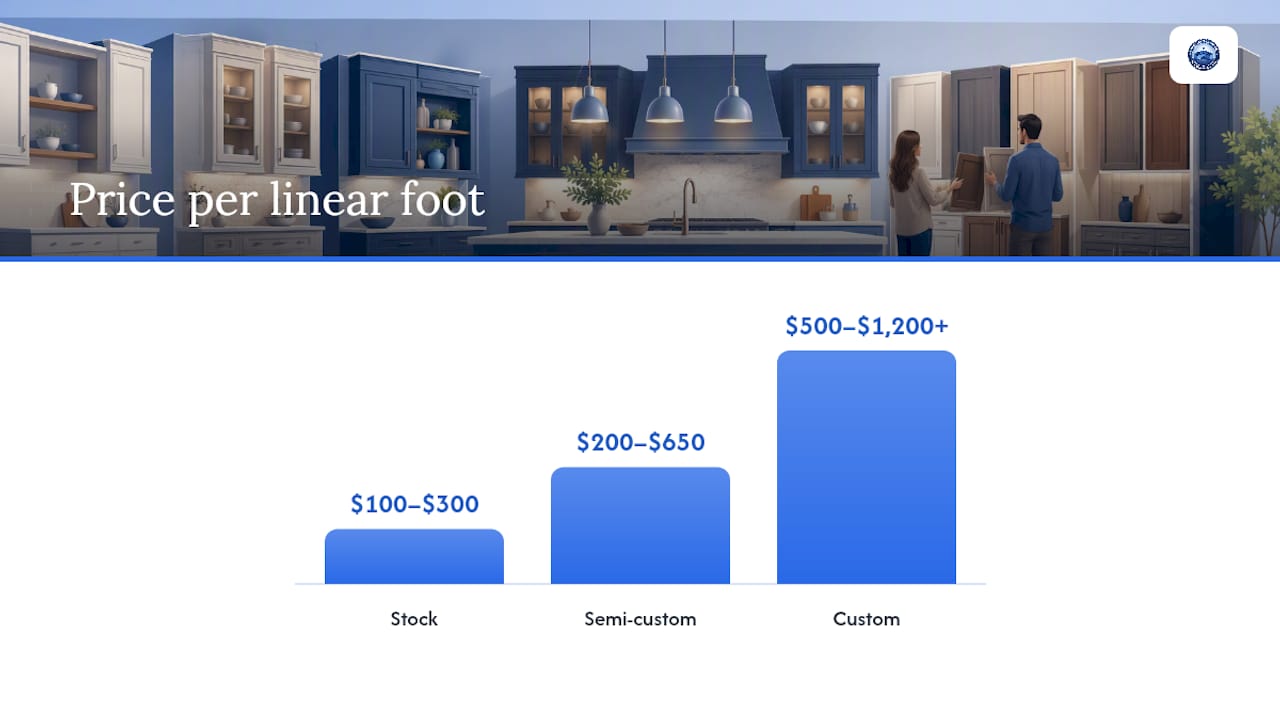
Stock cabinets typically run $100 to $300 per linear foot, semi-custom lands between $200 and $650, and custom cabinetry starts around $500 and climbs past $1,200 per linear foot. For a standard 10x10 kitchen, that translates to roughly $2,000 to $13,000 for stock or semi-custom cabinets, and $10,000 to $24,000 or more for custom work. These figures cover the cabinets themselves, not the labor to hang them.
TL;DR:
- RTA cabinets are usually 20 to 50% cheaper than assembled options due to lower factory labor and smaller shipping volume but require assembly time.
- Material quality and customization level, such as plywood boxes and solid wood doors, significantly influence the overall cost and durability of cabinets.
- Total kitchen renovation costs, including installation and secondary expenses, typically range from $4,000 to over $30,000 depending on cabinet tier and location.
- Lead times differ: stock RTA cabinets ship within days or weeks, while semi-custom or custom cabinets may take four to eight weeks or longer to produce.
Table of Contents
- How Much Do Kitchen Cabinets Cost Per Linear Foot?
- RTA vs. Assembled Cabinets: Which Costs Less?
- What Actually Drives Your Cabinet Purchase Price?
- How Do You Estimate Your Total Cabinet Purchase Cost?
- What Does Cabinet Installation Labor Typically Cost?
- What Other Costs Come With a Cabinet Installation Project?
- Do Cabinet Costs Vary by Region?
- What's a Realistic Total Budget for a Kitchen Cabinet Project?
- How Long Does It Take From Order to Installed Kitchen?
- A Buyer's Perspective on Getting Real Value From Your Cabinets
- Get a Project-Ready Cabinet Quote From Best Cabinet Specialist
- Sources
- FAQ
How Much Do Kitchen Cabinets Cost Per Linear Foot?
Every kitchen cabinet quote starts with a simple question: how many linear feet of cabinetry does your kitchen need? That number, multiplied by your price-per-foot rate, gives you a baseline before hardware, finishes, or shipping enter the picture.
The per-linear-foot ranges hold up across most U.S. markets: stock cabinets at $100 to $300 per foot, semi-custom at $200 to $650, and custom at $500 to $1,200-plus. A standard 10x10 kitchen usually needs 20 to 25 linear feet of cabinetry once you count base, wall, and tall units, which is why the same square footage produces such a wide dollar range depending on tier.
Per-cabinet pricing tells a different but related story. Individual stock or semi-custom units, including hardware like pulls and handles, typically run $100 to $600 each, with hardware alone adding $2 to $50 per piece. Retailers use per-cabinet pricing when you're buying a handful of units for a partial remodel or an add-on pantry wall, while per-linear-foot pricing works better for full-kitchen quotes.
Here's how the numbers usually break down by project size:
- Small galley kitchen (12 to 15 linear feet): $1,500 to $9,750 depending on tier
- Standard 10x10 kitchen (20 to 25 linear feet): $2,000 to $24,000 depending on tier
- Large kitchen with island (30-plus linear feet): $3,000 to $36,000-plus depending on tier
One number worth remembering before you start picking finishes: cabinetry typically consumes 35 to 41% of a kitchen remodel budget, making it the single largest line item in most projects. If you're working with a fixed remodeling budget, that percentage should shape how much you allocate to countertops, appliances, and flooring before you even open a cabinet catalog.
RTA vs. Assembled Cabinets: Which Costs Less?
Ready-to-assemble cabinets typically cost 20 to 50% less than the same style pre-assembled. That gap comes from two places: lower factory labor because you're doing the final assembly, and cheaper freight because flat-pack boxes take up far less truck and container space.
Packing method changes your landed cost more than most buyers expect. Flat-packed RTA cabinets reduce shipping volume by roughly 30 to 50% compared to assembled units, which matters a lot if your order is shipping across the country rather than across town. Assembled cabinets arrive ready to install, but they cost more to ship and carry a higher risk of transit damage since the boxes can't nest as tightly.
Here's a quick way to decide which fits your project:
- Choose RTA if you're a contractor buying in volume, comfortable with basic assembly, or shipping cross-country
- Choose assembled if your timeline is tight and you want cabinets on-site and ready with no assembly step
- Consider a hybrid by ordering RTA for less-visible runs (pantry, laundry) and assembled for showpiece areas like an island
Pro Tip: Read our guide on RTA cabinet assembly before you order. Most units take 30 to 60 minutes to assemble, and knowing that upfront helps you budget your own time alongside your dollars.
What Actually Drives Your Cabinet Purchase Price?
Materials and construction quality separate a $2,000 kitchen from a $15,000 one more than any other factor. Plywood boxes with solid wood doors cost more upfront than particleboard or MDF construction, but they hold up to humidity, weight, and years of daily use in ways cheaper substrates simply don't.
A handful of choices push your total up or down before you even get to freight:
- Construction quality: plywood boxes and dovetail drawers cost more than particleboard but resist warping and sagging over time
- Customization level: custom sizing, integrated panels, and specialty storage (pull-out spice racks, appliance garages) each add incremental cost per unit
- Hardware and finish: soft-close hinges, upgraded pulls, and premium paint or stain finishes are small line items that add up across a full kitchen
- Order quantity: buying more units at once spreads fixed design and setup costs, which is why contractors and developers typically see the biggest per-unit savings from volume orders
- Shipping and lead time: expedited freight and assembled packing both raise landed cost, while standard RTA shipping keeps it lower
Layout complexity deserves its own mention. If your project requires moving plumbing or electrical to accommodate a new cabinet configuration, that can add $3,000 to $10,000 to the broader project, even though it's not a cabinet cost itself. Planning your layout before you order, using a resource like our cabinet layout planner, helps you avoid ordering units that need costly rework later. For a deeper look at how tier and finish affect your per-foot rate, our price-per-linear-foot guide breaks down real examples.
How Do You Estimate Your Total Cabinet Purchase Cost?
Four steps get you from a bare kitchen to a working budget number, and you don't need a contractor to walk through them.
- Measure and count. Get exact wall lengths and cabinet counts using a guide like how to measure a kitchen for new cabinets, or check the 13-foot rule for common kitchen layouts if you're still finalizing your floor plan.
- Select your tier and rate. Apply the per-linear-foot rate for stock, semi-custom, or custom, or use per-cabinet pricing if you're buying individual units.
- Add freight and extras. Factor in RTA versus assembled freight, hardware, filler strips, and decorative panels, then build in a 10 to 15% contingency for damage or reorders.
- Apply volume pricing. Contractors and bulk buyers should ask about trade discounts before finalizing quantity.
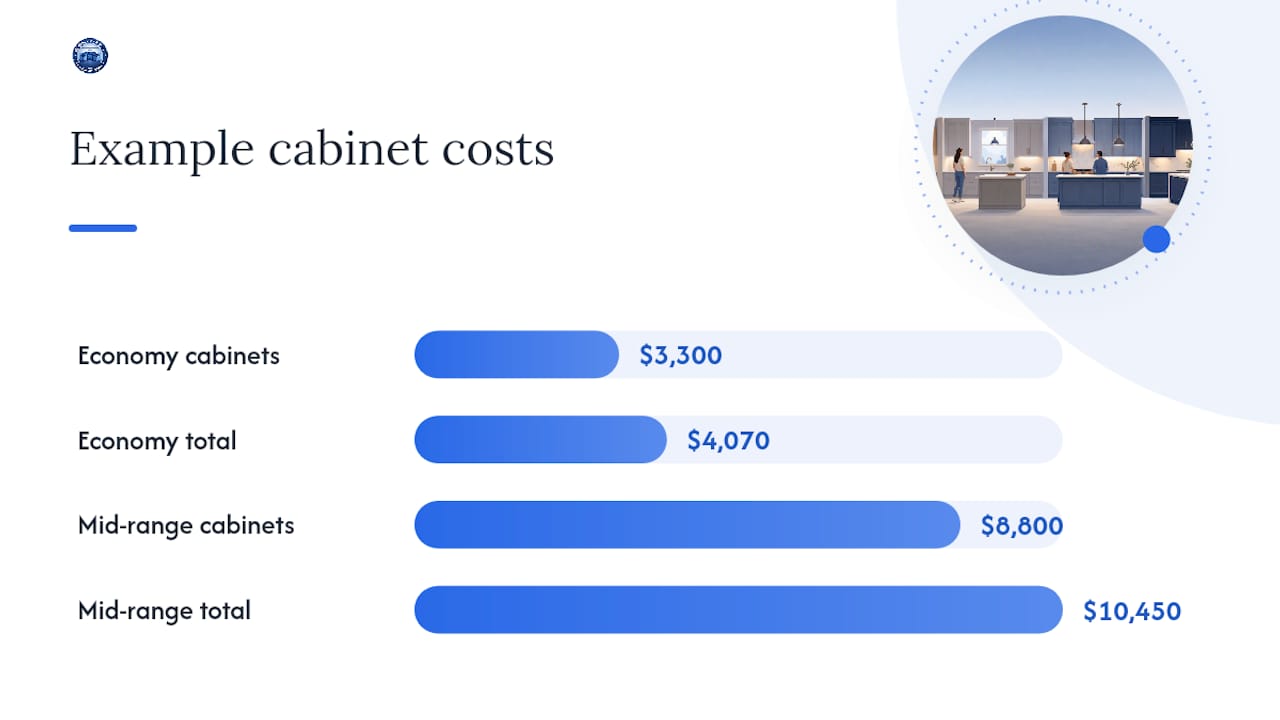
Economy 10x10 example: 22 linear feet of stock RTA cabinets at $150/foot = $3,300, plus $400 hardware and freight, plus 10% contingency = roughly $4,070.
Mid-range 10x10 example: 22 linear feet of semi-custom assembled cabinets at $400/foot = $8,800, plus $700 hardware and freight, plus 10% contingency = roughly $10,450.
What Does Cabinet Installation Labor Typically Cost?
Installation labor sits outside your cabinet purchase price, but it's the number most buyers ask about next, so it's worth a quick answer. Professional installers typically charge either an hourly rate, often in the $50 to $100 range per installer, or a flat per-cabinet or per-linear-foot fee that covers hanging, leveling, and securing units to studs.
A standard 10x10 kitchen usually takes one to three days to install, depending on how many cabinets need custom scribing to fit uneven walls or ceilings. Installers who also handle crown molding, under-cabinet lighting prep, or filler panel trimming will typically charge more than a bare hang-and-level job. If you're ordering assembled cabinets, installation tends to move faster since there's no on-site assembly step, but RTA cabinets that arrive flat-packed add assembly time to the installer's clock, which shows up in the final labor invoice.
What Other Costs Come With a Cabinet Installation Project?
Beyond the cabinets and the installer's time, a handful of secondary costs show up on almost every project. Removing and disposing of old cabinets typically adds a separate line item, since it involves demolition, hauling, and sometimes disposal fees depending on your local waste rules.
Wall repairs are common once old cabinets come down, especially in older homes where the drywall behind cabinets has settled, cracked, or hidden outdated wiring. Patching, sanding, and repainting that section before new cabinets go up is a small but real cost that catches a lot of first-time buyers off guard. Delivery is the other piece: if your cabinets ship freight rather than small parcel, expect a curbside or dock delivery fee, and confirm whether the carrier offers inside delivery or if you'll need extra hands to move boxes into the kitchen. None of these are part of your cabinet purchase price, but skipping them in your planning is the fastest way to blow past a tight budget.
Do Cabinet Costs Vary by Region?
Cabinet purchase prices themselves don't swing much by region since most stock and semi-custom lines ship nationwide at consistent pricing, but installation labor and secondary costs do. Metro areas on the coasts, particularly the Northeast and West Coast, tend to see higher hourly labor rates than the Midwest or South, simply because general contractor and skilled trade wages run higher in those markets.
Freight costs can also shift depending on how far your delivery address sits from a supplier's distribution point, which is one reason flat-pack RTA shipping tends to offer more consistent, predictable freight across a wide range of ZIP codes compared to bulky assembled shipments. If you're comparing quotes from local cabinet shops versus a nationwide e-commerce supplier, ask specifically how each handles freight to your region before assuming the sticker price is your final number.
What's a Realistic Total Budget for a Kitchen Cabinet Project?
Combining product cost with installation labor gives you the number that actually matters for planning a renovation. For a standard 10x10 kitchen, that combined budget typically lands between $4,000 and $30,000-plus, depending on your cabinet tier, whether you choose RTA or assembled, and local labor rates.
A stock RTA kitchen with modest installation labor might land near the low end of that range, while a custom, fully assembled kitchen installed by a premium contractor in a high-cost metro area sits at the top. The honest way to plan is to nail down your cabinet purchase cost first, using the estimator steps above, then request a separate installation quote once you know your exact cabinet count and packing method. Trying to guess both numbers at once is how budgets go sideways.
How Long Does It Take From Order to Installed Kitchen?
Cabinet lead times vary by tier and packing method, and that timeline matters just as much as price when you're planning a renovation around it. Stock RTA cabinets from an e-commerce supplier can often ship within days to a couple of weeks, since they're pulled from existing inventory rather than built to order. Semi-custom and custom cabinets typically take four to eight weeks or longer, because each order goes into a production queue with specific sizing and finish requirements.
Once cabinets arrive, installation itself usually takes one to three days for a standard 10x10 kitchen, assuming no major wall repairs or layout changes are needed. Add a few days if you're assembling RTA units on-site before the installer starts hanging them. Altogether, a realistic timeline from placing your order to a finished kitchen runs anywhere from two weeks for an in-stock RTA order to two or three months for a fully custom build. Ordering early and confirming lead times before demo day is one of the simplest ways to avoid a kitchen sitting half-finished for weeks.
A Buyer's Perspective on Getting Real Value From Your Cabinets
Plywood boxes and solid wood doors aren't a marketing detail. They're the difference between cabinets that still close smoothly in ten years and ones that sag, swell, or delaminate the first time a dishwasher leaks. That construction choice raises material cost compared to particleboard, but it's the single best dollar-for-dollar investment in a kitchen buyer's control.
Some cabinet companies build around that principle: plywood boxes, solid wood doors, and fast shipping to close the gap between ordering and installing. As a business with a personal, project-ready approach, they address a category too often dominated by long lead times and vague quotes. If there's one habit worth adopting from trade buyers, it's this: request a detailed, itemized quote before you order anything, listing per-unit pricing, freight, and hardware separately, so you know exactly what you're paying for and why.
— Nathan
Get a Project-Ready Cabinet Quote From Best Cabinet Specialist
Best Cabinet Specialist sells what you actually need to hit the budget ranges covered above: plywood-box, solid-wood-door cabinets shipped fast, with no six-week wait just to get a quote back. Whether you're buying RTA Cabinets to keep your per-linear-foot cost down or Assembled Cabinets to skip the on-site assembly step, the product lines, including the Shaker, Classic, and Slim series, are built to fit stock-to-semi-custom budgets without the custom-shop price tag.

To get an accurate quote, send your measurements, total cabinet count, packing preference (RTA or assembled), and target timeline. That's enough for a real, itemized number rather than a rough guess. Browse the full lineup at the kitchen and bathroom cabinets page and request your project-ready quote today.
Sources
- Kitchen Cabinet Installation: 2026 Cost Guide
- RTA vs Assembled Cabinets: Cost, Quality & Lead Times (2026) - Kraftersland Cabinet
- What Actually Drives the Cost of Custom Kitchen Cabinets - WA Construct
FAQ
Does "cost to install kitchen cabinets" mean labor or the cabinets themselves?
In this guide, it refers to the purchase price of the cabinets, whether RTA or pre-assembled, not the labor charged by an installer. Installation labor is a separate cost typically billed hourly or as a flat per-cabinet fee.
How much do kitchen cabinets cost per linear foot?
Stock cabinets run $100 to $300 per linear foot, semi-custom runs $200 to $650, and custom starts around $500 and can exceed $1,200. A standard 10x10 kitchen needs roughly 20 to 25 linear feet.
Are RTA cabinets actually cheaper than assembled ones?
Yes, RTA cabinets typically cost 20 to 50% less than the same style pre-assembled, mainly due to lower factory labor and reduced freight from flat-pack shipping. The trade-off is the time you spend assembling them yourself.
Does Best Cabinet Specialist publish set prices for its cabinets?
Current pricing for RTA and assembled lines is available directly on the Best Cabinet Specialist site, since costs vary by series, finish, and order size. Requesting a quote with your measurements and cabinet count gets you an exact number.
What isn't included in a typical cabinet purchase quote?
Cabinet purchase quotes generally exclude installation labor, old cabinet removal, wall repairs, and delivery fees for freight shipments. Budgeting separately for those items keeps your total project cost from catching you off guard.