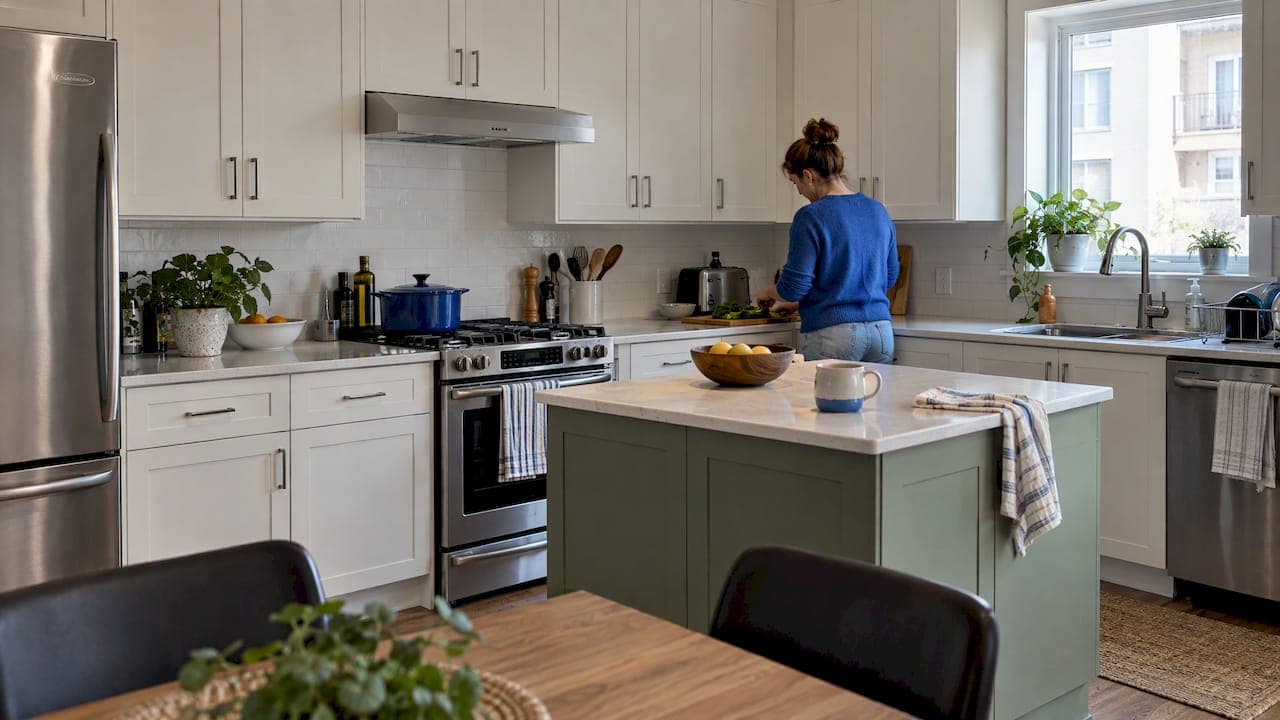
Transitional kitchen cabinets sit between traditional and modern design. They keep the warmth of classic woodwork, such as paneled doors and familiar proportions, and pair it with cleaner lines, less ornament and simpler hardware. The most common example is the Shaker door: a flat, recessed center panel in a slim frame. It looks neither fussy nor stark, which is why it works in so many homes.
This guide explains what the term means, how to recognize transitional cabinets, which doors, colors and hardware fit the style, and how to plan a kitchen around them without overspending.
TL;DR
- Transitional cabinets blend traditional woodwork with a cleaner, more modern look. Think simple paneled or flat doors, minimal ornament and understated hardware.
- Shaker-style doors are the most common starting point, and they can be dressed up or down with different pulls and finishes.
- Light to medium colors such as white, gray and soft wood tones are typical, and they are easy to coordinate with countertops and lighting.
- The style is popular with U.S. homeowners, which makes it a practical choice if you may sell in the future.
- RTA and assembled Shaker cabinets are a budget-friendly way to get the look.
Table of Contents
- What transitional kitchen cabinets mean
- How to recognize transitional cabinets
- Transitional vs. traditional, modern and contemporary
- Colors and finishes that suit the style
- Hardware that fits
- Why homeowners choose transitional kitchens
- How to plan a transitional kitchen
- Our perspective
- Getting the look with RTA or assembled cabinets
- Build your transitional kitchen with us
- Common mistakes to avoid
- FAQ
- Sources
What transitional kitchen cabinets mean
"Transitional" describes a design that moves between two eras. In cabinetry, it means details somewhere between traditional and modern, with a cleaner look that still draws on traditional woodwork. Period Homes describes transitional cabinetry as falling between traditional and modern, often with paneled doors, and sometimes with frameless construction and full-overlay doors and drawers.
In plain terms:
- From traditional: wood or painted-wood doors, framed panels, a sense of warmth and craft.
- From modern: straight lines, flatter profiles, fewer decorative moldings and simpler hardware.
The result is a kitchen that does not read as old-fashioned or as trend-driven. That balance is the whole point of the style.
How to recognize transitional cabinets
You can spot transitional cabinets by a handful of details. No single one is required, but most transitional kitchens combine several.
Door style
Transitional doors have cleaner lines than traditional doors and are often flat or flush. According to Kitchen & Bath Business, they sometimes add mitered edges, raised panels or reeding for a bit of character. Period Homes adds that transitional cabinetry can use flat panels with minimal edge details.
In practice, three door types cover most transitional kitchens:
- Shaker doors. A recessed flat panel inside a simple frame. This is the safest and most versatile choice.
- Slim-frame or narrow-rail doors. A lighter, more contemporary take on the Shaker profile.
- Subtly detailed doors. A simple panel with a mitered edge or a restrained raised profile, for a bit more tradition.
If you are still deciding between profiles, our guide to cabinet door styles walks through each one, and Shaker vs. slab cabinets compares the two most common options.
Construction and overlay
Transitional kitchens often use full-overlay doors, where the door covers most of the cabinet frame so you see mostly door and little frame. This gives a streamlined look. If you want to understand how overlay changes the appearance and the usable space, read our cabinet door overlay guide.
Storage
Storage is part of the style, too. The NKBA's 2019 Design Trends report notes that transitional cabinets include more drawers and integrated storage options. Drawer bases are practical for pots, pans and containers, and they keep the front of the kitchen clean and uncluttered.

Transitional vs. traditional, modern and contemporary
People often confuse these four terms. This table shows how they differ on the cabinet itself.
| Style | Door profile | Overall feel | Hardware |
|---|---|---|---|
| Traditional | Raised panels, ornate moldings, decorative detail | Formal, warm, classic | Decorative pulls and knobs |
| Transitional | Shaker or simple paneled doors, minimal edge detail | Balanced, calm, timeless | Simple, understated pulls |
| Modern | Flat slab doors, no visible frame | Sleek, minimal | Integrated or very slim hardware |
| Contemporary | Flat or slightly textured, follows current trends | Current, changes over time | Varies with the trend |
If you are torn between transitional and modern, our comparison of transitional vs. modern cabinets goes deeper on how to choose.
Colors and finishes that suit the style
Transitional kitchens lean toward calm, versatile colors. The most common cabinet choices are:
- White. Bright, simple and easy to pair with almost any countertop.
- Gray. A softer alternative to white, with a slightly more modern edge.
- Warm neutrals. Beige, greige and bone tones that feel welcoming.
- Natural or medium wood tones. These bring in the traditional side of the style.
- Soft blues and greens. Often used on an island or a single run of cabinets as an accent.
A simple rule works well: use a neutral color on the main run of cabinets and add one deeper tone on the island or a single wall. That keeps the room cohesive and gives it a focal point. For the current palette, see our guide to kitchen cabinet color trends.
Hardware that fits
Hardware is where you decide how traditional or how modern the kitchen feels. Transitional kitchens usually favor simple bar pulls, slim cup pulls or modest knobs in a matte or brushed finish. The same Shaker door looks more traditional with a classic knob and more modern with a long, slim bar pull.

Mixing metals is also common in this style. Combining, for example, a warm brass light fixture with brushed nickel pulls can add depth, and Acadiana Profile notes that layering mixed metals and collected elements can keep a kitchen from feeling like it needs a refresh for years. Keep the finishes limited to two or three so the room stays calm. Our cabinet hardware finishes guide helps you compare options.
Why homeowners choose transitional kitchens
The style has a strong following. In its 2026 Kitchen Trends Report, the NKBA found that 72% of participants named transitional as their favorite kitchen style, ahead of farmhouse and contemporary.
Several practical reasons explain that popularity:
- It lasts. Because it avoids extremes, it is less likely to feel dated in a few years.
- It fits many homes. It works with older houses, new builds, condos and rental units alike.
- It is flexible. You can change hardware, lighting and paint later without replacing the cabinets.
- It appeals to buyers. A neutral, familiar kitchen is easy for a future buyer to picture themselves in. Our article on kitchen cabinet colors for resale covers this in more detail.
How to plan a transitional kitchen
A clear plan keeps the look cohesive and your budget in check.
- Choose the door first. The door profile sets the tone for everything else. A Shaker door is the easiest starting point.
- Pick a main color and one accent. Neutral on the perimeter, a deeper color on the island, if you have one.
- Select hardware next. Match the style of pull to the feel you want, traditional or modern.
- Coordinate the countertop. Simple stone-look or solid surfaces in light or neutral tones keep the cabinets as the focus.
- Add lighting last. Pendants and under-cabinet lights in simple forms and one or two metal finishes finish the room.
- Plan the storage. Use drawer bases for cookware and tall utility cabinets for pantry items, so that the look stays clean.
Order a door sample before you commit. Seeing the color and finish in your own kitchen light prevents surprises, and you can request sample doors from us.
Our perspective
We see the same thing in many of our customers' projects: the people who are happiest with their kitchens chose a door they would still like in ten years, not the loudest look of the season.
That is why we build our lines around Shaker-based designs. Our cabinets use plywood boxes and solid wood doors, with soft-close hardware, and they come in modern, traditional and transitional styles. Transitional is where those pieces meet: a door with enough detail to feel warm and enough restraint to feel current.
We also think a good kitchen should not come with a long wait or a steep price. Our aim is fast shipping and project-ready cabinets, whether you are a homeowner redoing one kitchen, a contractor on a tight schedule, or a builder outfitting a whole development. As a women-owned and veteran-owned business, we care about getting the details right for each of them.
If you are unsure which direction to take, start with a Shaker door in a neutral color. You can always change the mood with hardware and lighting.
Nathan
Getting the look with RTA or assembled cabinets
Transitional style does not require custom cabinetry. A Shaker door in a neutral finish gives you the core of the look, and ready-to-assemble (RTA) or pre-assembled cabinets are a practical way to get there on a budget and a schedule.
Here is how the two options compare:
- RTA cabinets arrive ready for you or your installer to assemble. They suit homeowners and contractors who want to keep costs down and have the flexibility to build on site.
- Assembled cabinets arrive built, which saves time on the job. They suit projects where speed matters, such as rental turnovers or tight build schedules.
Both are available with plywood boxes and solid wood doors. For a smaller footprint, our guide to small kitchen cabinet ideas shows how to make a compact room work, and our custom kitchen design article explains how to plan a layout around stock sizes. If your budget is the main concern, see these modern kitchen cabinet ideas for every budget.
Build your transitional kitchen with us
We offer Shaker, Classic and Slim series cabinets in the styles and finishes described above, as ready-to-assemble or assembled units, for kitchens and bathrooms. Homeowners, contractors, builders, designers and property managers can order single cabinets or bulk packages.
Start with the RTA cabinets if you want the best value, or browse assembled cabinets if you need to move quickly. Popular starting pieces for a transitional layout include the White Shaker base cabinet, 18"W, the White Shaker 2 drawer base cabinet, 36"W, the Grey Shaker 3 drawer base cabinet, the White Shaker wall cabinet, 24"W and the White Shaker utility cabinet. For a bolder accent, the Black Shaker 2 drawer base cabinet works well on an island. Shop Now at Best Cabinet Specialist.
Common mistakes to avoid
- Mixing too many styles. One door profile throughout keeps the kitchen cohesive.
- Using too many finishes. Limit metals to two or three, and keep colors to a main tone plus one accent.
- Ignoring scale. Hardware that is too small or too large for the door looks off. A pull around the width of the drawer's visual center usually reads well on wide drawers.
- Skipping drawers. Drawer bases are a defining feature of the style and make daily use easier.
- Choosing color first. Door style and layout come first. Paint and finish can be adjusted afterward.
FAQ
What is the difference between transitional and traditional kitchen cabinets?
Traditional cabinets usually have raised panels and decorative moldings. Transitional cabinets keep a paneled or framed look but simplify it, with cleaner lines and less ornament. Shaker doors are the typical example.
Are Shaker cabinets transitional?
Shaker cabinets are often the foundation of a transitional kitchen because their recessed flat panel sits between ornate and slab doors. Whether a Shaker kitchen reads as transitional, traditional or modern then depends on the color, the hardware and the rest of the room.
What colors work best for transitional kitchen cabinets?
White, gray, beige and soft wood tones are the most common, with muted blues or greens as accents. A neutral main color with a single deeper accent on an island is an easy formula to follow.
What hardware suits transitional cabinets?
Simple bar pulls, slim cup pulls and modest knobs in matte or brushed finishes are a good match. Choose a more classic knob for a traditional feel, or a long bar pull for a more modern one.
Sources
- Cabinet Trends in Traditional Kitchens, Period Homes
- A Lesson in European, Transitional and Luxury Style, Kitchen & Bath Business
- NKBA 2019 Design Trends: Kitchens
- Kitchen Revision, Acadiana Profile
- Most Popular Kitchen Style in 2026, Yahoo Shopping