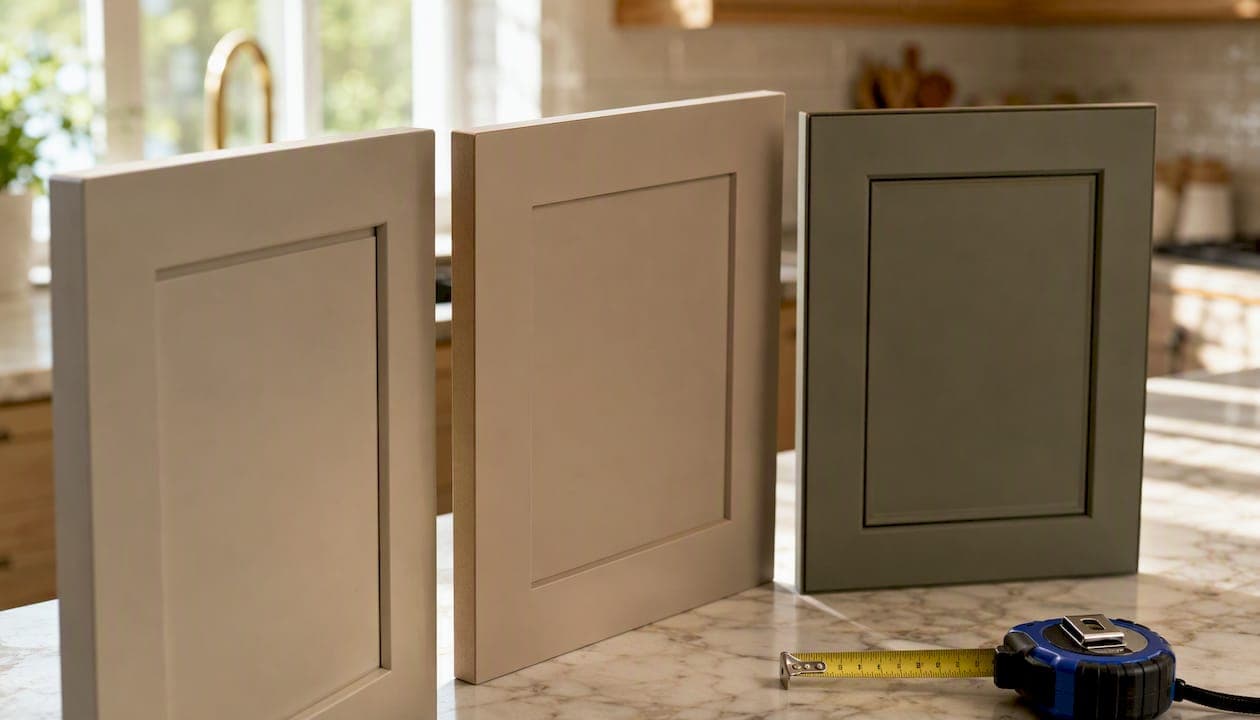
A cabinet door overlay is the amount a door or drawer front extends over the cabinet face frame or box edge. That measurement determines how your cabinets look, which hinges you need, and exactly how to measure for replacement doors. Before you read another word, grab a tape measure and check the gap between your door edge and the face frame on the hinge side. That single number tells you almost everything.
Here are the overlay types you're most likely to encounter, according to Woodworker Express:
- Full overlay: Doors nearly cover the entire face frame; very little or no frame is visible when closed. Common in modern and contemporary kitchens.
- Partial (half) overlay: Doors cover roughly half the face frame stile, leaving a visible strip of wood between doors. The most common type in U.S. kitchens built before 2000.
- Inset: Doors sit flush inside the face frame opening. A traditional, furniture-style look that requires precise fitting.
- Lipped/partial inset: A hybrid where a small rabbet on the door edge overlaps the frame slightly while the door body sits partially inside the opening.
- Frameless (full access): No face frame at all. Doors mount directly to the cabinet box sides, almost always with a full overlay.
The NKBA sets the industry terminology and standards that cabinet manufacturers and designers follow across the U.S., so when you see these terms on an order form or spec sheet, they carry consistent meaning.
Table of Contents
- What are the different types of cabinet door overlay?
- How do you measure cabinet door overlay accurately?
- What are the most common overlay sizes in U.S. kitchens?
- Full overlay vs. partial overlay: which one is right for you?
- How does overlay choice affect hinges and cabinet hardware?
- How do you choose the right overlay for your project?
- Pro tips from the installer's perspective
- Key Takeaways
- The overlay detail most homeowners overlook
- Ready to order the right cabinet doors?
- Useful sources and further reading
What are the different types of cabinet door overlay?
Understanding which overlay you have, or want, starts with knowing what each type looks like from across the room and up close. Homestead Cabinet Design explains that framed face-frame cabinets show the face frame when partial overlay is used, while full overlay can be applied to either framed or frameless construction and often hides the frame entirely when the doors are closed.
Full overlay
Full overlay doors cover nearly all of the face frame stile, leaving only a small gap (typically 1/8" to 3/16") between adjacent doors. The result is a clean, uninterrupted surface that reads as modern or transitional. Shaker-style doors in white or gray are the most common pairing. Because so little frame is exposed, the cabinet box itself needs to be square and level; any misalignment shows immediately.
Partial (half) overlay
Partial overlay is the workhorse of American cabinetry. Each door covers roughly half the face frame stile on its side, leaving a visible reveal of about 1/2" between doors. You'll find this in most tract-built homes from the 1970s through the early 2000s. Raised-panel doors in oak or maple are the classic pairing. The visible frame adds a bit of visual structure and, practically speaking, gives you a little more tolerance for minor box irregularities.
Three-quarter overlay
Less common but worth knowing: a 3/4" overlay sits between partial and full. Some manufacturers use it as a standard, so if your reveal measures 1/4" rather than 1/2", you likely have a three-quarter overlay rather than a full.
Inset
Inset doors sit completely inside the face frame opening, flush with the front of the frame. The look is refined and furniture-like, common in traditional, craftsman, and high-end transitional kitchens. The trade-off is precision: gaps must be consistent all around the door, and wood movement can cause sticking. As Cabinet Doors notes, inset installation requires specialized hinges and more exacting fitting than any overlay type.
Lipped/partial inset
A lipped door has a small rabbet (a stepped cut) around its perimeter so the outer edge overlaps the face frame while the door body sits partially recessed. This style was popular in mid-century kitchens and often used with offset or "H" hinges. It's rarely specified in new construction today but shows up frequently in older homes.
Frameless vs. framed
Pro Tip: To tell framed from frameless when doors are closed, open one door and look at the interior edge of the cabinet opening. A framed cabinet has a solid wood strip (the face frame stile) running along the inside edge. A frameless cabinet shows only the plywood or MDF panel of the box side, with no wood border.
Frameless cabinets almost always use full overlay doors because there's no face frame to partially cover. Framed cabinets can use any overlay type, but partial overlay is the traditional default.
How do you measure cabinet door overlay accurately?
Accurate measurement prevents costly ordering mistakes. HardwareHut's measuring guide walks through a step-based approach that accounts for both doors and drawer fronts, and it's the method professional installers rely on.
Tools you need:
- Steel tape measure (1/16" increments minimum)
- Digital calipers or a steel rule for precise reveals
- Notepad or phone for recording measurements
Here's the procedure:
- Open the door and measure the face frame stile. Note the full width of the stile on the hinge side. This is your reference point.
- Close the door and measure the reveal on the hinge side. The reveal is the gap between the door edge and the adjacent door or the cabinet wall. This is your overlay per side.
- Measure the reveal on the latch side. It should match the hinge side. If it doesn't, the door may be warped or the box may be out of square.
- Calculate overlay per side. Overlay = (stile width / 2) minus the visible reveal. For a 1-1/2" stile with a 1/2" reveal, overlay = 1/2".
- Measure door height and width. Width = opening width + (overlay per side × 2). Height = opening height + (overlay per top and bottom).
- Measure drawer fronts separately. Drawer fronts often use the same overlay as doors, but the opening height differs. Measure each drawer opening independently.
- Record hinge cup diameter and center-to-center spacing. For European cup hinges, note the cup diameter (typically 35mm) and the distance from the door edge to the cup center.
Pro Tip: Measure every door in a run, not just one. Cabinets settle, frames rack, and a run of six doors can have reveals that vary by 1/8" from end to end. Measure left, center, and right; use the smallest reveal as your baseline.
For a deeper walkthrough on ordering replacement doors, the DIY cabinet door measuring guide at Best Cabinet Specialist covers opening dimensions, hinge placement, and common pitfalls in one place.
What are the most common overlay sizes in U.S. kitchens?
Most American kitchens use one of a handful of standard overlay sizes. Knowing the numbers lets you match what you measure to a standard and order with confidence.
| Overlay Type | Overlay per Side | Visible Reveal | Typical Use |
|---|---|---|---|
| Half/partial overlay | 1/2" | ~1/2" between doors | Standard framed cabinets, pre-2000 homes |
| Three-quarter overlay | 3/4" | ~1/4" between doors | Some manufacturer-specific standards |
| Full overlay | 1-1/4" | 1/8"–3/16" gap | Modern framed and frameless kitchens |
| Ultra/full overlay | 1-1/4" or 1-3/8" | Minimal gap | Contemporary, high-end frameless |
| Inset | 0" (no overlay) | Flush with frame | Traditional, craftsman, furniture-style |
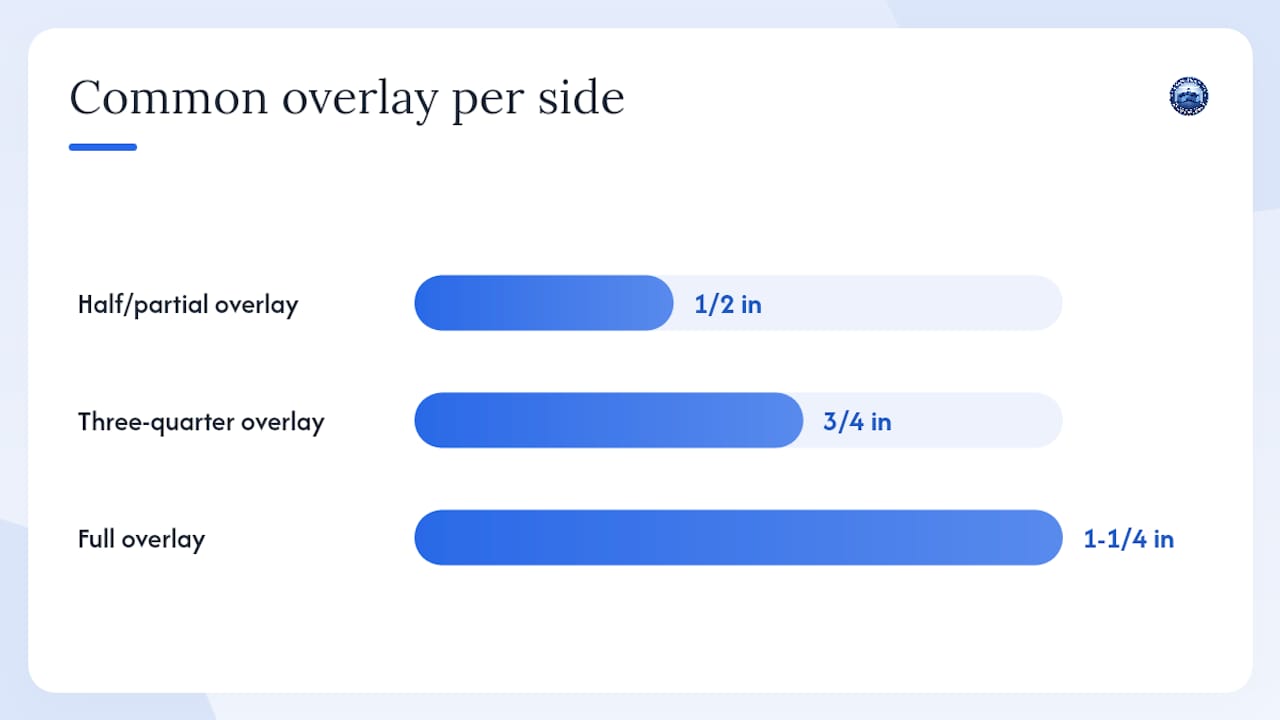
Chris Loves Julia and other sources confirm that 1/2" partial and 1-1/4" full overlay are by far the most common sizes in U.S. kitchens; 'ultra' full overlay sometimes refers to 1-3/8", but most U.S. installations use 1-1/4" for full overlay or 1/2" for partial overlay. When in doubt about sizing, measure rather than assume.
Full overlay vs. partial overlay: which one is right for you?
| Dimension | Full Overlay | Partial (Half) Overlay |
|---|---|---|
| Appearance/look | Modern, clean, minimal visible frame | Traditional, structured, visible frame strips |
| Visible face frame/reveal | 1/8"–3/16" gap between doors | ~1/2" reveal between doors |
| Typical overlay measurement | 1-1/4" per side | 1/2" per side |
| Cost impact | Up to ~16% more than partial overlay | Lower cost; standard hardware widely available |
| Interior access/opening size | Wider opening; better access to cabinet interior | Slightly narrower opening due to face frame overlap |
| Durability/ease of repair | Doors more exposed at edges; minor dings more visible | Face frame provides edge protection; easier to touch up |
| Hinge/hardware implications | Concealed European cup hinges standard | Exposed or semi-concealed hinges common; more options |
When to choose full overlay:
- You want a contemporary or transitional kitchen aesthetic.
- You're working with frameless cabinet boxes.
- Maximizing interior access matters (useful for corner cabinets and deep base units).
When to choose partial overlay:
- You're replacing doors on existing framed boxes and want a straightforward swap.
- Budget is a priority; hardware and doors cost less.
- You prefer a classic or traditional look with visible frame detail.
When to choose inset:
- You want a furniture-quality, heirloom look and are prepared for higher cost and tighter tolerances.
- Your cabinet boxes are perfectly square and level.
The framed vs. frameless variable modifies this comparison in one important way. On a frameless box, partial overlay isn't really an option because there's no face frame to partially cover. Full overlay is the default. On a framed box, you have full flexibility, but switching from partial to full overlay during a reface means ordering wider doors and likely replacing hinges. That's a manageable project, but it's not a simple door swap. The face frame vs. frameless guide at Best Cabinet Specialist breaks down the construction differences in detail.
How does overlay choice affect hinges and cabinet hardware?
Overlay and hinge selection are inseparable. Get one wrong and the other won't work. Angi notes that full overlay cabinets commonly use concealed European cup hinges, while partial overlay and inset doors often use visible or specialty hinges.
Common hinge types by overlay:
- European cup hinges (35mm): The standard for full overlay and most modern cabinetry. Fully concealed when the door is closed. Available in full overlay, half overlay, and inset versions, each with a different mounting plate offset.
- Semi-concealed hinges: Common on partial overlay framed cabinets. The barrel is visible from the side but the hinge leaf is hidden behind the door.
- Exposed/decorative hinges: Used on inset and some traditional partial overlay doors. The hinge is visible and often a design feature.
- Wrap-around hinges: Used on partial overlay framed cabinets where the hinge wraps around the face frame stile for added strength.
Measurement checklist for ordering replacement doors and hinges:
- Hinge cup diameter (standard is 35mm for European hinges)
- Cup center distance from door edge (typically 3mm to 5mm)
- Center-to-center distance between hinge cups on the door
- Overlay per side (determines the hinge plate/arm offset)
- Door thickness (standard is 3/4"; some doors are 7/8")
- Edge profile (square, eased, or shaped affects hinge mortise fit)
Drawer fronts follow the same overlay logic as doors but are measured against the drawer box opening, not a face frame stile. If you're adding soft-close undermount drawer slides, confirm the slide's required face-frame clearance before finalizing overlay dimensions, since some slides need a minimum 1/2" inset from the face frame front.
Pro Tip: When submitting an order for replacement doors, include the hinge cup diameter, plate offset (e.g., "1/2" overlay plate" or "full overlay plate"), and door thickness in your notes. A vendor who receives those three numbers can confirm fit before shipping, which eliminates the most common return reason.
For guidance on door materials and construction, the solid wood cabinet doors buyer's guide covers thickness, edge profiles, and finish options that interact with hinge selection.
How do you choose the right overlay for your project?
Work through these steps before placing any order:
- Measure first. Record hinge-side reveal, door width and height, and hinge cup specs for every door in the run.
- Decide on the look. Full overlay reads modern and clean; partial overlay reads traditional and structured; inset reads furniture-quality and formal.
- Match to your cabinet construction. Frameless boxes require full overlay. Framed boxes support any type, but switching overlay type means new hinges and possibly wider doors.
- Check your budget. Full overlay doors and concealed European hinges cost more than partial overlay equivalents. Factor in hardware costs, not just door prices.
- Confirm durability needs. Partial overlay's visible face frame provides edge protection. Full overlay doors are more exposed at the edges and show dings more readily.
- Finalize hinge and hardware specs. Order hinges that match your overlay measurement and door thickness. Soft-close mechanisms add cost but meaningfully improve daily use.
Questions to ask when requesting a quote:
- What overlay per side do you need (e.g., 1/2" or 1-1/4")?
- Are the cabinet boxes framed or frameless?
- What is the hinge cup diameter and plate offset on existing hinges?
- What door thickness and edge profile do you want?
- Are you replacing all doors in a run, or just one or two?
Red flags that suggest hiring a professional:
- Cabinet boxes are visibly warped, racked, or out of plumb.
- You have a mixed-overlay run (some doors are partial, some are full) with no clear reason.
- You want to convert from partial overlay to inset, which requires precise fitting and often shimming or rebuilding the face frame.
Pro tips from the installer's perspective
Experienced installers approach overlay projects differently from homeowners, and a few of their habits are worth adopting.
How pros measure: They measure every opening, not just a representative sample. They also measure the diagonal of each cabinet box to check for square before ordering doors. A box that's 1/4" out of square will make a perfectly sized door look crooked.
Tolerance allowances: Most door manufacturers build to +/- 1/16" tolerance. Pros order doors 1/8" smaller in width than the calculated dimension to allow for adjustment. On inset doors, they reduce that to 1/16" per side to keep reveals consistent.
Common field adjustments: European hinges have three-way adjustment (in/out, up/down, side-to-side), which lets installers fine-tune alignment after hanging. Pros hang all doors loosely first, then adjust systematically from one end of the run to the other.
Refacing scenario: Switching a partial-overlay kitchen to full overlay during a reface is one of the most common modernization projects. The existing boxes stay in place; new full-overlay doors and concealed hinges replace the old hardware. The face frame remains but is hidden behind the new doors. This approach, as Homestead Cabinet Design describes, updates the look without the cost of new boxes.
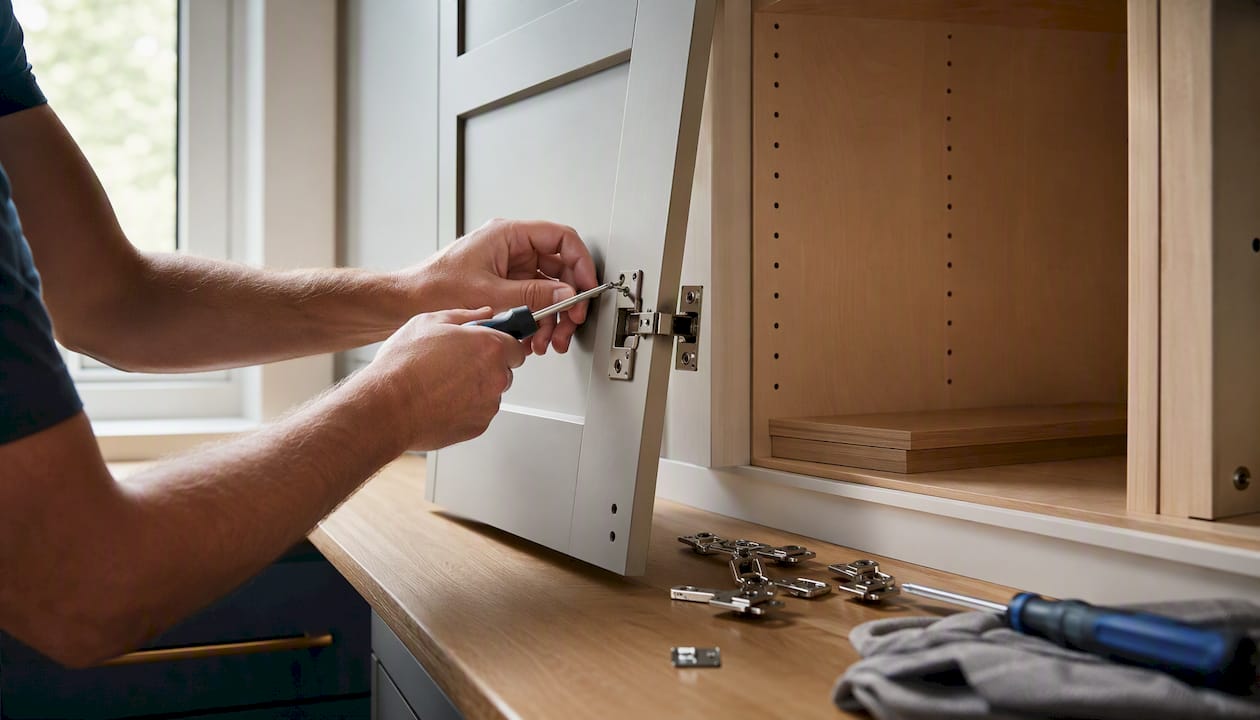
Single warped door replacement: When replacing one door in an existing run, bring the old door to the supplier or photograph it next to a tape measure. Matching the overlay, thickness, and edge profile exactly prevents a visible mismatch in the finished kitchen.
What to include in a quote request:
- Cabinet box dimensions (width, height, depth)
- Overlay per side (measured, not assumed)
- Hinge type and plate offset
- Door finish, style, and edge profile
- Whether soft-close hardware is needed
Key Takeaways
The overlay measurement on the hinge side is the single most important number to record before ordering replacement doors or planning a cabinet reface.
| Point | Details |
|---|---|
| Overlay defined | Overlay is how much the door covers the face frame or box edge, measured per side in inches. |
| Most common U.S. sizes | Half overlay (1/2" per side) and full overlay (1-1/4" per side) make up the vast majority of American kitchens. |
| Measure hinge side first | Record the hinge-side reveal on every door in the run before ordering; reveals can vary across a single cabinet run. |
| Hardware must match overlay | European cup hinge plate offsets are overlay-specific; ordering the wrong plate is the most common installation error. |
| Best Cabinet Specialist | Offers solid wood doors, plywood-box RTA cabinets, and soft-close hardware sized to standard U.S. overlay specs with fast shipping. |
The overlay detail most homeowners overlook
Most articles on this topic treat overlay as a style decision. It is, but the more consequential issue is hardware compatibility. A homeowner who picks full overlay doors for a modern look, then orders the wrong hinge plate offset, ends up with doors that won't close flush or that bind against adjacent doors. That's not a style problem; it's a measurement problem that requires reordering.
The other thing worth saying plainly: partial overlay gets dismissed as "dated," but it's genuinely more forgiving to install and maintain. The visible face frame hides minor box irregularities, gives you more adjustment range with semi-concealed hinges, and protects door edges from the kind of everyday contact that chips full overlay doors over time. If you're replacing doors on a 1990s framed kitchen and the boxes are in good shape, staying with partial overlay is a perfectly sound choice. Modernizing the door style within the same overlay type, say, switching from raised-panel oak to flat-panel white, delivers a dramatic visual update without the hardware complexity of changing overlay types.
Full overlay is the right call when you're working with frameless boxes, when you want maximum interior access, or when the kitchen design genuinely calls for a seamless, frame-free look. But it's not automatically better. The best overlay is the one that fits your boxes, your budget, and your actual daily use.
Ready to order the right cabinet doors?
Best Cabinet Specialist makes the ordering process straightforward for homeowners and contractors who know their measurements. The catalog includes solid wood doors in modern, shaker, and traditional styles, all sized to standard U.S. overlay specs, paired with plywood-box RTA and assembled cabinets built with soft-close hardware included.

Where most cabinet sources require long lead times, Best Cabinet Specialist ships fast, with trade pricing available for contractors, builders, and property managers. The business is women-owned and veteran-owned, and the team is set up to help you confirm overlay specs, hinge plate offsets, and door dimensions before your order ships.
Visit cabinet-specialist.com to browse door styles, request a quote, or get help matching your measured overlay to the right door and hardware combination.
Useful sources and further reading
- nkba.org
- What is Cabinet Door Overlay? | Woodworker Express
- Full vs. Partial Overlay Cabinets: Which Is Right for You? | Angi
- Full Overlay vs. Partial Overlay vs. Inset Cabinets | Homestead Cabinet Design
- Measuring Cabinet Door Overlay | HardwareHut
- What's the difference between inset and overlay cabinets? | Cabinet Doors
- Cabinet Overlays 101 | Chris Loves Julia