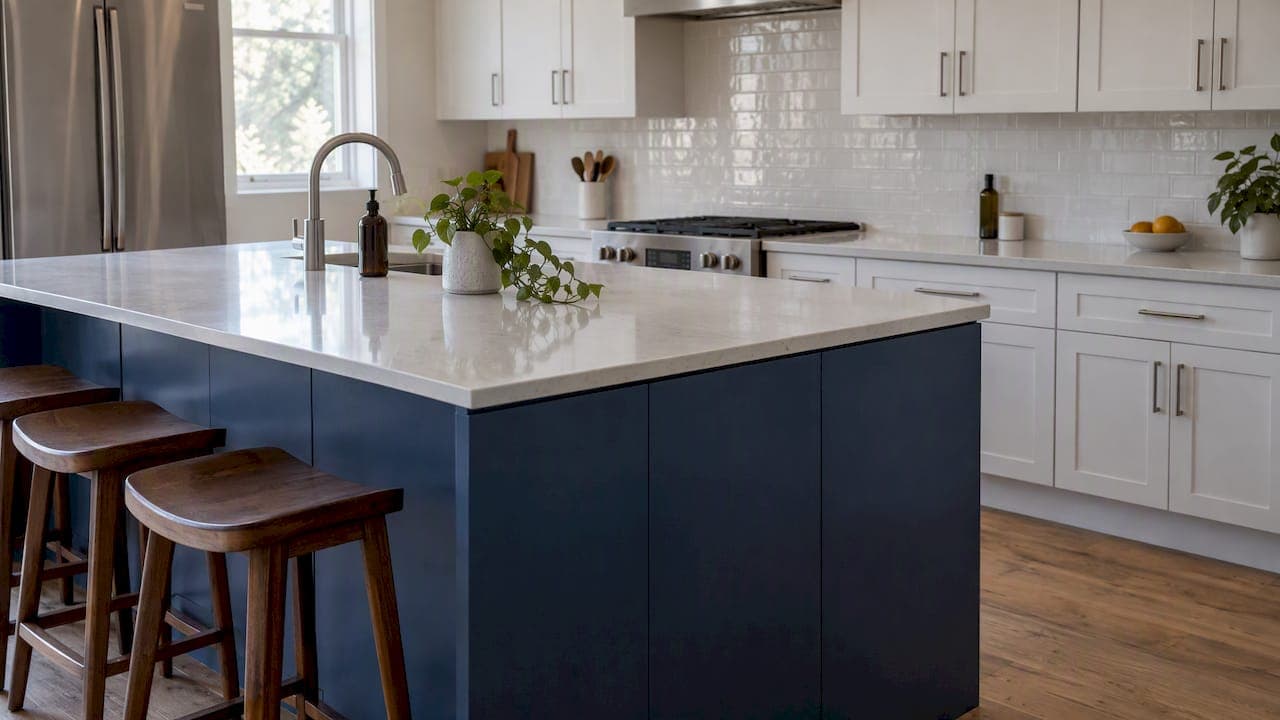
Shaker doors have a five-piece frame with a recessed center panel. Slab doors are one flat piece with no frame. Shaker is the safer choice for most homes and resale. Slab is the better fit for modern design, rentals and kitchens that need quick wipe-downs. Slab is also usually the cheaper door to build for the same material. The right pick depends on your home's architecture, how hard the kitchen works, your budget and how soon you need cabinets on site.
Below we compare the two on the points that decide real projects: look, price, cleaning, durability, trends and availability. We also explain a terminology trap that can throw off your quotes.
TL;DR
- Shaker suits traditional, transitional and farmhouse kitchens, and it has the broadest buyer appeal. It was the top door style in the 2026 Houzz study.
- Slab suits contemporary and minimalist kitchens. Its flat face wipes clean in one pass, and it usually costs less than a shaker door in the same material.
- Slim shaker is the middle ground: a narrow frame that reads cleaner than classic shaker but keeps a hint of detail.
- Door style says little about durability. Construction and finish do, so ask for a KCMA certification and a written construction spec.
- Confirm that "flat panel" means the same thing in every quote before you compare prices.
Table of Contents
- What actually separates the two doors
- Style: which look fits which home
- Are shaker cabinets outdated in 2026?
- Cost: is shaker more expensive?
- Cleaning and daily use
- Durability: door style is the wrong question
- Availability and lead time
- Which one should you choose?
- Our perspective: what we see on real projects
- See the doors before you order
- Mistakes to avoid when choosing a door style
- FAQ
- Sources
What actually separates the two doors
A shaker door is built from a frame of rails and stiles around a recessed center panel. Lily Ann Cabinets describes it as five pieces cut, joined and finished, which is why it takes more work to make. A slab door is a single flat piece. Its edges may be square or lightly eased, and it has no frame or visible joints.
That one structural difference changes three things:
- How the kitchen reads. The frame adds shadow lines and a little depth. A slab face is continuous and quiet.
- How the door cleans. A shaker door has four inside corners around the panel. A slab face has none.
- What it costs to make. More pieces and more machining mean more labor.
A terminology trap to check before you compare quotes
"Slab" always means one flat door. "Flat panel" is looser. According to Homestead Cabinet Design, it can also describe a framed door whose center panel happens to be flat. Two quotes that both say "flat panel" may describe different doors with different prices. Ask each supplier for a door drawing or a physical sample before you compare numbers. This matters most on bulk orders, where a small difference in door construction is repeated across dozens of units.
Style: which look fits which home
Shaker works in more rooms than any other profile. It sits comfortably in traditional, farmhouse and transitional homes, and it still looks right in many newer builds. Kitchens of the South calls it the most popular, versatile and enduring door style in America.
Slab suits contemporary, minimalist and European-inspired kitchens, especially with handleless or low-profile hardware. A common caution from designers is that slab depends on good proportions, grain and finish. With little detail to carry the design, a poorly chosen slab kitchen can look flat rather than sleek.
Slim shaker narrows the frame so the door reads closer to flat while keeping a thin recess. If you are torn between the two, this is usually the answer. Designer Charlotte Sardet, quoted by The Kitchn, described shaker's appeal as subtle dimension without visual overload. Rail width and panel depth are the levers that let you modernize shaker without giving up its familiar shape.
For a wider overview of profiles beyond these two, see our guide to cabinet door styles.
Are shaker cabinets outdated in 2026?
No. In reporting on the 2026 Houzz Kitchen Trends Study, Real Simple notes that shaker remained the leading door style at 58% of renovating homeowners' selections, with flat-panel second at 22%. The study surveyed 1,780 Houzz users who had recently completed, were undertaking or planned a kitchen remodel.
Slab is still gaining ground. Houzz's 2026 design predictions say flat-panel cabinets and vanities are gaining even in traditional and transitional rooms. The same Real Simple report found wood cabinetry at 29%, just ahead of white at 28%.
What this means in practice:
- You do not have to pick between "timeless" and "current" by door profile alone.
- Finish, wood tone, hardware and proportion change the result as much as the door does.
- A shaker door in a natural wood tone with slim pulls looks very different from the same door in builder white with a glossy knob.
For color direction, our 2026 cabinet color guide goes further. Looking at how another maker presents flat-front ranges can also help you picture the look. This South African collection of flat-fronted cabinets is one example, though it is a furniture range, not kitchen cabinetry.
Cost: is shaker more expensive?
For the same material, slab is usually the cheaper door. Lily Ann Cabinets points out that one piece is simpler to build than five, and that premium wood, glass or high-gloss finishes push either style up.
That qualifier matters. Door style is only one input in a cabinet price. Material, finish, box construction, hardware and how many units you order all move the total, and a high-gloss slab door can cost more than a painted shaker door. Do not assume slab wins on budget before you compare like for like.
We do not quote a single "shaker premium" here because no honest universal figure exists. Likewise, the commonly cited remodel budgets, such as Houzz's $60,000 median kitchen-remodel spend, describe whole projects, not the price gap between two door styles.
A better way to compare:
| Cost factor | Shaker | Slab |
|---|---|---|
| Door construction | Five pieces, more machining | One piece, simpler |
| Typical price tendency, same material | Higher | Lower |
| What can reverse it | Basic painted shaker vs. high-gloss or exotic-veneer slab | Premium finishes |
| Where budget really goes | Box construction, hardware, installation | Same |
Cleaning and daily use
This is where slab has a clear edge. Homestead Cabinet Design explains that a shaker door's panel-to-frame joints create ledges where dust and cooking grease can collect, while a slab face is uninterrupted. Citadel Spaces makes the same point: slab wipes clean in one pass, while shaker's recessed corners can hold dust and splashes.
There is a trade-off. The Designery notes that slab may show fingerprints most easily, even though it is the easiest to wipe. Shaker has corners to navigate but hides light smudges better.
So choose by how the room is used:
- Busy family kitchen with heavy cooking: slab is easier to keep clean, but pick a finish that hides fingerprints.
- Rental unit with frequent tenant turnover: a flat face speeds up turnover cleaning. Shaker still works if you specify a durable finish.
- Bathroom vanity: both work. Moisture resistance depends far more on finish and construction than on door shape.
See our guide to evaluating cabinet finish durability before you decide.
Durability: door style is the wrong question
Neither profile is universally tougher. The more meaningful signal is third-party testing. KCMA A161.1 certification covers cabinet structure, drawers, doors and finishes, plus resistance to household substances, temperature and humidity, and repeated use. The standard itself, KCMA A161.1-2022, lays out the structural tests. Certification applies to specific products, so it does not mean every shaker or slab cabinet on the market qualifies.
What to ask any supplier:
- Is this exact line KCMA certified, and can I see the documentation?
- What are the box and door materials: plywood, particleboard, solid wood, veneer?
- What finish is used, and how is it tested?
- What hardware is standard, and is it soft-close?
Our articles on KCMA tests and kitchen cabinet durability and KCMA certified cabinets explain how to read those answers.
Availability and lead time
For contractors and builders, schedule risk can outweigh a small style preference. The NAHB's 2025 remodeling market report said remodelers identified cabinets among the products that were difficult to obtain. When a delayed cabinet order can hold up countertops, plumbing and flooring, a door style that is in stock and ships quickly can protect the schedule better than a theoretically ideal style with uncertain delivery.

Before you commit, confirm the lead time in writing and plan your install date around it. Our guide on using cabinet lead times to fix your install date walks through the process.
Which one should you choose?
| Your situation | Better fit |
|---|---|
| Traditional, farmhouse or transitional home | Shaker |
| Resale matters, and you want the widest buyer appeal | Shaker |
| Contemporary or minimalist design with handleless hardware | Slab |
| Tight cleaning demands or rental turnover | Slab, or shaker with a durable finish |
| You want a clean look with some detail | Slim shaker |
| Bulk order for a new build or rental portfolio | Whichever style you can get in stock, certified and on schedule |
| Budget-first, same material | Slab is usually cheaper, but compare real quotes |
Our perspective: what we see on real projects
We sell kitchen and bathroom cabinets with plywood boxes and solid wood doors, in ready-to-assemble and assembled versions. The question we hear most is whether to chase a trend or stay safe. Our answer is to start with the room and the schedule, not the headline.
Shaker is our default recommendation for most homeowners and builders because it fits the widest range of homes and holds up on resale. Our Shaker Series and Slim Shaker options let you choose between a classic frame and a slimmer, more modern one. Slab is a legitimate choice, and our own slab cabinet doors guide covers its style, build and buying points. If you want it, buy it for the look and the cleaning ease, not because someone told you shaker is dead. The data says it is not.
We also tell contractors to check three things before any style: the box construction, the finish, and the lead time. A door style cannot make up for a weak box or a late delivery. And if you are ordering for several units, get samples first so everyone agrees on what the door looks like.
— Nathan
See the doors before you order
If you are deciding between framed and flat looks, a physical sample settles it faster than photos. You can order sample doors to see color, finish and frame width in your own light. When you are ready, browse our RTA cabinets, including the Shaker, Classic and Slim series, or our assembled cabinets if you want units that arrive ready to install. We are a women-owned and veteran-owned business, and we offer special pricing for trade professionals and bulk packages. Shop Now to start your kitchen or bathroom order.
For a specific look, here are two examples from the catalog: the Black Shaker 2 Drawer Base Cabinet and the White Slim Shaker Vanity Drawer Base Cabinet.
Mistakes to avoid when choosing a door style
- Choosing on photos alone. Lighting changes how frames and finishes look. Order a sample.
- Comparing quotes with different door definitions. Check whether "flat panel" is slab or a framed flat center.
- Ignoring finish. A durable finish matters more to daily wear than the profile.
- Skipping certification questions. Ask for KCMA documentation for the exact line.
- Leaving the schedule for last. Confirm lead time before you finalize the design.
Our list of kitchen cabinet mistakes to fix before you order and the checklist to avoid cabinet ordering mistakes cover the rest.
FAQ
What are the downsides of shaker cabinets?
The recessed corners collect dust and grease, so they take a little more effort to clean than a flat face. Shaker doors also cost more to make than slab in the same material. Their wide appeal can feel safe rather than distinctive, though slim rails and a bold finish can change that.
Are shaker cabinets outdated?
Not according to current data. Shaker was the leading cabinet door style in the 2026 Houzz Kitchen Trends Study, chosen by 58% of renovating homeowners. Flat-panel was second at 22%, so slab is growing but has not displaced shaker.
Are shaker cabinets more expensive than slab?
Usually, yes, when the material is the same, because a shaker door has five pieces and a slab door has one. Premium finishes such as high gloss can reverse that. Compare quotes with the same material, finish and door drawing.
Is a flat panel door the same as a slab door?
Not always. Slab means one flat piece. Flat panel can also mean a framed door with a flat center panel, so confirm with a sample or drawing before you order.
Sources
- Shaker vs. Flat Panel Cabinet Doors, Homestead Cabinet Design
- Shaker vs. Slab (Flat-Panel) Cabinets, Lily Ann Cabinets
- Shaker vs. Slab Cabinet Doors, Kitchens of the South
- Shaker vs Slab Cabinet Doors, Citadel Spaces
- Find Your Kitchen Cabinet Style, The Designery
- The Kitchn on the 2025 Houzz kitchen study
- Real Simple on the 2026 Houzz kitchen trends report
- Houzz 2026 design predictions
- Houzz 2025 Kitchen Trends Study press release
- NAHB, Remodeling Market Poised for Growth in 2025
- KCMA A161.1 Quality Cabinet Certification
- KCMA A161.1-2022 standard