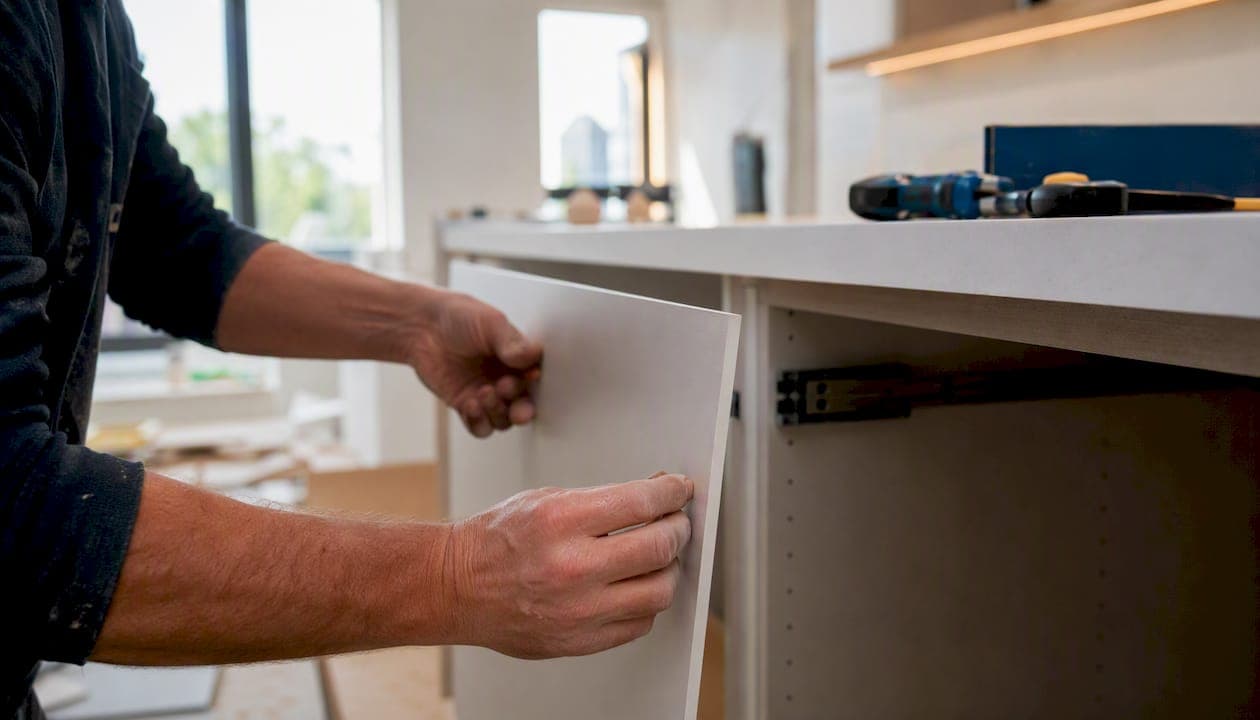
A slab cabinet door is a single, uninterrupted flat panel with no frame, no rails, and no decorative profile. It's the cleanest door style available, and it's generally the least expensive to construct because there are no frame components to cut, join, or finish separately. Whether you're remodeling a kitchen, updating a bathroom, or spec'ing a new build, flat-panel doors give you a modern look that's easy to clean and straightforward to order.
Quick buying cues before you read further:
- Slab doors suit any project where you want a sleek, contemporary finish
- They're available as stock sizes or made-to-order custom dimensions from online retailers
- You can request door samples before committing to a full order
- Best Cabinet Specialist offers fast-shipping cabinet packages with solid wood doors and plywood boxes, so you can compare options without a long wait
Key Takeaways
Slab cabinet doors are the most practical starting point for modern and transitional remodels: low maintenance, cost-efficient, and compatible with nearly any hardware direction.
| Point | Details |
|---|---|
| Material for moisture-prone areas | MDF or plywood cores with sealed edges outperform solid wood in kitchens and bathrooms. |
| Standard door thickness | 3/4" is the widely recommended thickness for cabinet doors, frames, and shelves. |
| Lead time gap | Unfinished doors ship in roughly 10–12 days; finished doors take approximately 30–35 days. |
| Order samples first | Request a door or edge sample before placing a full order to confirm finish, color, and sheen. |
| Best Cabinet Specialist | Offers plywood-box, solid-wood-door cabinet packages with fast shipping and trade pricing at Cabinet-specialist. |
Table of Contents
- What are slab cabinet doors, and what are they called?
- What materials are slab doors made from?
- What thickness should slab doors be?
- What finish and edge options do slab doors come in?
- How durable are slab doors, and how do you maintain them?
- How do you measure and order slab cabinet doors?
- What do slab doors cost, and how long does shipping take?
- Installation basics: hinges, hardware, and when to hire a pro
- How do you choose the right slab door for your project?
- Pro-level tips from Best Cabinet Specialist for durable slab doors
- Why slab doors are the right default for most remodels
- Best Cabinet Specialist makes ordering slab-style cabinets straightforward
- Sources
What are slab cabinet doors, and what are they called?
The term "slab" is the most common name in the U.S. market, but you'll see the same door listed as a flat-panel door, a one-piece door, or a full-overlay door depending on the retailer. All of these refer to the same basic construction: one flat surface, no center panel, no stile-and-rail frame.
Flat-panel doors provide a clean contemporary look, are easiest to maintain, and are generally less expensive to construct than raised-panel styles. That combination of low cost and low maintenance is why they dominate modern and transitional kitchen designs right now.
The three main variants you'll encounter:
- Painted slab: A smooth substrate (usually MDF) finished with lacquer or paint. Hides grain completely for a uniform color.
- Veneered slab: A thin real-wood or engineered-wood layer bonded to a stable core. Shows grain and texture while keeping the panel flat.
- Edge-banded slab: Any slab with a thin strip of material (PVC, wood, or veneer) applied to the exposed edges for a finished look and moisture protection.
When comparing slab doors to shaker vs raised panel options, the key trade-off is visual weight. Shaker doors add a subtle frame detail; raised-panel doors add depth and shadow lines. Slab doors do neither, which is exactly the point for a modern or minimalist space.
What materials are slab doors made from?
Material choice drives everything: cost, weight, warp resistance, and which finishes you can apply. The four substrates you'll see most often are MDF, plywood, solid wood, and thermofoil-wrapped engineered core.
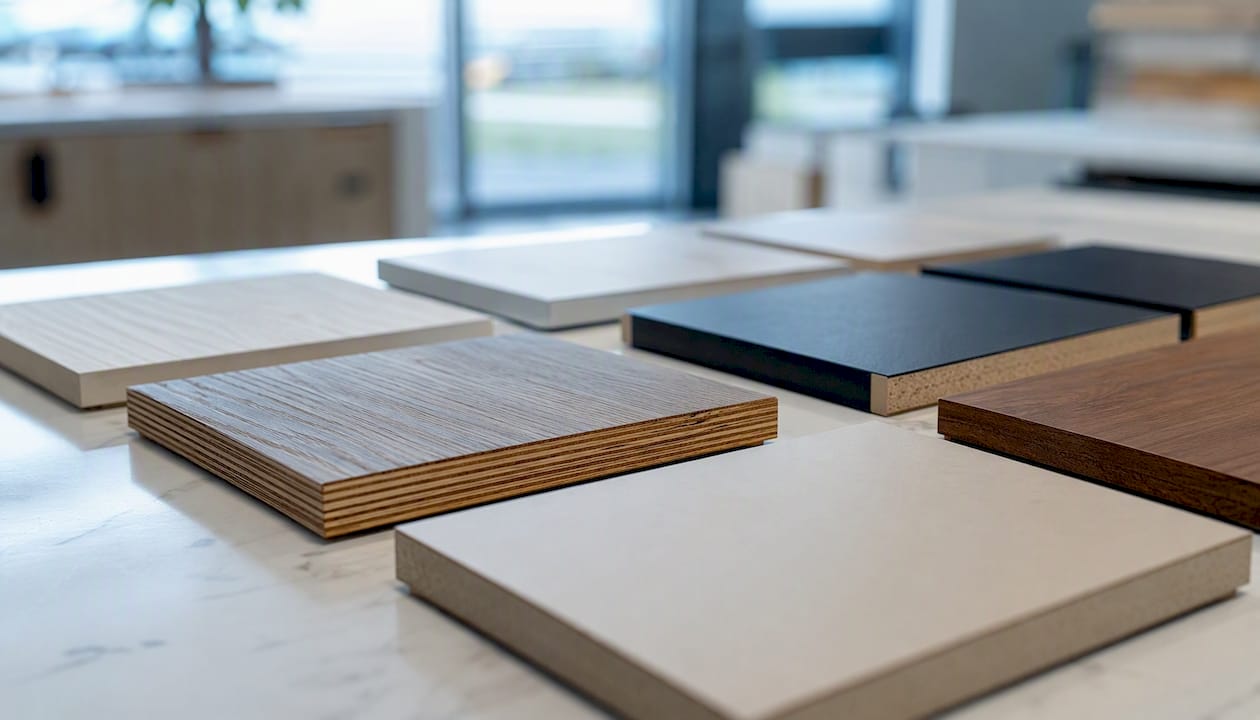
Slab doors built from MDF or engineered substrates stay flatter in humid environments than single-piece solid-wood slab doors, which are more susceptible to seasonal movement. That's the single most important material fact for kitchen and bathroom applications.
| Material | Best for | Finish options | Warp resistance | Relative cost |
|---|---|---|---|---|
| MDF core | Painted slab doors | Paint, lacquer, thermofoil | High | Low |
| Plywood core | Veneered slab doors | Veneer, stain, paint | High | Moderate |
| Solid wood | Stained or natural-look doors | Stain, oil, paint | Lower (seasonal movement) | Higher |
| Thermofoil / RTF | Budget painted look, rentals | Thermofoil wrap only | Moderate | Low |
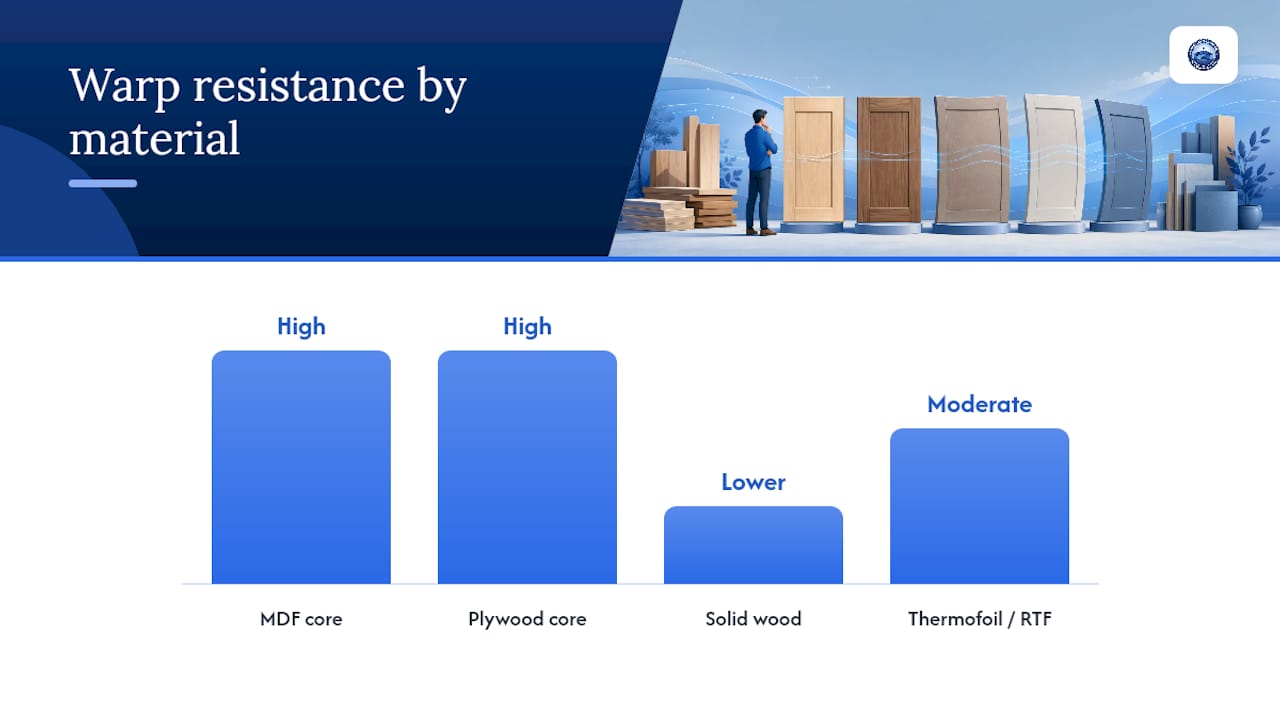
MDF substrates keep panels flat and reduce warping; five-piece frame-and-panel construction improves dimensional stability in fluctuating humidity compared to a single-piece solid slab. For bathrooms or kitchens near a dishwasher, MDF or plywood cores are the practical choice.
A few additional points worth knowing:
- MDF machines cleanly and takes paint well, but it's heavier than plywood and doesn't hold screws as firmly at edges
- Plywood is lighter, stronger at the edges, and handles moisture better than MDF when properly sealed
- Solid wood looks premium and can be refinished, but it requires proper acclimation and sealed edges to minimize movement
- Thermofoil (RTF/TFL) is a cost-effective option for rentals or secondary spaces, though the film can lift near heat sources over time
For a deeper look at how these substrates compare in cabinet boxes, the MDF vs plywood comparison covers the structural trade-offs in detail.
What thickness should slab doors be?
Thickness is one of the most practical specs to get right before ordering. Too thin and a wide door sags; too thick and it adds unnecessary weight to hinges and hardware.
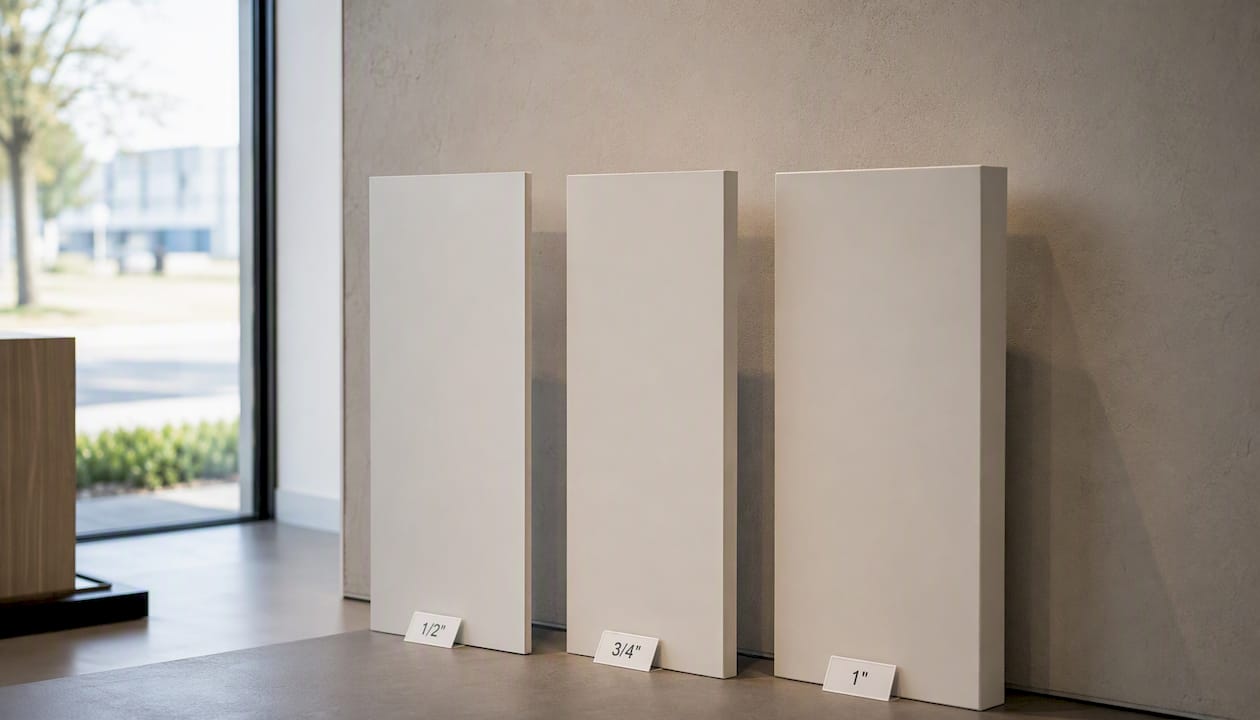
For cabinet frames, doors, and shelves, 3/4" plywood is widely recommended for structural integrity; 1/2" is commonly used for backs and drawer sides. That 3/4" standard applies to slab doors as well.
| Thickness | Common use | Notes |
|---|---|---|
| 1/2" | Small doors, drawer fronts | Suitable for widths under 12"; may flex on taller panels |
| 3/4" | Standard cabinet doors | Recommended for most kitchen and bath applications |
| 1" | Large or heavy doors | Used for doors over 24" wide or 40"+ tall |
Retail product pages commonly note that doors taller than roughly 40" carry a higher warping risk if not built on an engineered core. For any door in that range, specify a plywood or MDF core rather than solid wood, and confirm the supplier's maximum practical height before ordering.
Core type matters as much as thickness:
- MDF core: heavier but very flat; good for painted doors up to standard sizes
- Plywood core: lighter and more screw-friendly; preferred for larger doors and humid spaces
- Solid wood core: premium feel but requires careful grain orientation and edge sealing to stay stable
What finish and edge options do slab doors come in?
Finish and edge treatment determine how a flat-panel door reads in a room. Because there's no frame to add visual interest, the surface and edge profile carry all the design work.
Common finish types:
- Painted lacquer: The most popular choice for modern kitchens. Available in matte, satin, or gloss. Matte hides fingerprints better; gloss amplifies light in smaller spaces.
- Stain or clear coat over veneer: Lets the wood grain show through. Works well in transitional kitchens where you want warmth without the formality of raised-panel doors.
- Thermofoil: A vinyl film heat-pressed over an MDF core. Durable for low-traffic areas, but avoid placing it directly above a range or dishwasher vent where heat can cause lifting.
Edge treatments and what they signal visually:
- Square edge: Crisp 90-degree corners. The most modern look, often paired with integrated pulls or recessed hardware.
- Eased edge: A very slight bevel that softens the corner without adding a profile. Reduces chipping on painted doors.
- Edge-banded veneer: A strip of real or engineered wood applied to the panel edge. Adds warmth and hides the substrate on plywood-core doors.
Grain direction is a detail many buyers overlook until they're standing in front of the finished cabinets. Vertical grain reads taller and more formal; horizontal grain feels wider and more relaxed. For a kitchen with standard 30" upper cabinets, vertical grain is the safer default. Horizontal grain works well on long lower runs or island panels where the width is the dominant dimension.
Hardware pairings that work with slab doors:
- Integrated finger pulls (routed into the door edge) for a handle-free, fully modern look
- Long bar pulls in brushed nickel or matte black for a transitional feel
- Recessed cup pulls for a mid-century modern direction
- Minimal round knobs in brass or black for a warmer, less industrial result
For more pairing ideas, the modern kitchen cabinet ideas guide shows how hardware choices shift the overall style of flat-panel installations.
How durable are slab doors, and how do you maintain them?
Slab doors are low-maintenance by design, but they have specific failure modes that are worth knowing before you buy.
Common failure modes by material:
- Solid-wood slab warping: The most frequent complaint. Solid wood moves with humidity changes, and a large unframed panel has nothing to resist that movement. Proper acclimation and sealed edges reduce the risk significantly.
- Thermofoil lifting: The film separates from the substrate when exposed to sustained heat or steam. Keep thermofoil doors away from dishwasher vents and range hoods.
- Edge separation on painted MDF: If the edges aren't sealed before painting, moisture can wick in and cause the paint to bubble or the edge banding to lift.
- Finish wear on high-traffic doors: Matte lacquer shows wear near pulls and edges faster than satin or semi-gloss finishes.
Maintenance by finish type:
- Painted lacquer: Wipe with a damp cloth and mild soap. Avoid abrasive cleaners that scratch the surface. Touch up chips quickly to prevent moisture from reaching the substrate.
- Veneer/stain: Dust regularly and apply a wood-safe cleaner. Avoid prolonged water contact near edges.
- Thermofoil: Wipe clean easily, but never use steam cleaners or leave standing water near seams.
Pro Tip: Before installation, let slab doors acclimate in the room where they'll be installed for at least 48–72 hours. Seal all four edges, including the top and bottom, before hanging. These two steps together reduce the chance of warping more than any other single precaution.
How do you measure and order slab cabinet doors?
Accurate measurement is the step that separates a smooth installation from a costly re-order. The step-by-step measuring guide covers the full process, but here's the core checklist.
Measuring checklist:
- Measure the cabinet opening width and height at three points (top, middle, bottom for width; left, center, right for height). Use the smallest measurement.
- Determine your overlay: full overlay covers most of the face frame; half overlay splits the frame with an adjacent door; inset sits flush inside the opening.
- For full overlay, add your overlay amount to each side of the opening (typically 1/2" to 3/4" per side).
- For inset doors, subtract 1/8" from both width and height for clearance.
- Note the hinge type: European concealed hinges (the standard for most modern cabinets) require a 35mm cup hole bored into the door back.
- Record door thickness, grain direction preference, and finish before submitting your order.
Before you buy, confirm these with the supplier:
- Sample policy: can you order a single door or edge sample before the full run?
- Return policy: what's the window, and who pays return shipping on defective doors?
- Hinge boring: is it included, or is it an add-on?
- Lead time: separate timelines for unfinished vs. finished doors
Pro Tip: Order one sample door in your chosen finish and size before placing a full order. Trade forum members consistently flag this as the step that prevents the most expensive mistakes, particularly with painted finishes where color and sheen can look very different on screen versus in your actual lighting conditions.
Unfinished doors typically ship faster than finished ones. One retailer cites approximately 10–12 days for unfinished doors and 30–35 days for finished doors, so factor that gap into your project schedule.
What do slab doors cost, and how long does shipping take?
Price varies more than most buyers expect, and the gap between stock and custom isn't always as large as it seems.
Typical price bands:
- Stock/semi-stock doors: Pre-made in standard sizes, usually unfinished or in a limited paint palette. Lowest cost per door; fastest lead time.
- Semi-custom doors: Made to your dimensions within a set range of materials and finishes. Moderate cost; lead times of two to four weeks for finished versions.
- Fully custom doors: Any size, any species, any finish. Highest cost; longest lead time, often four to six weeks or more for complex finishes.
Factors that push price up:
- Specialty veneer species (walnut, white oak) vs. paint-grade MDF
- Gloss or high-sheen lacquer vs. standard matte
- Hinge boring and edge-banding as add-ons
- Custom sizes outside standard increments
- Expedited shipping on large orders
Trust signals to request before ordering:
- CARB/TSCA-compliant material sheets confirming formaldehyde emissions meet U.S. standards
- Warranty documentation (what's covered and for how long)
- Tracking information and carrier details for your shipment
- Sample policy in writing
Material specs and CARB/TSCA compliance are a credible trust signal for online suppliers. Ask for these documents when evaluating quotes, particularly for doors going into spaces with limited ventilation.
Checking customer reviews on independent platforms before ordering can surface recurring delivery or quality issues that don't appear in a supplier's own marketing.
Installation basics: hinges, hardware, and when to hire a pro
Slab doors install the same way as any other cabinet door, but the flat surface leaves no room for hinge placement errors. A misaligned hinge is visible immediately.
Hinge types and what they require:
- European concealed hinge (35mm cup): The standard for modern frameless and face-frame cabinets. Requires a 35mm Forstner bit hole bored into the door back, typically 3mm from the edge. Fully adjustable after installation.
- Overlay hinge: Surface-mounted; no boring required. Less common on new builds but useful for retrofits.
- Inset hinge: Requires precise door sizing and a clean opening. Less forgiving of measurement errors.
Hardware placement basics:
- Mark hinge cup locations on the door back using a template or jig (most hinge manufacturers include one).
- Bore the 35mm cup hole with a drill press or handheld drill and Forstner bit.
- Mount the hinge plate to the cabinet box at the correct height.
- Hang the door and use the hinge's three-axis adjustment to align it with adjacent doors.
- Check gap consistency across all doors before tightening final screws.
When to hire a contractor:
- Doors over 24" wide or 40" tall, where weight and alignment tolerances are tighter
- Inset installations, which require precise face-frame squareness
- Full kitchen runs of 20+ doors where cumulative alignment errors compound
- Any project involving plumbing or electrical adjustments behind the cabinet boxes
How do you choose the right slab door for your project?
Start with your project constraints, not the finish catalog. The finish you want is irrelevant if the material can't handle your kitchen's humidity or your budget doesn't support a custom veneer.
Project-first criteria:
- Moisture exposure: Bathroom vanities and cabinets near dishwashers need MDF or plywood cores with sealed edges. Solid wood is a risk in these locations.
- Budget: MDF painted doors are the most cost-effective. Veneer and solid wood add cost; specialty species add more.
- Door size: Doors wider than 18" or taller than 40" need an engineered core and careful thickness selection to stay flat.
- Finish preference: If you want a painted finish, MDF is the better substrate. If you want visible grain, specify a veneer or solid wood option.
Questions to ask every supplier:
- What substrate is used, and is it CARB/TSCA compliant?
- Are edges sealed before shipping, or is that my responsibility?
- What are your production tolerances (typically ±1/16")?
- What's the lead time for my specific finish and size?
- Do you offer door samples, and what's the cost?
- What does your warranty cover, and for how long?
Red flags in quotes and communications:
- No sample policy or refusal to provide one
- Vague lead times ("ships when ready") with no tracking commitment
- Missing or unavailable material spec sheets
- No written warranty or warranty limited to "manufacturer defects" with no definition
Pro-level tips from Best Cabinet Specialist for durable slab doors
Getting slab doors right at the construction and ordering stage prevents the callbacks and replacements that cost contractors time and homeowners money.
What Best Cabinet Specialist provides: Plywood box construction, solid wood doors, soft-close hardware, and fast shipping on RTA and assembled cabinet packages. These aren't just marketing points; plywood boxes hold screws better than particleboard at the hinge mounting points, and solid wood doors can be refinished if the finish wears.
Construction and ordering tips:
- For doors wider than 18", specify a plywood core over MDF. Plywood's cross-grain construction resists racking better across wider spans.
- Request hinge boring at the time of order. Having it done at the factory is more accurate than field-boring, and it eliminates one step on the job site.
- Confirm edge-sealing is included. An unsealed top or bottom edge is the most common entry point for moisture on installed doors.
- For large orders, tag each door with its cabinet location before delivery. Re-sorting doors on a job site wastes time and risks damage.
For trade professionals batching orders:
- Group doors by finish type to simplify delivery and staging
- Order 5–10% extra on painted doors to cover field damage and future touch-up replacements
- Request a single-door sample from each finish batch to confirm color consistency before the full run ships
Getting all three right at the order stage is far cheaper than correcting them after installation.
Pro Tip: Experienced cabinetmakers seal the top and bottom edges of every slab door with two coats of finish before installation, even on factory-finished doors. This single step reduces moisture infiltration at the most vulnerable points and is the most common preventive measure cited for reducing future warping callbacks.
For more on solid wood door construction and when it's worth the premium, the solid wood kitchen cabinet doors guide covers species selection and construction details.
Why slab doors are the right default for most remodels
Slab doors win on three counts that matter for the majority of kitchen and bathroom remodels: they're the easiest to keep clean, the most cost-efficient to produce, and the most flexible stylistically because a flat surface works with almost any hardware direction.
When I look at the projects where clients end up happiest with their door choice, it's usually a painted or veneered slab in a neutral color with well-chosen hardware. The simplicity of the door lets the hardware, the countertop, and the overall layout do the design work. Raised-panel doors can look dated quickly; shaker doors are a safe middle ground but add visual noise in smaller spaces. A slab door gets out of the way.
That said, there are real cases where a framed or raised-panel door is the better call. Heritage homes with traditional millwork, very large rooms where the cabinets need visual weight to anchor the space, and clients who specifically want a farmhouse or craftsman aesthetic will be better served by a shaker or raised-panel option. The flat-panel default isn't universal; it's just the right starting point for most contemporary and transitional projects.
Best Cabinet Specialist makes ordering slab-style cabinets straightforward
Flat-panel cabinets with plywood boxes and solid wood doors at a price that doesn't require a contractor's budget. That's the core of what Best Cabinet Specialist delivers, and it's what separates them from suppliers who charge custom-shop prices for standard-size orders.
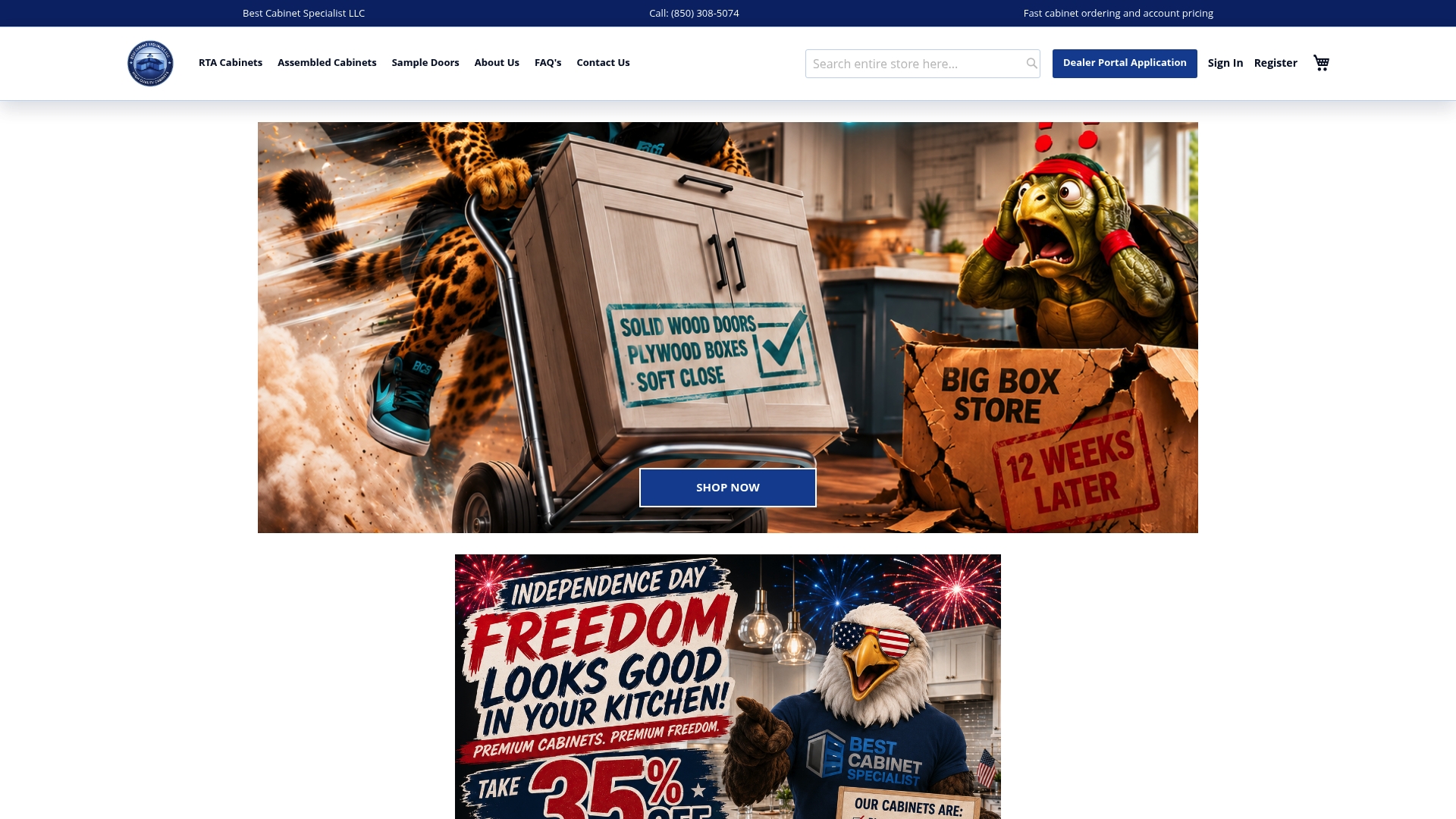
Best Cabinet Specialist offers RTA and assembled cabinet packages with soft-close hardware, fast shipping, and trade pricing for contractors and builders. Their plywood box construction holds hinges and hardware securely over time, and the solid wood doors can be refinished if your style direction changes. You can view cabinet options and request samples directly on the site, confirm lead times before you commit, and reach their trade support team for bulk order pricing. Whether you're updating a single bathroom vanity or spec'ing a full kitchen build, the ordering process is direct and the shipping timeline is clear from the start.
Sources
These resources support the specs and recommendations in this guide:
- Shaker vs. Flat Panel vs. Raised Panel: Cabinet Door Style Guide - Custom Kitchen Cabinets
- Best Plywood for Cabinets: How to Choose the Right Plywood for Cabinets: A Complete Guide