
The most durable kitchen cabinets pair a plywood box with solid-wood or quality veneered doors, a factory-applied conversion varnish finish, and full-extension hardware rated for daily use. Look for ANSI/KCMA A161.1 certification as proof the box survived 25,000 door cycles and a 600-pound wall load. You'll pay more upfront, but you'll likely skip a full kitchen replacement for 20 years or longer.
TL;DR:
- Plywood boxes with full-extension hardware rated for daily use and certification prove they last over 25,000 door cycles and can support 600 pounds wall load.
- Dovetailed drawers and a sturdy back panel attachment significantly extend cabinet lifespan beyond basic stapled or glued counterparts.
- Factory-applied catalyzed finishes outperform site-applied paint by resisting stains, chemicals, and moisture, especially when KCMA tested.
- Cabinets in humid or coastal environments should prioritize sealed edges and plywood construction to prevent warping or swelling over time.
- Upgrading from particleboard to plywood with dovetailed drawers and durable finishes offers a 15- to 30-year lifespan, representing a high-value investment.
Table of Contents
- What Makes Some Cabinet Materials More Durable Than Others?
- Which Construction Details Separate Long-Lasting Cabinets From Short-Lived Ones?
- How Do Finishes Affect Kitchen Cabinet Durability?
- Which Cabinets Fit Your Kitchen and Lifestyle?
- How Long Do Kitchen Cabinets Actually Last?
- What Should You Check Before You Buy Cabinets?
- Where Does Best Cabinet Specialist Fit Into This?
- Ready to Buy Cabinets Built on These Standards?
- Sources
What Makes Some Cabinet Materials More Durable Than Others?
Kitchen cabinet durability starts with the box material, and not all materials behave the same way once they meet steam, spills, and slammed drawers for a decade straight.
Solid hardwood takes impact well and can be sanded and refinished multiple times over its life. Its weakness is movement: hardwood expands and contracts with humidity, which can crack panels or loosen joints in kitchens near dishwashers or humid climates.
Plywood is the material pros lean on for cabinet boxes. Its cross-laminated veneers hold screws far better than particleboard, and that layered grain structure resists the swelling that ruins lower-quality boxes when water gets under the sink. This is why plywood boxes are the professional standard for long-term performance rather than a marketing upgrade.
MDF (medium-density fiberboard) takes paint beautifully because it has no visible grain, which is why it dominates painted shaker-style doors. Its edges need sealing, though. Left raw, an MDF edge will swell and crumble the first time it sits in standing water.
Particleboard works fine for low-stress applications like shelving inside a closed cabinet, but it loses screw-holding strength fast and swells permanently once wet. It's the most common failure point in low-cost cabinet lines.
Laminate (HPL) and metal shrug off moisture and chemicals almost entirely, which is why you see them in commercial kitchens and coastal builds.
Before buying, ask these questions:
- What is the box material, specifically. plywood thickness or particleboard grade?
- Are cabinet doors solid wood, veneered, or thermofoil?
- Is any exposed MDF edge sealed or banded?
- Has the material been tested for moisture exposure, or is that just a sales claim?
For a deeper breakdown of when each material makes sense, MDF vs. plywood for kitchen cabinets covers the trade-offs in more detail.
Which Construction Details Separate Long-Lasting Cabinets From Short-Lived Ones?
Two kitchens can look identical on install day and diverge completely by year eight, and the difference almost always comes down to construction choices buried behind the finish. Practitioners who work on cabinets long term point to back attachment, drawer joinery, and box material as the three factors that predict how a kitchen actually performs over a decade.
Here's what to check, in order of impact:
- Box material. Plywood outperforms stapled hardboard on every measure that matters: screw retention, moisture resistance, and rigidity.
- Back panel attachment. A half-inch plywood back set into a machined dado acts like a shear panel, holding the box square for decades. A thin hardboard back stapled to the sides adds almost no structural rigidity.
- Drawer construction. Dovetailed drawer boxes use wood-to-wood mechanical joints that hold up under repeated heavy loading far longer than glued or stapled corners.
- Hardware. Full-extension, soft-close slides with a documented weight rating and quality hinges determine whether drawers still glide smoothly in year ten.
- Shelf thickness and mounting. Thin shelving sags under stacked dishware, and cabinets mounted to bowed or uneven walls stress joints from day one regardless of how well they were built.
Pro Tip: Pull a drawer all the way out at the store or in a showroom. If you see interlocking finger joints at the corners instead of straight glued seams, you're looking at dovetail construction, one of the strongest predictors of drawer lifespan.
How Do Finishes Affect Kitchen Cabinet Durability?
Finish quality decides how a cabinet ages, not just how it looks on day one. Factory-applied industrial finishes, like catalyzed conversion varnish, resist stains, chemicals, and humidity in ways that field-applied paint typically can't match, because they cure under controlled heat and pressure rather than air-drying in your kitchen.
Watch for these finish and edge details:
- Factory-cured conversion coatings hold up to grease, cleaning chemicals, and steam better than site-applied latex paint.
- KCMA testing subjects finishes to hotbox and cold-box cycles along with common household liquids to confirm they don't blister or discolor.
- Edge-banding and veneer sealing prevent delamination at the seams, which is where most veneer failures start.
- Solid wood and quality catalyzed finishes can often be sanded and refinished; thermofoil and damaged laminate generally can't, meaning replacement is the only fix once they peel.
For more detail on comparing finish types before you buy, see how to evaluate cabinet finish durability.
Which Cabinets Fit Your Kitchen and Lifestyle?
The right combination depends on how your kitchen actually gets used, not just how it looks in a showroom.
- Busy families: Plywood boxes, dovetailed drawers, and a catalyzed finish handle daily impact and spills with minimal upkeep.
- Coastal or humid climates: Prioritize plywood over particleboard and confirm sealed edges everywhere; humidity swings are where cheap boxes fail first.
- Rental or low-maintenance properties: Laminate or thermofoil doors on plywood boxes balance durability against a tighter budget and near-zero refinishing needs.
- Long-term owners investing in a forever kitchen: Solid wood doors on plywood boxes with a factory finish cost more but can be refinished decades later instead of replaced.
How Long Do Kitchen Cabinets Actually Last?
Lifespan tracks construction quality closely. Plywood boxes with dovetailed drawers and a factory-applied finish commonly last 20 to 30 years with normal use and occasional hardware replacement. Solid hardwood doors on that same box can go even longer since they're refinishable. MDF and particleboard boxes with basic finishes typically hold up 10 to 15 years before swelling, sagging shelves, or failed drawer joints force a replacement.
By the numbers: ANSI/KCMA A161.1 certification requires cabinets to survive 25,000 door and drawer cycles and a 600-pound wall-load test, the closest thing the industry has to a lab-verified lifespan guarantee.
Since cabinets often account for 30% to 50% of a full kitchen remodel budget, upgrading from particleboard to plywood construction and dovetailed drawers is one of the highest-return decisions in the entire project. For a closer look at how that math plays out, plywood kitchen cabinets: a budget buyer's guide breaks down where the extra cost pays off fastest.
What Should You Check Before You Buy Cabinets?
Bring this checklist to a showroom or use it while reading a product page online:
- Confirm the box material. Ask directly whether it's plywood, MDF, or particleboard.
- Pull a drawer and look for dovetail joinery at the corners.
- Check the slide and hinge type, plus their weight rating, and confirm soft-close mechanisms.
- Ask whether the finish is factory-applied and catalyzed, or field-painted.
- Inspect exposed edges for sealed banding, especially on MDF doors.
- Request documentation of KCMA A161.1 certification rather than taking "commercial grade" as a given.
- Review warranty length and exactly what it covers, box, hardware, and finish are often warrantied separately.
Walk away if a seller can't answer the box-material question directly, can't confirm slide weight ratings, or claims KCMA certification without being able to point to documentation. Vague answers on any of these usually mean the cabinet was built to a price point, not a standard. If you're weighing solid wood doors specifically, this buyer's guide covers species selection and upkeep in more depth, and the right pantry door material matters just as much when it takes the same daily wear as the rest of your kitchen.
Where Does Best Cabinet Specialist Fit Into This?
Best Cabinet Specialist builds around the exact construction priorities this guide covers: plywood boxes, solid wood doors, and hardware chosen for daily use, not just showroom appeal. As a women-owned and veteran-owned business focused on fast shipping, it's built for homeowners and contractors who don't want to wait months for cabinets that meet a real durability standard. If your project calls for fully custom sizing or unusual layouts, a custom kitchen design route may serve you better than assembled or RTA options. For most kitchens, though, a plywood-box, solid-door combination covers the durability needs above without the custom timeline.
— Nathan
Ready to Buy Cabinets Built on These Standards?
Some suppliers sell plywood boxes, solid wood doors, and quality hardware with shorter wait times than fully custom shops. If you've read this far because you want cabinets that hold up past year ten instead of needing repair by year five, this is the more direct path to that outcome than sourcing individual components yourself or gambling on a big-box particleboard line.
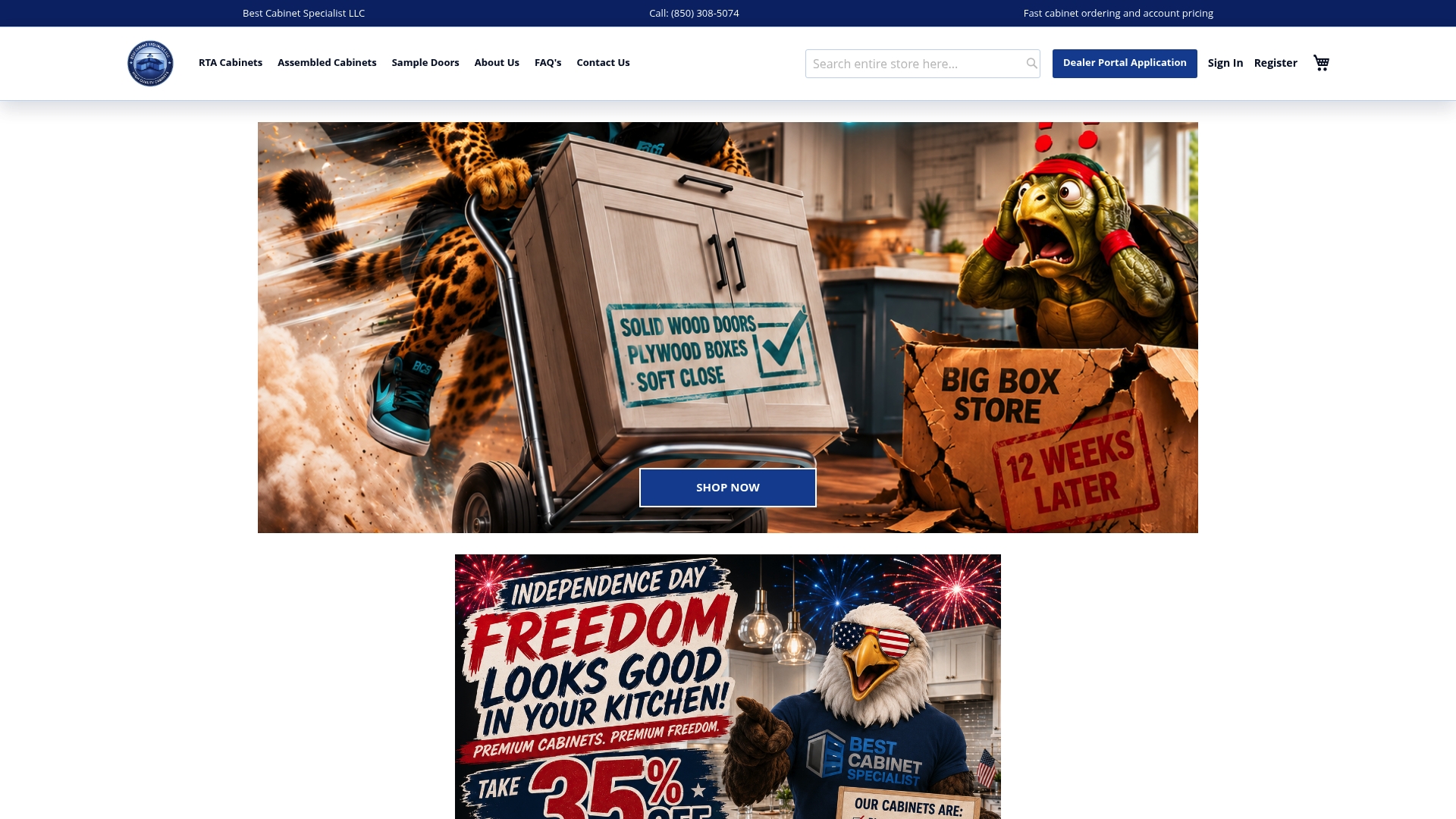
Homeowners can find cabinets with plywood boxes, solid wood doors, and factory finishes that often avoid custom-shop budgets and long lead times. Contractors and builders working multiple units may seek consistent quality across bulk orders rather than risking variable batches. Browse the current cabinet lineup at Best Cabinet Specialist and check what's in stock for your project timeline before your next renovation deadline creeps closer.
Sources
- ROI of Cabinet Durability: Reducing Project Risk With A161.1 | KCMA
- Complete guide to cabinetry: selection, installation and customization