
KCMA-certified cabinets are cabinets tested by the Kitchen Cabinet Manufacturers Association and independent labs against the A161.1 Quality Certification standard, which is developed under ANSI-accredited procedures and covers structural strength, finish resistance, and long-term durability. HUD has specified A161.1-certified cabinetry in dwelling units, and outlets like This Old House point homeowners toward the seal as a shortcut for quality assurance.
The short verdict: if you want fewer surprises after installation, whether you're buying builder-grade, ready-to-assemble, or custom cabinets, choosing KCMA certification is one of the more reliable ways to lower your risk.
- Tests structural durability, not just appearance
- Backed by ANSI-accredited standards development
- Recognized by HUD, and referenced by trade groups like AIA and NKBA
- Available across nearly every price tier, from stock to custom
Key Takeaways
KCMA certification works because it forces cabinets through standardized, third-party lab testing that verifies durability, finish resistance, and structural strength before a single unit reaches a kitchen.
| Point | Details |
|---|---|
| Three distinct seals | A161.1 covers durability, ESP covers sustainability, and Severe Use targets high-wear rentals. |
| Rigorous pass rate | Roughly 40% to 50% of manufacturers fail certification on their first attempt. |
| Tests mirror real use | 25,000 door and drawer cycles and a 600-pound wall load simulate years of daily wear. |
| Certification spans all budgets | RTA, builder-grade, and custom cabinets can all carry KCMA certification. |
| Verify before you buy | Best Cabinet Specialist can confirm certification documentation on request for its plywood-box, solid-wood-door cabinet lines. |
Table of Contents
- What Does KCMA Certification Actually Test?
- What Are the Three KCMA Seals, and Which One Applies to You?
- Why Should Certification Factor Into Your Buying Decision?
- How Do You Verify a Cabinet Is KCMA-Certified?
- Does Certification Cost More, and Is It Available Everywhere?
- How We Think About KCMA Certification When Advising Homeowners
- Getting Certified Options Without the Guesswork
- Where to Learn More About KCMA Certification
- Frequently Asked Questions
- Sources
What Does KCMA Certification Actually Test?
The A161.1 program doesn't rely on a manufacturer's word. Cabinets go through lab-based, third-party testing that pushes boxes, doors, and shelves well past normal daily use.
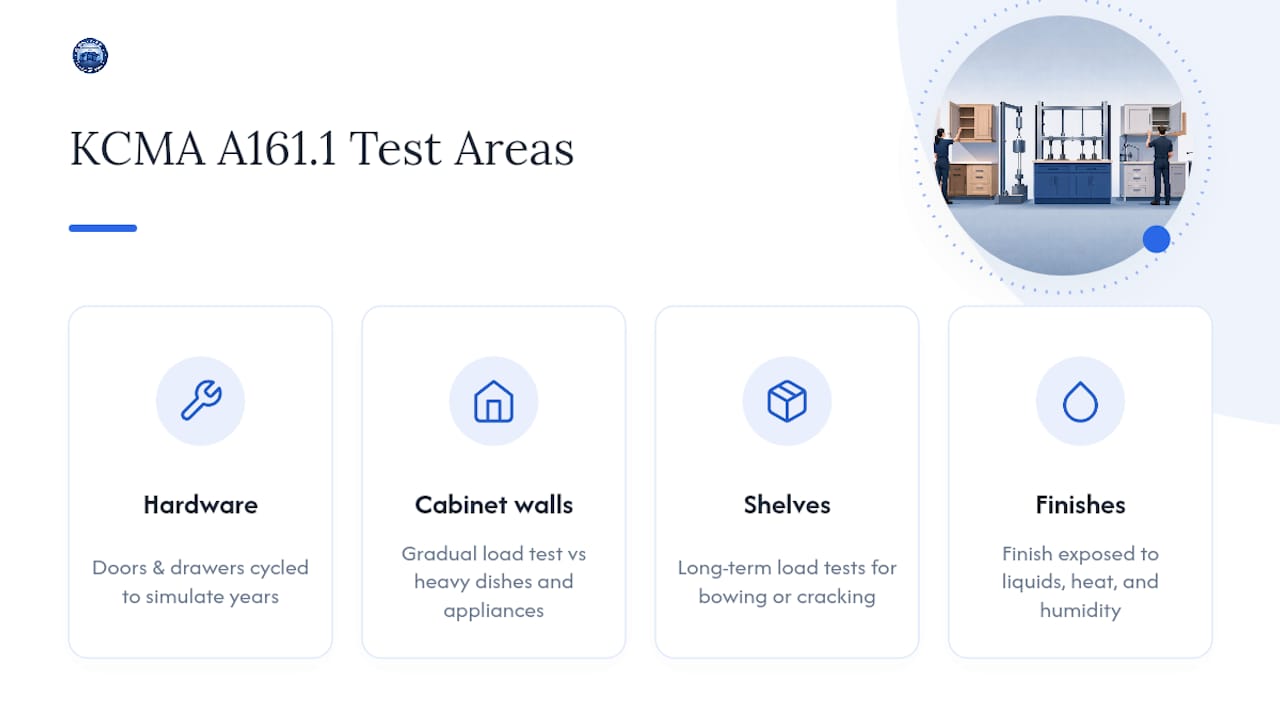
Door and drawer hardware gets cycled many times to simulate years of opening and closing, and cabinet walls are subjected to a gradual load test to confirm the box won't sag or fail under heavy dishes, small appliances, or a stack of cast iron cookware. Shelves undergo long-term load testing too, checking whether they bow or crack after sustained weight rather than just a quick snapshot test. Finish samples are exposed to household liquids, heat, and humidity to see whether coffee spills, steam from a stockpot, or a humid summer kitchen will degrade the surface over time.
Why this matters in practice: a cabinet that passes these tests has already survived, in a lab, roughly what your kitchen will throw at it over a decade or more of daily use. That's the entire point of the standard, developed under ANSI procedures to keep the testing framework fair and technically consistent across different construction styles, including frameless and RTA cabinets.
What Are the Three KCMA Seals, and Which One Applies to You?
Not every KCMA seal measures the same thing, and confusing them can lead you to ask a seller the wrong question. KCMA maintains three distinct certifications, each built for a different priority.
- A161.1 Quality Certification covers structural durability and finish performance. This is the standard most single-family homeowners should look for.
- Environmental Stewardship Program (ESP) certifies sustainable manufacturing practices, from responsible wood sourcing to reduced emissions. It matters most if your renovation has a green-building goal.
- Severe Use Certification, originally developed with HUD, targets extremely high-wear environments like multi-family apartment kitchens where turnover and heavy use are constant.
A homeowner remodeling a primary kitchen typically wants A161.1. A landlord furnishing a rental unit should ask specifically about Severe Use. Someone chasing LEED points or a lower environmental footprint should confirm ESP status before anything else.
Why Should Certification Factor Into Your Buying Decision?
Certification gives you something a showroom display can't: proof. A cabinet stamped with the A161.1 seal has already been tested for the exact failures homeowners complain about most, sagging shelves, loosening hinges, and finishes that dull or stain within a few years.
The bar is genuinely high. Between 40% and 50% of manufacturers fail their first certification attempt, which tells you this isn't a rubber-stamp process. It also means certification carries real accountability: KCMA offers a mediation process if a certified cabinet underperforms, giving you a resolution path beyond just the manufacturer's warranty.
- Structural integrity tested before it ever reaches your kitchen
- Finish durability verified against real household conditions
- An added accountability layer if something goes wrong
Pro Tip: If you're outfitting a rental property, a basement kitchenette, or any space that will see heavy daily use, prioritize certification over style. Finishes and door profiles are easy to swap later; a weak cabinet box is not.
How Do You Verify a Cabinet Is KCMA-Certified?
Don't assume "high-end" or "solid wood" means certified. Confirm it directly using this process:
- Look for the KCMA seal in product photos, spec sheets, or marketing materials.
- Ask the manufacturer or retailer for their KCMA certificate or listing number.
- Check the KCMA website to confirm the manufacturer's current certification status.
- Request test documentation or confirmation of the A161.1 designation specifically.
- Clarify which seal applies, since A161.1, ESP, and Severe Use are not interchangeable.
When you're talking to a seller or installer, keep your questions specific:
- "Do these cabinets carry the KCMA A161.1 Quality Certification?"
- "Which tests were actually performed on this line?"
- "Can you show me the certificate or the KCMA listing?"
Shopping online adds a wrinkle, since certification details aren't always on the main product photo. Check the specifications tab or product description first, and if it's missing, contact support directly. Reputable sellers should be able to confirm certification status within a single email or chat exchange, if you're weighing your options, this buyer's guide to sourcing cabinets covers what else to look for when comparing retailers.
Does Certification Cost More, and Is It Available Everywhere?
Here's the part that surprises a lot of homeowners: KCMA certification tests performance, not materials, price, or style. That means certified cabinets show up across the entire market, from budget builder-grade lines to premium custom work.
Ready-to-assemble cabinets can absolutely carry A161.1 certification, and the same standard applies whether the box is frameless, face-framed, or shipped flat for RTA assembly. Initial testing fees for manufacturers are relatively modest, which is part of why certified options exist at nearly every price point rather than being locked to luxury brands.
- Certification is independent of cabinet style or door material
- RTA and assembled cabinets can both be certified
- Ask about certification status at the quoting stage, not after delivery
Timing matters. Request certification documentation when you get your quote, not after cabinets arrive on a truck. It's far easier to swap a product line during ordering than to renegotiate after installation has started.
One-Page Buying Checklist for KCMA-Certified Cabinets
- Confirm the seal (A161.1, ESP, or Severe Use) matches your project.
- Request the manufacturer's KCMA certificate before ordering.
- Ask about finish testing if your kitchen sees heavy moisture or sunlight.
- Confirm the warranty and mediation process in writing.
- Schedule delivery and installation with care instructions for certified finishes.
If in doubt, request the KCMA listing before you send final payment, not after.
How We Think About KCMA Certification When Advising Homeowners
We treat KCMA certification as a practical filter, especially for multi-family projects, rental units, and heavy-use kitchens where durability outweighs everything else. For a lightly used guest kitchen on a tight timeline, style and lead time sometimes take priority. Certification isn't a universal rule, it's one strong signal among several.
Getting Certified Options Without the Guesswork
Best Cabinet Specialist builds cabinets with plywood boxes and solid wood doors, and we know certification questions come up constantly during renovation planning. As a women-owned and veteran-owned supplier, we focus on getting project-ready cabinets to your door fast, without the long lead times common elsewhere in the industry.
We're a supplier, not the certifying body, so if you need documentation on a specific product line, ask us directly and we'll point you to the manufacturer's KCMA listing or certificate. Whether you're outfitting a single kitchen or sourcing in bulk for a multi-unit project, our product catalog is built for fast turnaround. Browse current options or reach out to request certification details before you place an order.
Where to Learn More About KCMA Certification
- The KCMA certifications page lists all three seals and current program details.
- The A161.1-2022 standard document covers the full technical scope for readers who want test specifics.
- For finish care after installation, this maintenance guide for sprayed kitchen finishes is a useful follow-up resource.
- For purchasing questions, contact Best Cabinet Specialist directly.
Frequently Asked Questions
What does KCMA certified mean on a cabinet listing? It means the cabinet line passed third-party lab testing under the A161.1 Quality Certification standard, covering structural strength, hardware durability, and finish resistance.
Is KCMA certification required by law? No. It's a voluntary industry standard, though HUD has specified A161.1-certified cabinetry in dwelling units, and many builders and specifiers treat it as a baseline expectation.
Are RTA cabinets ever KCMA certified? Yes. Certification tests performance, not assembly method, so ready-to-assemble cabinets can carry the same A161.1 seal as fully assembled or custom units.
How do I know which KCMA seal my cabinets need? A161.1 fits most primary residences, Severe Use fits rental or multi-family properties, and ESP fits projects prioritizing sustainable manufacturing.
What happens if a certified cabinet fails after installation? KCMA offers a mediation process to help resolve disputes between homeowners and manufacturers, adding a layer of accountability beyond the standard warranty.
Sources
- Certifications | KCMA
- PERFORMANCE AND CONSTRUCTION STANDARD FOR KITCHEN AND VANITY CABINETS KCMA A161.1-2022