Factory-applied catalyzed conversion varnish and 2K polyurethane are the most durable cabinet finishes available for kitchen use. Pre-catalyzed lacquer and high-quality cabinet enamels follow closely, offering strong performance at lower cost. For a busy primary kitchen, factory-catalyzed systems are worth the premium. For lower-traffic areas or budget-conscious refinish projects, a professionally applied waterborne cabinet enamel delivers solid results.
Here is a quick summary of where each finish type lands:
- Factory-applied catalyzed conversion varnish / 2K polyurethane: Highest hardness, chemical resistance, and lifespan. Best for primary kitchens.
- Pre-catalyzed lacquer: Balanced toughness and sheen variety. Common in mid-range factory-finished cabinetry.
- Waterborne alkyd / cabinet enamels (e.g., Benjamin Moore Insl-X Cabinet Coat): Good durability for professionally applied field finishes. Practical for refinishing projects.
- Traditional oil-based alkyd / polyurethane topcoats: Decent hardness but slower cure and yellowing risk over time.
- Thermofoil / laminate: Strong moisture and stain resistance; vulnerable at edges if bonding fails.
When durability is the priority, prefer manufacturers who test to ANSI/KCMA A161.1. That standard is the clearest third-party signal that a finish has been verified against real kitchen conditions, not just marketing claims.
Key Takeaways
Factory-applied catalyzed finishes verified against ANSI/KCMA A161.1 deliver the longest cabinet finish lifespan in a working kitchen, and edge sealing quality is the most common failure point regardless of topcoat type.
| Point | Details |
|---|---|
| Top finish for durability | Factory-applied catalyzed conversion varnish or 2K polyurethane lasts 15–25 years in primary kitchens. |
| Verification step | Ask suppliers for ANSI/KCMA A161.1 certification and the product Technical Data Sheet before purchasing. |
| Edge sealing matters most | Moisture enters at edges first; inspect and confirm watertight edge bonding on any cabinet you buy. |
| Coat count and cure time | For waterborne enamels, two or more coats with full cure (up to 30 days) are required for optimal durability. |
| Best Cabinet Specialist | Offers plywood-box cabinets with solid wood doors and durable finish options; request finish details and a quote at cabinet-specialist.com. |
Table of Contents
- How does cabinet finish durability compare across finish types?
- What actually makes a cabinet finish durable?
- Which finish type is right for your kitchen?
- How long do cabinet finishes actually last?
- How to clean and maintain cabinet finishes
- How do you choose the right finish for your project?
- Why ANSI/KCMA A161.1 is the standard worth asking about
- What I'd tell you if durability is your main goal
- Durable cabinets, built and finished to last
- Sources
How does cabinet finish durability compare across finish types?
The table below covers the major finish categories across the dimensions that matter most in a working kitchen.
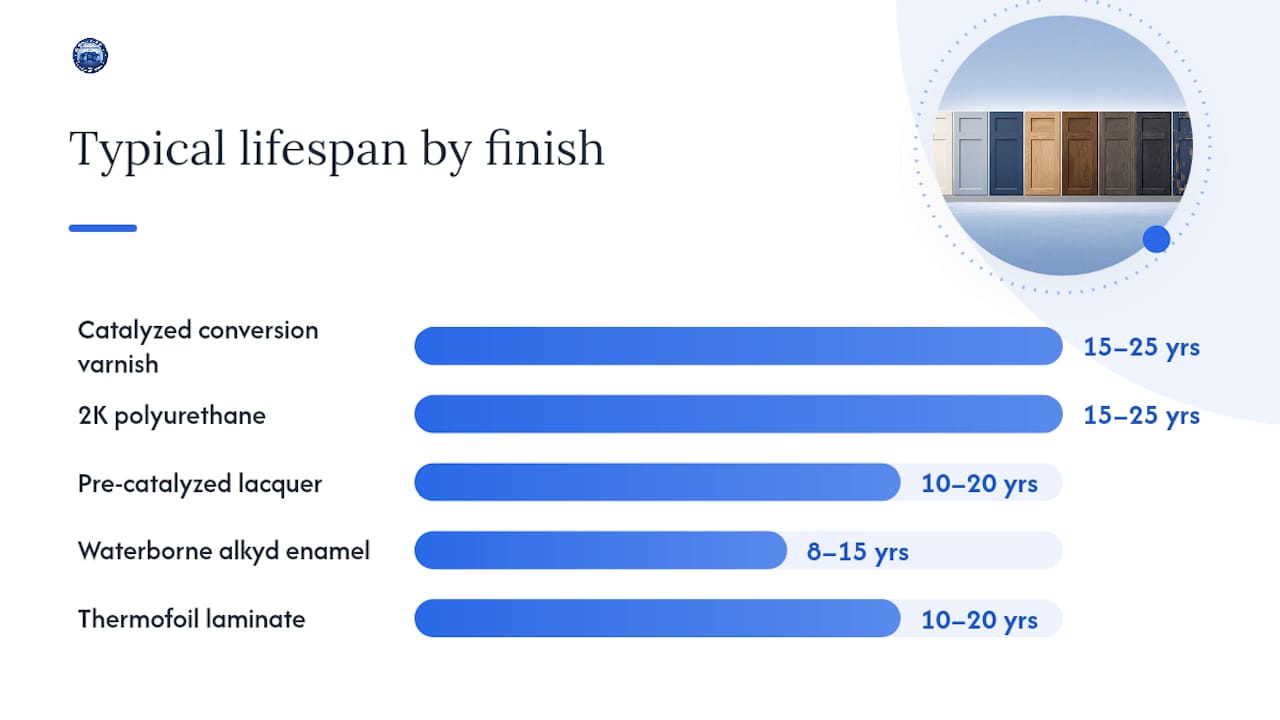
| Finish Type | Scratch Resistance | Chemical/Stain Resistance | Moisture/Steam Resistance | Heat Resistance | Repairability | Typical Lifespan | Cost/Complexity | Appearance/Sheens |
|---|---|---|---|---|---|---|---|---|
| Catalyzed conversion varnish | High | High | High | High | Low (pro respray) | 15–25 years | High / factory spray | Matte to high gloss |
| 2K polyurethane | High | High | High | High | Low (pro respray) | 15–25 years | High / factory or pro shop | Matte to gloss |
| Pre-catalyzed lacquer | Medium-High | Medium-High | Medium | Medium | Medium (shop respray) | 10–20 years | Medium / factory or shop spray | Matte to gloss |
| Waterborne alkyd / cabinet enamel | Medium | Medium | Medium | Medium | Medium (brush/roll touch-up possible) | 8–15 years | Low-Medium / field or shop | Satin to semi-gloss |
| Oil-based alkyd / polyurethane | Medium | Medium | Medium-Low | Medium | Medium | 8–15 years | Low-Medium / field | Satin to gloss |
| Thermofoil / laminate | Medium-High | High | High | Low (heat causes lifting) | Low (panel replacement) | 10–20 years | Low-Medium / factory | Limited, flat or textured |
A few patterns stand out. Catalyzed systems hold the top positions across nearly every durability column, but they require factory or professional shop conditions to apply correctly. Thermofoil scores well on moisture and stain resistance yet fails badly under heat, which makes it a poor choice near cooktops. Waterborne enamels have closed the gap with oil-based products significantly, and Benjamin Moore's Insl-X Cabinet Coat is a well-regarded example of how far that category has come.
What actually makes a cabinet finish durable?
Durability is not a single property. It is the sum of several measurable characteristics, and a finish can score well on one while failing on another.
Hardness and mar resistance determine how well a surface holds up against daily contact: keys on the counter, rings dragged across a door, the edge of a pan. Catalyzed systems cure into a much harder film than single-component paints because the crosslinking reaction creates a dense polymer network.
Adhesion is what keeps the coating bonded to the substrate. Even the hardest topcoat fails quickly if adhesion is poor, particularly at edges and corners where mechanical stress concentrates. Substrate preparation, including sanding, cleaning, and priming, controls adhesion more than the topcoat formula alone.
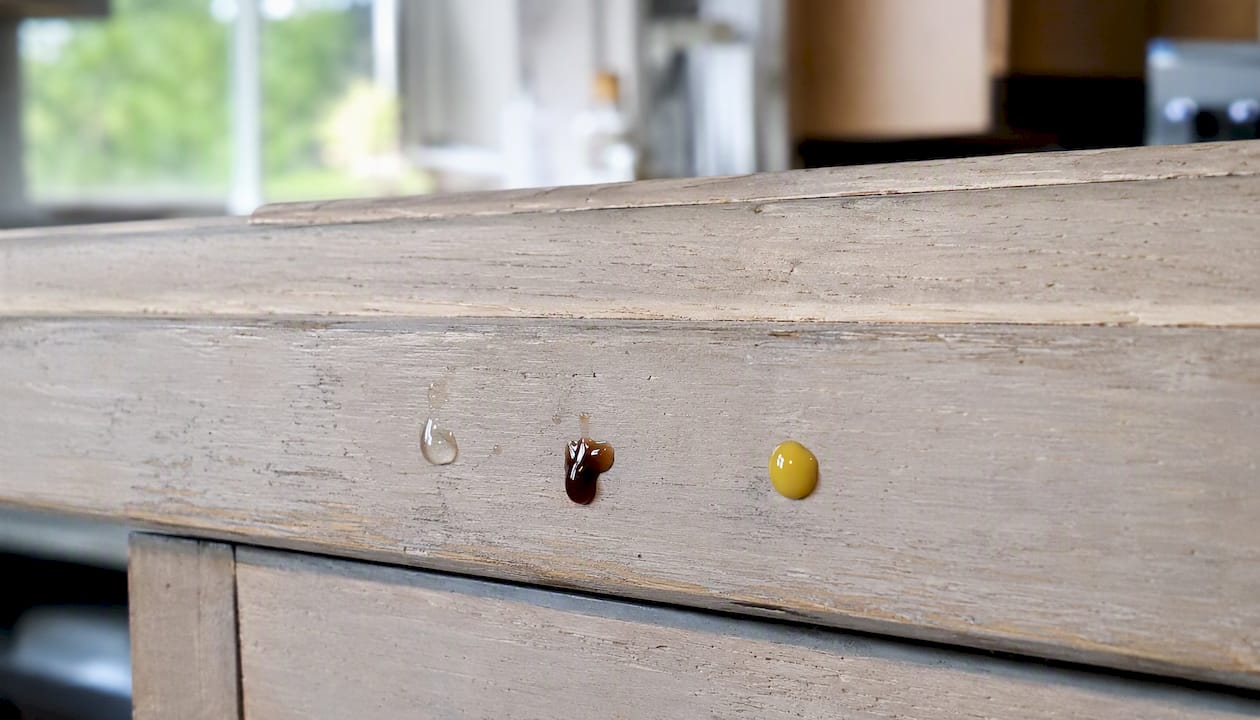
Chemical and food resistance matters in kitchens more than in any other room. Cooking oils, acidic foods, cleaning sprays, and grease all attack finishes over time. The KCMA A161.1 standard tests finish resistance to a defined list of kitchen chemicals, including vinegar, mustard, coffee, and common household cleaners, with 24-hour exposure periods and strict pass/fail criteria for discoloration and blistering.
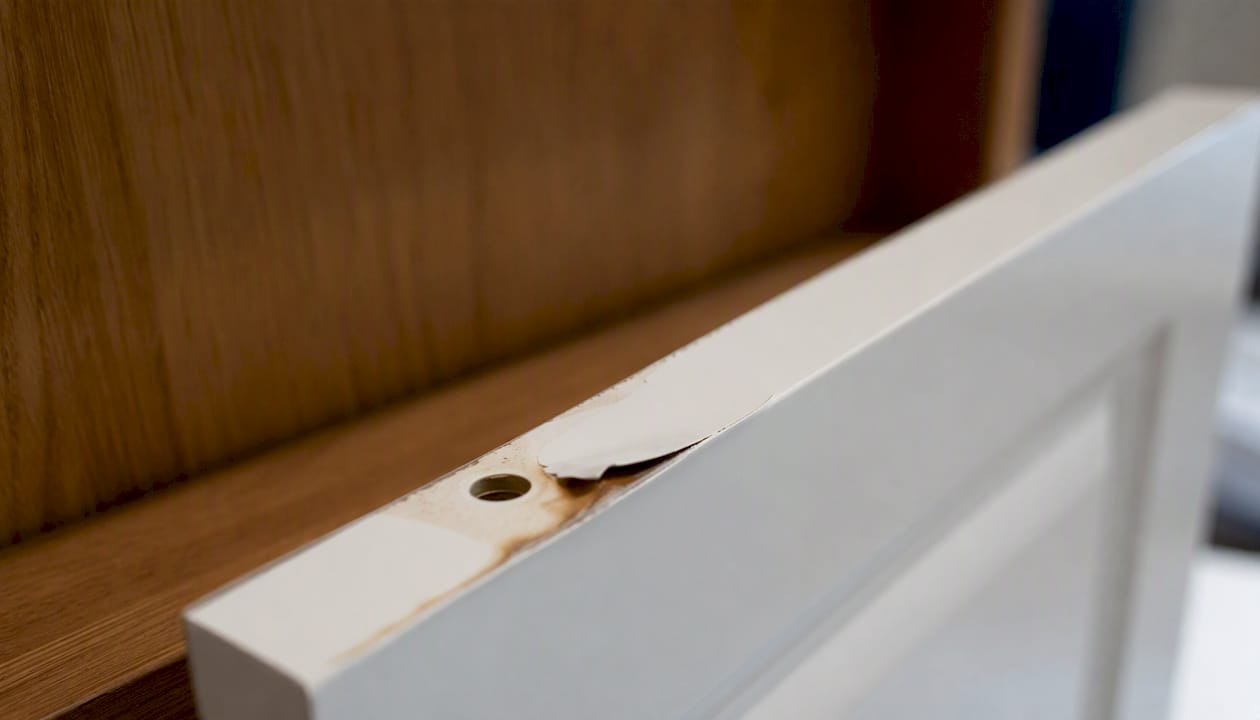
Moisture and steam resistance is critical around sinks, dishwashers, and cooktops. Moisture that penetrates a finish migrates to the substrate, causing swelling, bubbling, and delamination. Edge sealing is where this most often fails: KCMA research consistently identifies poor edge bonding and seam integrity as the most common durability failure point, even when face coatings are strong.
Cure method is the single biggest differentiator between finish categories. Single-component paints dry by solvent evaporation or oxidation. Catalyzed systems cure by a chemical crosslinking reaction that produces a fundamentally harder, denser film. That chemistry is why factory-catalyzed finishes outperform field-applied brush-and-roll work on every durability metric.
KCMA A161.1 subjects cabinets to 14 tests, including a hotbox at approximately 120°F and 70% relative humidity, five hot/cold cycles, 24-hour chemical exposure, and 25,000 door and drawer operation cycles. Passing all 14 is the clearest available signal that a finish is ready for real kitchen conditions.
Pro Tip: Ask any cabinet supplier whether their product has passed ANSI/KCMA A161.1. A supplier who cannot answer that question has likely not tested to it.
Which finish type is right for your kitchen?
Catalyzed conversion varnish
Conversion varnish is the benchmark finish in professional cabinet shops. It cures through an acid-catalyzed crosslinking reaction, producing a film that is harder and more chemically resistant than any single-component coating. The tradeoff is that it requires a spray booth, proper ventilation, and precise mixing. Technical data sheets for catalyzed systems are explicit about pot life: once the catalyst is mixed, the working window is limited, and product applied after that window produces a softer, less durable film. This is not a DIY finish. It belongs in a factory or professional shop environment.
2K polyurethane
Two-component polyurethane works on the same principle as conversion varnish: a hardener is mixed into the base, triggering a crosslinking cure. The result is exceptional hardness and chemical resistance. Pot life management is equally critical here. Misuse of pot life or incorrect catalyst ratios reduces crosslink density, which directly lowers hardness and mar resistance. Both 2K polyurethane and conversion varnish are the finishes trade finishers consistently recommend when a client's primary concern is long-term durability.
Pre-catalyzed lacquer
Pre-catalyzed lacquer comes with the catalyst already blended into the product, which simplifies application while still delivering better hardness than standard single-component coatings. It is the most common finish in mid-range factory-finished cabinetry. Sheen options range from flat to high gloss. Repairability is better than 2K systems because a skilled shop can respray individual doors without the full crosslinking complexity, though matching sheen and color still requires professional equipment.
Waterborne alkyd and cabinet enamels
This category has improved substantially over the past decade. Products like Benjamin Moore Insl-X Cabinet Coat are formulated specifically for cabinetry, resisting chipping, scuffing, food stains, grease, and water. BEHR's cabinet enamel dries to touch in about an hour and recommends two coats for optimal durability, which illustrates a key principle: coat count and full cure time matter as much as product selection. Magnolia Home by Joanna Gaines Cabinet Paint is another mid-tier waterborne option that combines low-VOC formulation with hard-finish claims and fast recoat windows.
Applied professionally with proper prep and multiple thin coats, these enamels can last a long time. Finishing professionals consistently note that three or more coats with proper sanding between applications, combined with a stable substrate like sealed MDF or plywood, is what pushes painted cabinets toward the upper end of that range.
Oil-based alkyds and polyurethane topcoats
Traditional oil-based products still have a place in lower-traffic areas and on furniture-grade pieces where a slow cure and self-leveling finish is an advantage. In a primary kitchen, their weaknesses show up over time: slower cure means longer exposure to damage during installation, and many oil-based alkyds yellow noticeably on white or light-colored cabinets. They remain a reasonable choice for secondary kitchens, laundry rooms, or bathroom vanities where traffic is lighter.
Thermofoil and laminate
Thermofoil is a vinyl film heat-pressed onto an MDF substrate. It offers strong resistance to moisture and food stains across the face, and it is one of the more affordable factory-applied options. The failure mode is specific: heat causes the vinyl to lift at edges and around hardware cutouts, and once delamination starts, it cannot be repaired without replacing the door. Keep thermofoil away from cooktops and high-heat appliances. For islands, pantry cabinets, and lower-heat zones, it is a practical and durable choice. The substrate matters here: thermofoil over quality MDF with tight edge bonding outperforms thermofoil over lower-density particleboard.
How long do cabinet finishes actually last?
Realistic lifespan ranges for U.S. kitchens under normal residential use:
- Factory catalyzed conversion varnish / 2K polyurethane: 15–25 years with proper care. Cabinets certified to ANSI/KCMA A161.1 frequently reach the upper end of this range.
- Pre-catalyzed lacquer: 10–20 years. Factory-applied systems with sealed edges perform significantly better than shop-applied systems with inconsistent edge coverage.
- Professionally applied waterborne cabinet enamel: 8–15 years. Prep quality and coat count are the primary variables.
- Standard field-painted cabinets (brush/roll, single-component paint): 4–8 years in a primary kitchen before visible wear, chipping, or staining requires attention.
- Thermofoil / laminate: 10–20 years in low-heat zones; potentially 5–10 years near cooktops or dishwashers where heat and steam accelerate edge failure.
The variables that move any finish toward the shorter end of its range: high-humidity kitchens without adequate ventilation, direct sunlight on cabinet faces (UV degrades most clear coatings over time), aggressive cleaning products, poor edge sealing at the factory or shop, and inadequate substrate preparation before finishing. A great finish over a poorly prepped or unstable substrate will underperform every time.
Factory-certified cabinets, particularly those tested to ANSI/KCMA A161.1, tend to land at the upper end of lifespan ranges because the standard forces manufacturers to address edge sealing, substrate stability, and finish chemistry together, not just the topcoat in isolation.
How to clean and maintain cabinet finishes
Daily habits have a bigger impact on cabinet finish lifespan than most homeowners expect.
Cleaning do's and don'ts:
- Use a soft cloth or microfiber towel with mild dish soap and warm water for routine cleaning. This works safely across all finish types.
- Wipe spills immediately, especially acidic foods like tomato sauce, vinegar, and citrus juice. Prolonged contact degrades most finishes, including catalyzed systems.
- Avoid abrasive sponges, steel wool, or scrubbing pads on any painted or lacquered surface. They scratch even hard catalyzed films.
- Never use bleach-based cleaners, ammonia, or solvent-based degreasers on painted or lacquered cabinets. These strip finish and cause discoloration.
- For thermofoil, avoid steam cleaners and excessive heat near the surface.
Routine maintenance checklist:
- Inspect door and drawer edges every six months for signs of lifting, bubbling, or moisture infiltration.
- Check caulk lines where cabinets meet walls, countertops, and backsplashes annually. Replace failing caulk before moisture reaches the substrate.
- Add felt pads to the inside of doors and drawer fronts if hardware contact is causing wear marks.
- In kitchens with high humidity, run exhaust fans consistently during cooking and consider a dehumidifier in summer months.
- For waterborne enamel cabinets, allow full cure (typically 30 days after application) before heavy cleaning or placing objects against doors.
Repair guidance:
- Small chips on waterborne enamel cabinets can often be touched up with a fine artist's brush and the original paint, if you kept it. Sand lightly, apply thin coats, and allow full cure between applications.
- Catalyzed and 2K systems do not touch up well with brush application because the chemistry of a new single-component coating will not bond or match the original crosslinked film. These require professional respray.
- Scratches on stained wood cabinets can often be addressed with a matching stain marker or touch-up pen before applying a compatible clear topcoat.
Pro Tip: Before attempting any DIY touch-up, test your repair product on the inside face of a door or the back of a drawer front. Incompatible products can cause lifting, cloudiness, or color mismatch that is worse than the original damage.
How do you choose the right finish for your project?
The right finish depends on four practical factors: how hard the kitchen works, your budget, whether you are buying new cabinets or refinishing existing ones, and how much maintenance you are willing to do.
Start with these questions:
- Is this a primary kitchen used daily, or a secondary kitchen, laundry room, or bathroom vanity?
- Are you buying new factory-finished cabinets, or refinishing existing ones in the field?
- What is your budget for the finish itself, and are you willing to pay a premium for factory catalyzed work?
- What sheen do you want, and how visible will wear be on that sheen over time?
- How much maintenance are you prepared to do, and how quickly do you need to address repairs?
Questions to ask suppliers and manufacturers:
- Does your finish meet ANSI/KCMA A161.1? Can you provide test documentation?
- Is this finish factory-applied or field-applied? What spray and cure conditions are used?
- What is the Technical Data Sheet (TDS) for this finish? What are the recommended coat count, dry times, and cure schedule?
- For 2K systems: what is the pot life, and what happens to hardness if product is applied after pot life expires?
- What does the warranty cover, and what voids it?
Red flags to watch for:
- Vague warranty language with no specific exclusions or coverage periods.
- No TDS available, or a supplier who cannot name the finish product used.
- "Painted in place" claims without documented shop conditions, spray equipment, or cure data.
- Inconsistent edge sealing visible on sample doors, or edges that feel rough or unsealed to the touch.
- Marketing language like "chip resistant" or "ultra-durable" with no third-party test standard cited.
When you are evaluating RTA cabinet options, the same questions apply. Factory finishing quality varies significantly across RTA suppliers, and the finish is often where cost-cutting shows up first.
Why ANSI/KCMA A161.1 is the standard worth asking about
ANSI/KCMA A161.1 is the most practical durability benchmark available for residential cabinetry in the United States. It is not a marketing claim. It is a third-party tested standard administered by the Kitchen Cabinet Manufacturers Association, and it requires cabinets to pass a 14-test battery before certification is granted.
The tests are designed to simulate real kitchen conditions. Chemical resistance tests expose finish surfaces to vinegar, mustard, coffee, olive oil, and common household cleaners for 24 hours, then evaluate for discoloration, blistering, and checking. The cycle test runs 25,000 door and drawer operations to simulate years of daily use. Edge delamination after moisture exposure is also evaluated, which is why KCMA certification addresses the full cabinet system, not just the topcoat.
What to look for in a Technical Data Sheet:
- Dry-to-touch and recoat times (critical for field-applied finishes)
- Recommended number of coats and film thickness per coat
- Full cure schedule (when the finish reaches maximum hardness)
- Pot life for 2K and catalyzed systems
- Recommended cleaning products and what to avoid
- Compatibility with primers and substrates
How to verify finish claims:
- Request KCMA A161.1 certification documentation or test reports directly from the manufacturer or supplier.
- Ask for the product TDS by name. A legitimate finish product always has one.
- For factory-finished cabinets, ask whether finishing is done in a controlled spray environment with documented cure conditions.
- For field-applied finishes, confirm the applicator is using the product within its specified pot life and coat count.
The NKBA and NAHB both provide specification guidance that aligns with these standards, and their resources can help you understand what professional specifiers expect from cabinet finishes.
Pro Tip: "Tested to ANSI/KCMA A161.1" and "meets KCMA standards" are not the same statement. Ask for the actual certification or test report, not just the marketing claim.
What I'd tell you if durability is your main goal
The conventional advice in most cabinet guides is to focus on finish type: get conversion varnish, avoid latex paint, and you will be fine. That framing misses the more important variable. Preparation and substrate integrity consistently matter more than marginal differences between high-quality topcoats. A catalyzed conversion varnish applied over poorly prepped, unsealed edges will fail faster than a well-applied waterborne enamel over a properly sealed, stable plywood substrate.
The second thing most guides understate is the edge problem. Face coatings get all the attention, but moisture almost always enters at seams, edges, and hardware cutouts first. That is where finish failure starts, and it is the reason KCMA's standard explicitly tests edge delamination after moisture exposure. When you are evaluating cabinet samples, run your finger along the door edges. If they feel rough, uncoated, or inconsistently sealed, that is a more reliable warning sign than any marketing claim about the topcoat.
The third point worth making: factory finishing is not just about the product used. It is about the controlled environment, the spray equipment, the cure conditions, and the quality control that field application cannot replicate. When a supplier tells you their cabinets are "professionally painted," ask where and under what conditions. A spray booth with documented cure times is a different thing entirely from a brush-and-roll application in an installation environment. The substrate choice matters here too: plywood boxes with solid wood doors give a finish a stable, dimensionally consistent surface to bond to, which is why Best Cabinet Specialist builds around that combination.
Durable cabinets, built and finished to last
Best Cabinet Specialist offers plywood-box cabinets with solid wood doors, built for homeowners and contractors who want lasting quality without the long lead times. The cabinets ship fast, and finish options are available across modern, traditional, and transitional styles. For primary kitchens where durability is the priority, the combination of plywood construction, solid wood doors, and factory-applied durable finishes gives you a cabinet system built to hold up under daily use.
If you want to know which finish options are available for a specific door style, or whether KCMA-certified options or Technical Data Sheets are available for a product you are considering, the team at Best Cabinet Specialist can help. Bring your kitchen footprint, your preferred door style, and your finish performance requirements, and get a quote that matches your project.
Browse cabinets and request a quote to find the right finish and construction for your kitchen.