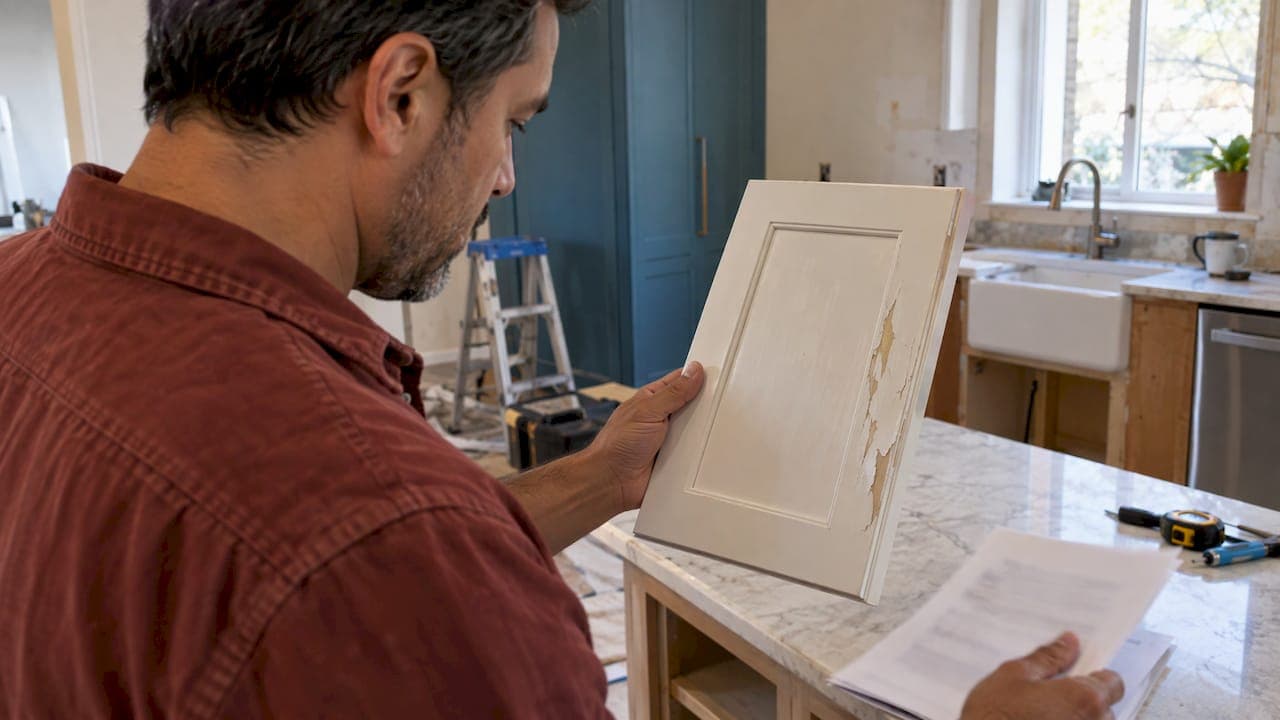
A cabinet warranty is a written promise from the maker or seller to fix or replace cabinets that fail because of a defect. It is not insurance against damage, and it is not the same thing as your installer's guarantee. The terms that matter most are who is covered, what is covered, what the company will do about a defect, how long it lasts and how you make a claim. Read those five points before you buy, and you will know most of what a warranty is worth.
Below, we walk through each part in plain language, for homeowners, contractors, builders and property managers.
TL;DR
- A cabinet warranty covers defects in materials and workmanship under normal use. It does not cover water damage, misuse, normal wear or fading.
- Federal rules require a written warranty on a consumer product costing more than $15 to state who is covered, what is covered, the remedy, the duration and the claim procedure.
- The cabinet maker's warranty and the installer's workmanship warranty are separate documents with separate claim routes.
- "Lifetime" is defined by the document, usually as the life of the product for the original owner, with exclusions attached.
- Keep your invoice, photos and delivery paperwork. Inspect on delivery and report problems quickly.
Table of Contents
- What a cabinet warranty actually is
- Manufacturer warranty vs. installation warranty
- What cabinet warranties usually cover
- What cabinet warranties usually exclude
- What "lifetime" means on cabinets
- How to compare warranties between quotes
- How to file a cabinet warranty claim
- How to protect your coverage
- Our perspective
- Cabinets built for the long run
- FAQ
- Sources
What a cabinet warranty actually is
A warranty is the seller's or manufacturer's written statement of what they will do if the product turns out defective. For cabinets, that usually means a flaw in the materials or in how the cabinet was built: a split panel, a failed joint, a door that delaminates, a finish that peels from the surface under ordinary use.
Federal law shapes how these documents are written. Under 16 CFR 701.3, a written warranty on a consumer product costing more than $15 has to disclose:
- who the warranty is extended to
- which products or parts are covered or excluded
- what the warrantor will do if there is a defect
- how long the warranty lasts
- the procedure for getting warranty service
That list is a useful checklist. If a cabinet warranty leaves one of those items unclear, you should be able to find it stated plainly in the document before you place an order.
The FTC also explains that a company offering a written warranty on a consumer product cannot disclaim implied warranties on that product. Implied warranties are the baseline expectation that a product is fit for its ordinary purpose. State law fills in details, so the specifics can differ depending on where you live.
Manufacturer warranty vs. installation warranty
This is where homeowners most often get confused. On a kitchen project you can end up with two separate warranties:
| Manufacturer (product) warranty | Installer (workmanship) warranty | |
|---|---|---|
| Who gives it | The cabinet maker or seller | The contractor or installer |
| What it covers | The cabinets: boxes, doors, finish, hardware | How the cabinets were set, leveled, fastened and adjusted |
| Typical remedy | Repair or replace the defective part | Re-do or correct the installation work |
| Who you call | The company you bought cabinets from | The crew that installed them |
One remodeling contractor's guide makes the same point: product and installation warranties are separate, each with its own document, responsible party, duration and claim route. It also notes that a product warranty often covers the part but not the labor to remove and reinstall it.
In practice, that means a replacement door may arrive at no charge, while the cost of taking down and rehanging it is a separate question. Check the remedy wording for the word "labor." If you are a contractor, settle this with your client before the job starts, so nobody is surprised later.

A good rule: if a cabinet is crooked or a door is out of alignment right after install, start with the installer. If a panel splits or a finish fails on a correctly installed cabinet, start with the cabinet warranty.
What cabinet warranties usually cover
Most cabinet warranties are limited warranties for normal residential use. The core coverage is defects in materials and workmanship in the cabinet itself. That typically includes:
- The box. Panels, joints, shelves and structural assembly that fail under intended use.
- Doors and drawer fronts. Warping, cracking at the joints, or delamination that is not caused by moisture exposure or abuse.
- The finish. Peeling or blistering that traces to the factory finish rather than to cleaning products or heat.
- Hardware. Hinges, drawer slides and soft-close mechanisms, often with their own time limit, sometimes shorter than the cabinet itself.
Construction matters here because the warranty only protects what is built in. Plywood boxes with solid wood doors are the kind of build we sell, and a sturdy box is the thing most likely to keep a claim from ever being needed. If you want to see how the industry tests this, read our guide to kitchen cabinet durability.
Certification is not a warranty, but it helps
The Kitchen Cabinet Manufacturers Association runs a certification program under its ANSI-accredited A161.1 standard. KCMA describes the program as laboratory testing across over a dozen tests in five categories, covering cabinet structure, door and drawer operation, and finish. A certified cabinet has passed those tests, which says something about how it should perform. It does not replace a written warranty, so you still want both. Our explainer on KCMA certified cabinets covers what the seal means for buyers.
What cabinet warranties usually exclude
Exclusions decide whether a warranty is useful, so read them as closely as the coverage. These show up in nearly every cabinet warranty:
- Water and moisture damage. Leaks under a sink, a dishwasher that overflows, steam from a nearby appliance, standing water on a floor. Moisture is the most common reason cabinets fail, and the most common reason claims are declined. See our guide to which cabinet materials resist water for how to choose well for wet areas.
- Normal wear and tear. Scuffs, small scratches, worn edges around handles, gradual dulling of a finish.
- Natural variation in wood. Differences in grain, color and tone between pieces, and gradual color change with light exposure. Solid wood is a natural material, so some variation is expected.
- Misuse and abuse. Overloading shelves, hanging heavy items off doors, climbing on cabinets, harsh chemical cleaners.
- Improper installation. Damage from poor leveling, wrong fasteners or modifications. This usually falls under the installer's warranty instead.
- Commercial or rental use. Some warranties shorten the term or change the terms for commercial use. One commercial cabinet warranty found in search results sets a twelve-month term, while residential terms are typically longer. If you are a property manager or builder, check which category your project falls under.
- Labor and shipping. Costs to remove, reinstall or ship replacements may not be included.
- Transfer to a new owner. Many warranties cover only the original purchaser.
None of this is a reason to worry. It is a map of what you need to do: keep cabinets dry, clean them with mild products, install them properly and handle them as intended.
What "lifetime" means on cabinets
A lifetime warranty sounds like a promise that lasts forever. In practice, the document defines it, and the definition usually reads as the life of the product for the original purchaser, applied to the defect coverage described above, with the same exclusions.
So a lifetime warranty does not mean:
- the cabinets will be replaced when they wear out
- water damage is covered
- the finish will look new in twenty years
- the next owner of the house is covered
- labor and shipping are free
When you see "lifetime," look for three details: what part is covered (box only, or doors and finish too), who it applies to (original owner only, or transferable), and what the remedy is (repair, replace or refund). Separate limited terms for finish and hardware are common, so a lifetime box with a shorter finish term is not unusual.
Federal rules also let the label "full" be used only on warranties that meet certain standards, while others must be labeled "limited." Because of that, read the heading of the document along with the headline term in the marketing.
How to compare warranties between quotes
If you are comparing cabinet quotes, put the warranties side by side and use the same criteria for each. This works for homeowners and for contractors specifying cabinets on behalf of a client.
| Question | Why it matters |
|---|---|
| Who is covered? | Original purchaser only, or transferable to a new owner |
| What parts are covered? | Box, doors, finish, hardware, accessories |
| What is the remedy? | Repair, replace or refund; whether labor and shipping are included |
| How long does it last? | Separate terms for structure, finish and hardware |
| How do you claim? | Contact method, deadline, photos required |
| What is excluded? | Water, wear, natural variation, commercial use |
| Who handles installation issues? | The installer's own workmanship warranty, in writing |
The first five rows follow the same structure federal rules require a written warranty to disclose, so any complete document should answer them. If a quote answers them with a vague phrase, ask for the full warranty text in writing before you order.
Builders and contractors can go a step further and put warranty expectations in the project specification. Our guide to cabinet specifications for builders shows what to put in writing, and the NKBA-based ordering checklist helps avoid mistakes that cause claims later.
How to file a cabinet warranty claim
A claim goes more smoothly when you have the paperwork ready. Here is the sequence we recommend.
- Inspect on delivery. Open boxes, check every door, panel and drawer against your order, and photograph any damage before you assemble or install. Shipping damage and defects found at delivery are usually handled by a faster route than later claims.
- Keep your records. Save the invoice or order confirmation, the product details (series, finish, size) and the date of delivery. If your cabinets were installed, keep the installer's contract too.
- Document the problem. Take clear, dated photos from a few angles, including a wide shot that shows the cabinet in the room and a close-up of the defect. Write down when you noticed it.
- Stop using or modifying the part. Do not sand, refinish or repair the defect yourself before the company has seen it, since that can void coverage.
- Follow the stated claim procedure. The warranty should name how to submit a claim and any time limit. Use that route and keep a copy of what you send.
- Ask about the remedy and the labor. Confirm in writing whether the fix is a replacement part, a repair or a refund, and who covers removal and reinstallation.
- Separate installation issues. If the problem is alignment, leveling or fastening, contact your installer under their workmanship warranty.
The single biggest thing you can do is act early. Small problems found within days of delivery are easier to resolve than ones reported a year later without photos.
How to protect your coverage
Most declined claims trace back to avoidable causes. A few habits keep your warranty in force:
- Wipe up spills, especially around the sink, dishwasher and range, right away.
- Use mild soap and a soft cloth. Skip abrasive pads and harsh solvents.
- Install cabinets on level, dry walls and floors, and seal around plumbing penetrations.
- Do not exceed reasonable shelf loads.
- Run the exhaust fan when cooking or showering so humidity does not build up.
- Pick finishes suited to the room. Our guide on evaluating cabinet finish durability shows what to look for.
For a bigger picture of the budget, including what a full replacement costs, see our breakdown of the cost to replace kitchen cabinets. And before you order, run through the common kitchen cabinet mistakes, since a wrong measurement or missing filler is a problem a warranty will not fix. For a deeper look at the terms themselves, read our guide to cabinet warranty terms.
Our perspective
We built Best Cabinet Specialist around a simple idea: a cabinet should be well made enough that you rarely think about the warranty at all. That is why we focus on plywood boxes, solid wood doors and soft-close hardware, the parts of a kitchen or bathroom that take daily use.
When we talk with homeowners, contractors and property managers, the same worry comes up: long lead times and surprise costs. A warranty is part of the same conversation. Buyers want to know what is covered, who to call and how fast a problem gets handled. We think those answers should be easy to find and written in plain words.
Our advice is to treat a warranty as one piece of a good purchase, alongside construction, finish and fast shipping. Choose cabinets built for the room they go in, inspect them when they arrive and keep your paperwork. As a women-owned and veteran-owned business, we care about earning trust one project at a time.
Nathan
Cabinets built for the long run
If you are ready to order, we offer ready-to-assemble and assembled cabinets in Shaker, Classic and Slim styles, for kitchens and bathrooms, with plywood boxes, solid wood doors and soft-close hardware. Homeowners, contractors, builders, interior designers and property managers can all order online, with bulk options for larger projects. Browse RTA cabinets or assembled cabinets and Shop Now.

Not sure about a door style or finish? Order sample doors first so you can see the color and construction in your own light.
FAQ
What are the three types of warranties?
People usually mean express warranties, implied warranties and extended warranties. An express warranty is the written or spoken promise a company makes. Implied warranties arise by law, such as the expectation that a product is fit for ordinary use. Extended warranties, often sold as service contracts, add coverage for a longer term. For cabinets, the written manufacturer warranty is the one you will use most.
Are cabinets guaranteed for life?
Only if the specific warranty says so, and even then the document defines what "life" means. It commonly refers to the life of the product for the original owner, covering defects in materials and workmanship with the usual exclusions. Water damage, wear and misuse are typically not covered. Read the part covered, who is covered and the remedy before relying on the word "lifetime."
What is not covered in a cabinet warranty?
Common exclusions are water and moisture damage, normal wear, natural variation in wood grain and color, misuse, improper installation and labor for removal and reinstallation. Some warranties also change the terms for commercial or rental use. Keeping cabinets dry and cleaning them gently avoids most declined claims.
Who do I call if the problem is installation, not the cabinet?
Call the installer. Workmanship warranties cover how cabinets were set, leveled and fastened, and they are separate from the product warranty. A contractor's written warranty should state its duration and how to request a repair. If the cabinet itself is defective, go to the cabinet company's warranty instead.
What should I keep for a warranty claim?
Keep your order confirmation or invoice, the product details, the delivery date, photos taken at delivery and photos of any defect. If a contractor installed the cabinets, keep their contract as well. Records like these let a claim be reviewed quickly.
Sources
- eCFR: 16 CFR 701.3, Written warranty terms
- FTC: Businessperson's Guide to Federal Warranty Law
- KCMA: Cabinets Certified to Last
- JDI Construction: Kitchen Remodel Warranties