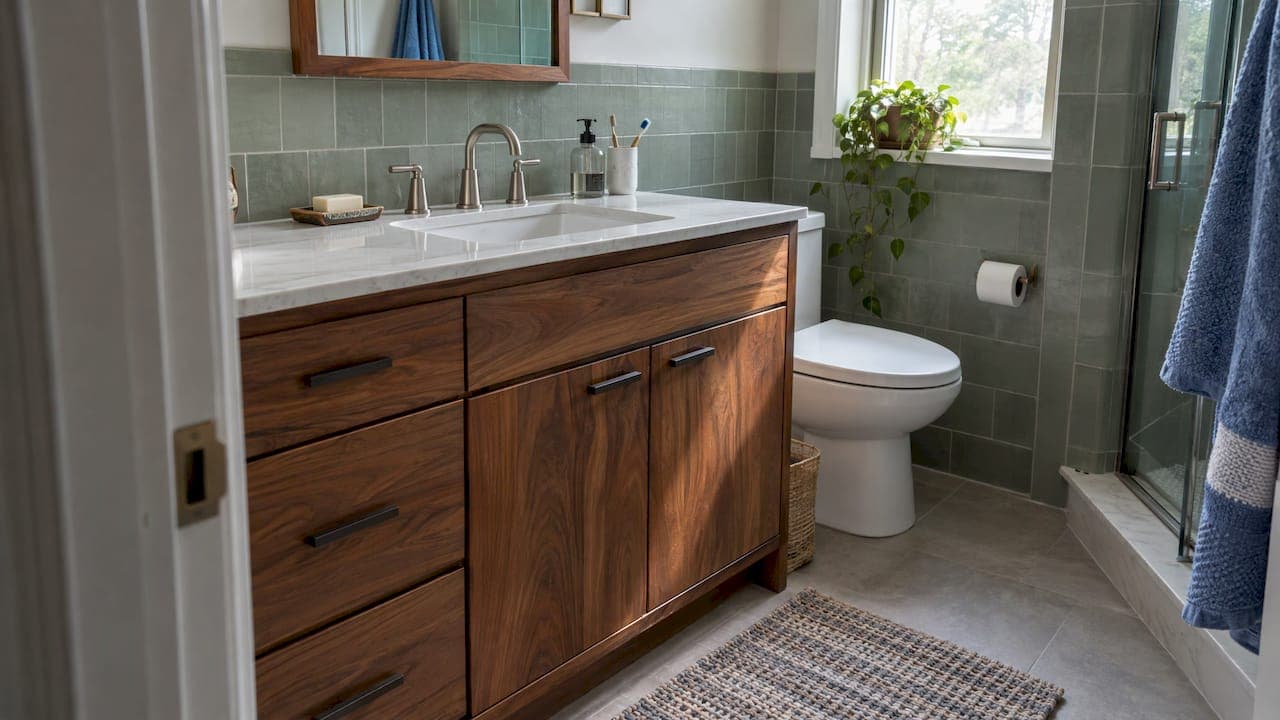
A walnut bathroom vanity works well in a bathroom if it is built from dry, stable material, sealed on every surface and paired with decent ventilation. Its deep brown tone and straight or wavy grain give a bathroom warmth that white and painted finishes do not. The risk is not the wood itself. It is poor construction, a thin finish and a steamy room with no exhaust fan. This guide covers what to check before you buy, how solid walnut, veneer and walnut-look finishes differ, how to size the vanity, and how to keep it looking good.
TL;DR
- Walnut suits a bathroom when the casework is built dry, the finish seals every edge and the room is ventilated.
- Solid walnut, walnut veneer over a stable core and walnut-look finishes differ in feel, repairability and price. Pick by how long you plan to keep the vanity.
- Measure width, depth and sink position before you choose a style, and check drawer clearance around the plumbing.
- Reseal or refinish on a schedule, wipe up standing water and run the exhaust fan after every shower.
- If you want the walnut look with a budget-friendly build, compare plywood-box cabinets with solid wood doors in a Shaker style, and order sample doors first.
Table of Contents
- Is walnut a good wood for a bathroom vanity?
- Solid walnut, walnut veneer and walnut-look finishes
- Walnut vanity styles and finishes
- Getting the size and sink fit right
- How to seal a walnut vanity
- Ventilation: the quiet factor
- Cleaning and daily care
- What affects the price of a walnut vanity
- When to buy
- Our perspective
- Build your bathroom with cabinets made for the job
- Frequently asked questions
- Sources
Is walnut a good wood for a bathroom vanity?
Yes, with conditions. Walnut is a dense, fine-grained hardwood that machines cleanly and takes a clear finish well. That is why it shows up so often in mid-century and modern bathrooms. But any wood in a bathroom faces steam, condensation and splashes.
Hunker notes that wood is vulnerable to shower steam, condensation and daily puddles, and that proper sealing and ventilation reduce that vulnerability. The same article points out that finishes need upkeep and may require periodic refinishing. In other words, a walnut vanity is not a set-and-forget fixture, but it is a manageable one.
Moisture content at the mill matters just as much as the finish. A hardwood supplier, J. Gibson McIlvain, recommends that interior vanity casework be milled to 6 to 8 percent moisture content. Lumber that is milled too wet can shrink as it settles indoors, which pulls panels out of their grooves and opens joints. When you shop, a vanity that arrives with tight joints, flat doors and an even finish on the inside of the cabinet is a good sign of dry, careful construction.
Three conditions decide how a walnut vanity ages:
- Finish coverage. The top, the edges, the back of the doors and the inside of the sink base all need sealing, not just the faces you see.
- Room ventilation. A bathroom that stays humid after showers stresses any wood product.
- Plumbing protection. A slow drip under the sink does more damage than steam. Check supply lines and the P-trap when you install.
Solid walnut, walnut veneer and walnut-look finishes
Listings use "walnut" loosely. Read the product description for how the vanity is actually built, because the three common constructions behave differently.
| Construction | What it is | Look | Repairability | Typical price position |
|---|---|---|---|---|
| Solid walnut | Walnut boards and panels throughout | Real grain on every surface, natural variation | Can be sanded and refinished more than once | Highest |
| Walnut veneer over a stable core | A thin layer of real walnut bonded to plywood or engineered board | Real walnut grain, consistent pattern | Limited sanding, since the veneer layer is thin | Middle |
| Walnut-look finish | Laminate, melamine or printed finish on a core | Uniform pattern, no real grain | Chips and scratches are hard to repair | Lowest |
Solid walnut has the weight and repair options of a long-term piece. Veneer over a stable core is a sound choice, because a plywood or engineered core resists the seasonal movement that solid panels go through. A walnut-look finish gives you the color at the lowest price, but it is a surface, not a material.
When you compare, ask these questions of every listing:
- Are the doors, frame and box all the same material, or is the walnut only on the front?
- What is the core material, and is it plywood or particleboard?
- Are the drawer boxes solid wood or plywood, and what hardware do they ride on?
- Is the finish applied on the interior and the back of the doors?
- What does the warranty say about water exposure?
Our own view on construction is simple. For cabinet boxes in a wet room, plywood is a smart base, which is why we build with plywood boxes. Our guide to cabinet materials that resist water and our notes on vanity materials that survive sink cutouts go deeper on how each material behaves around a sink.
Walnut vanity styles and finishes
Walnut vanities cluster into a few looks.
Mid-century modern. Slab or flat-panel fronts, tapered legs and slim pulls, often in a floating or legged design. This is the style most people picture first.
Transitional Shaker. A five-piece Shaker door in walnut reads warmer than painted white, and it sits comfortably in both traditional and modern rooms.
Contemporary slab. Plain doors and drawers with a continuous grain and minimal hardware. Grain matching across drawers is the detail to inspect.
Two-tone. A walnut vanity against white tile, or a walnut base with a stone top, is a common pairing. Walnut's brown base keeps the room from feeling stark.
Color varies more than people expect. Natural walnut can run from chocolate brown to a lighter, grayish brown, and finishes range from clear oil to a darker stain. Always judge the finish in the light of your own bathroom. If you are matching other cabinetry or a door color, order samples and compare them against your tile and paint before you commit. You can order sample doors from us to check color and construction in person.
Getting the size and sink fit right
Most returns and install headaches come from measurement, not from style. Before you pick a walnut vanity, record three things: the usable wall width, the depth the room allows, and where the drain and supply lines come out of the wall.
- Width. Standard vanity widths step up in common increments. Measure the wall space between obstacles such as a tub, a door swing or a toilet, and leave clearance on each side. Our walkthrough on how to measure a bathroom vanity takes you through the three measurements to record first, and the bathroom vanity sizes guide explains the four steps for U.S. homes.
- Depth. Many vanities are deeper than the minimum a small bathroom can spare. If the room is tight, a narrower depth keeps the walkway open. See our bathroom vanity depth guide and our narrow vanity ideas for 16 to 18 inch options.
- Single or double. A double sink only makes sense if you have the width for both sinks and enough counter space between them. Our single vs. double vanity comparison helps you decide.
- Sink and plumbing. Check where the drain sits relative to the drawers. A drawer base with a cutout around the plumbing is a common design, and a vanity with deep drawers under the sink may need a shaped drawer to clear the trap.
- Top and faucet. Confirm that the faucet holes on the top match your fixture, and that the top overhangs the front enough to keep drips off the door faces.
Storage is the other half of fit. Count what you actually keep under the sink and compare it with the drawer and door layout. Drawers are easier to use than a single large door, but they lose space around the plumbing.
How to seal a walnut vanity
Sealing is where most of the long-term protection comes from. Whether you buy a factory-finished vanity or finish one yourself, the goal is the same: no raw wood exposed to water.
- Check the factory finish. Open the doors and drawers and look at the inside faces, the underside of the top and the edges. Raw wood in any of these places is a weak point.
- Seal cut edges. If the top is cut for a sink or faucet, coat the cut edges before you install the fixtures. Water that reaches an unsealed cutout swells the material around it.
- Use a finish designed for wet areas. Oil finishes bring out the grain and are easy to touch up. Film finishes such as polyurethane or a conversion varnish give more surface protection. Follow the manufacturer's cure times before the vanity sees regular use.
- Caulk the gaps. Run a bead of silicone where the top meets the wall and the backsplash, so water does not travel behind the cabinet.
- Plan for refinishing. Hunker's guidance that finishes need maintenance and may require refinishing over time is worth treating as a schedule, not a surprise.
If you are protecting a bathroom that has a shower or window nearby, waterproofing the surrounding surfaces helps the vanity too. A guide to shower window waterproofing shows how to keep water out of the areas that feed moisture into the room.
Ventilation: the quiet factor
The wood does not care whether the humidity comes from a shower or a poorly vented room, but you can control one of them. Run the exhaust fan during every shower and for a while after. If the fan is weak or the house is tightly sealed, whole-home ventilation can help balance moisture, and this overview of matching ventilation to moisture with HRV or ERV systems explains what each system does. Less lingering humidity means less stress on the finish, the joints and the hardware.
Cleaning and daily care
Walnut care is not complicated, but it rewards consistency.
- Wipe up splashes and toothpaste drips the same day, especially around the sink cutout and on the door faces nearest the basin.
- Clean with a soft cloth and mild soap diluted in water. Skip abrasive pads and harsh sprays, which can dull the finish.
- Dry the surface after cleaning. Do not leave a damp cloth or wet towels on the top or against the doors.
- Keep hair tools and hot items off the top. Heat can mark a film finish.
- Check under the sink every few months for slow leaks, damp spots or swelling at the base.
- Touch up chips early so water cannot get under the finish.
Over the years, the finish will lose some sheen. A dull top or a worn edge is a sign that it is time to clean, recoat or refinish. For a deeper look at how professionals bring dull wood surfaces back, this article on restoring dull countertops and wood surfaces covers cleaning, polishing and sealing.
What affects the price of a walnut vanity
Prices for walnut vanities cover a wide range, and the same size can differ by a large amount. The drivers are consistent:
- Material. Solid walnut costs more than veneer, and veneer costs more than a walnut-look finish.
- Size and configuration. A double vanity with more drawers costs more than a single 24 or 30 inch unit.
- Top. Stone, quartz or solid-surface tops add cost, and some vanities are sold with the top included while others are base only.
- Hardware. Soft-close hinges and full-extension drawer slides raise the price but improve daily use.
- Assembly. Ready-to-assemble units usually cost less to ship and buy than fully assembled ones.
- Brand and finish. Custom shops and furniture-style vanities carry a premium for handwork.
A useful way to budget is to price the whole setup: base, top, sink, faucet, mirror and installation. Our roundup of bathroom vanities for every budget is a good place to compare tiers before you decide how much to spend on the wood itself.
When to buy

There is no single best month to buy a bathroom vanity, and promotions change from year to year. Retailers often run sales around major holiday weekends and at the end of seasons, and many offer trade pricing for contractors on larger orders. If your timeline is flexible, watch for promotions, and if it is not, remember that a delayed install costs more than most discounts save. Check the retailer's official sales page for the current schedule rather than relying on last year's dates.
Our perspective
We build kitchen and bathroom cabinets with plywood boxes and solid wood doors because that combination is designed for the conditions cabinets really live in. A bathroom is the hardest room in the house for wood, and a stable plywood box gives the vanity a solid base, while solid wood doors give you the look and feel of real wood.
For a walnut-toned bathroom, we would start with the questions that matter more than the species name: how the box is built, how the finish is applied, and whether the size fits your room. A beautiful face on a weak box will disappoint you in a few years, and a well-built vanity in a simpler style can serve you for a long time.
That is also why we offer Shaker, Classic and Slim series cabinets in RTA and assembled formats. Homeowners get a clean, practical look at a competitive price, and contractors and builders get project-ready cabinets with fast shipping. We are a women-owned and veteran-owned business, and we answer to the people who install our cabinets.
Nathan
Build your bathroom with cabinets made for the job
If you are planning a bathroom and want durable cabinets without long lead times, look at our RTA cabinets and assembled cabinets. Both use plywood boxes and solid wood doors, with soft-close hardware and a range of styles and finishes for residential and commercial projects. Contractors, builders and property managers can ask about bulk packages and trade pricing.

For a vanity-sized starting point, the White Shaker vanity sink base cabinet in 42 inches has drawers on the left and right of the sink, and the White Slim Shaker vanity drawer base in 18 inches fits tighter spaces. Not sure of the finish? Order sample doors and hold them against your tile. Shop Now at cabinet-specialist.com.
Frequently asked questions
Is walnut good for a bathroom vanity?
Yes, as long as it is well built and well sealed. Walnut is a stable, attractive hardwood, but like any wood it is exposed to steam and splashes. Proper sealing, ventilation and quick wipe-ups protect it, according to Hunker's guidance on wood vanity tops.
What is the best wood for a bathroom vanity?
The best choice is the one that is dry, stable and well finished, whatever the species. Construction matters as much as the wood: a plywood box with solid wood doors and a sealed finish handles a bathroom well. Pick a species based on the color and grain you like, then check the build.
What color bathroom vanity is timeless?
White, soft neutrals and natural wood tones such as walnut have all lasted across design cycles. Walnut is a safe pick against white tile or a light stone top, because the warm brown balances a bright room. Choose a simple door style, such as Shaker, to keep the look from dating.
What is the best month to buy bathroom vanities?
No month is reliably the cheapest. Retailers often discount around major holiday weekends and seasonal clearances, but the schedule changes, so check each seller's current promotions. If you are a contractor or builder, ask about trade or bulk pricing, which does not depend on the calendar.
How do I know if a vanity is solid walnut or veneer?
Read the product specifications, which should name the material for the doors, frame and box. Look at the edges and the inside of the cabinet: a veneer shows a thin layer over a core, while solid walnut has grain running through the full thickness. If the listing is vague, ask the seller before you order.
Sources
- Wood Vanity Tops: What You Should Know, Hunker
- Bathroom Vanity Casework in Hardwood, J. Gibson McIlvain
- Shower Window Waterproofing: How to Do It Right
- Match Ventilation to Moisture: HRV or ERV for Homeowners
- Why Your Beautiful Countertops Look Dull