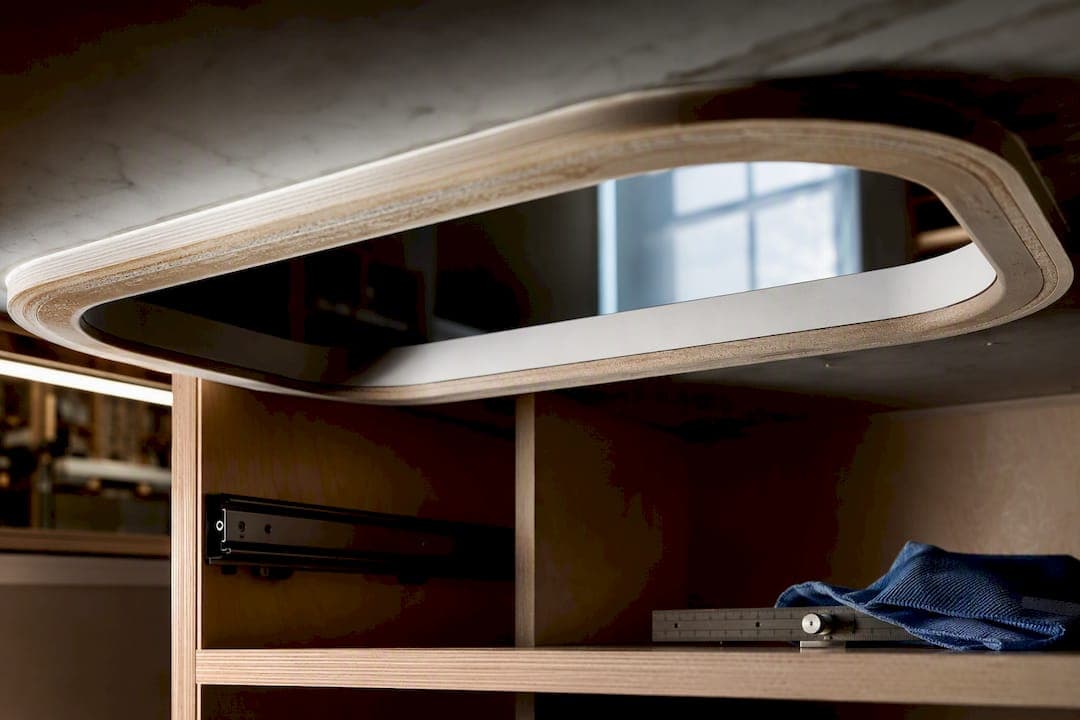
For most bathrooms, plywood or moisture-rated engineered cores for the cabinet box, paired with an engineered quartz top, give you the best balance of durability and low upkeep. Solid wood and natural stone can outperform them in the right room, but they demand more sealing and care. Budget and humidity level should decide the mix, and a supplier like Best Cabinet Specialist that builds with plywood boxes and solid wood doors is a solid starting point for shopping.
TL;DR:
- Moisture-rated plywood cores are the most resistant to water damage and warping, making them the best choice for humid or high-use bathrooms.
- Solid wood cabinets perform best when properly sealed but are vulnerable at joints and end grains without waterproof finishes.
- Engineered quartz tops require the least maintenance, resist stains and heat, and do not typically need sealing, unlike natural stones like granite or marble.
- Particleboard and MDF are unsuitable for wet zones, as they swell and fail quickly when exposed to moisture, especially at cut edges or plumbing openings.
- Buyers should prioritize asking about core material, waterproofing, and weight support before selecting a finish or countertop to avoid early failures.
Table of Contents
- What Are the Best Bathroom Vanity Materials for Cabinets?
- Which Countertop Material Holds Up Best in a Bathroom?
- Which Material Pairing Fits Your Bathroom Best?
- What Should You Ask Before You Buy a Vanity?
- How Does Best Cabinet Specialist Build to These Standards?
- Where This Guidance Comes From
- What Actually Matters Most When You're Choosing
- Ready to Order Vanity Cabinets Built for Wet Rooms?
- Sources
What Are the Best Bathroom Vanity Materials for Cabinets?
The cabinet box (the "core") matters more than what the door looks like, because that's the part sitting closest to sink splashes, leaky supply lines, and daily humidity swings. Five core materials dominate the market, and they don't behave the same way once water gets involved.
Solid wood is the traditional choice and still the best-looking option when it's finished right. Species matter a lot here. Teak and white oak hold up better in humid bathrooms than softer woods, but even those species need a waterproof finish to last, according to HouseDigest's guidance on durable vanity materials. Maple is common too, and it takes stain well, but it's less naturally moisture-resistant than oak. Without a sealed finish, solid wood swells, cups, or cracks at the joints when it repeatedly gets wet and dries out.
Plywood is layered wood veneer, and the layering is exactly why it resists moisture better than solid boards or fiberboard. Cross-grain construction keeps it from warping the way solid lumber does, and it holds screws and hardware more reliably. Marine-grade or moisture-rated plywood uses waterproof adhesive between layers, which makes it the standard recommendation for wet zones, including from KJBath's material guidance for high-humidity bathroom projects. Standard interior-grade plywood is fine for a dry powder room but isn't built for constant splash exposure.
MDF (medium-density fiberboard) is made from compressed wood fibers and resin. It's smooth, paintable, and cheaper than plywood, which is why it shows up in a lot of budget vanities. The problem is the exposed edges and cutouts. Once water gets into a drilled hole or a factory-cut edge, MDF swells and doesn't recover. Maker guides and industry writeups consistently flag this as the top failure point on cheap vanities, since MDF and particleboard are especially vulnerable at cut edges and plumbing openings.
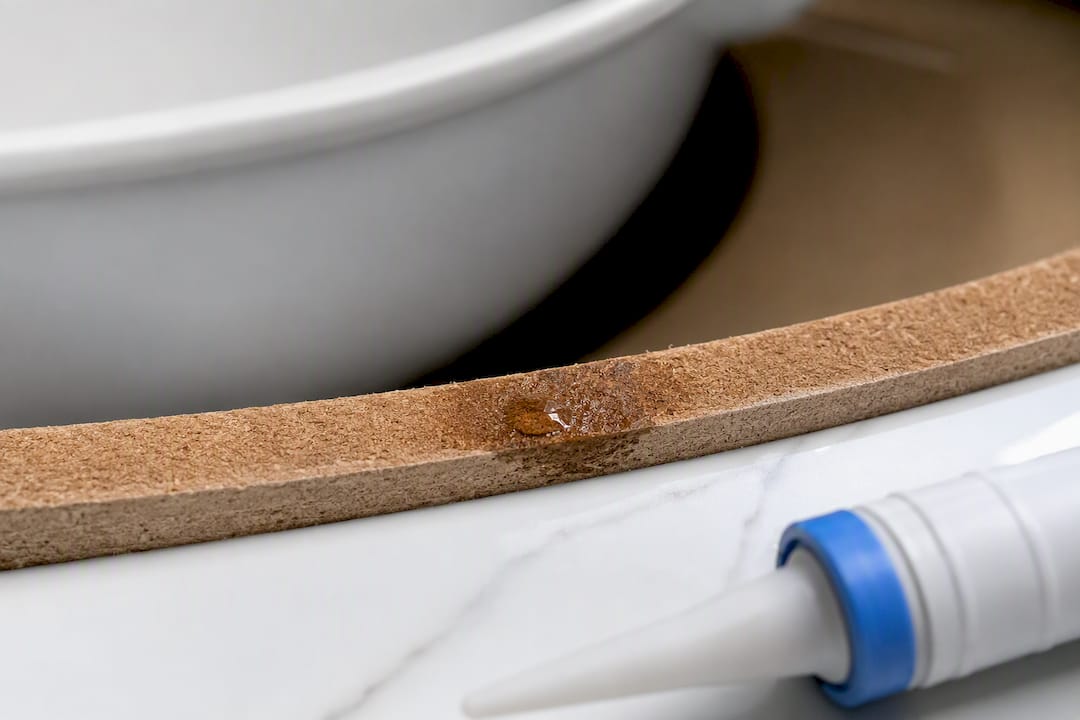
Particleboard is the weakest of the group. It's compressed wood chips and glue, and it has the lowest moisture tolerance of any core material sold for cabinetry. It's common in entry-level, big-box vanities because it's cheap to produce, but it has no business under a sink that will ever see a slow drip.
Engineered plastics (PVC and HDPE) are the outliers. They don't rot, swell, or delaminate because they're not wood at all. PVC vanity cabinets show up mostly in commercial bathrooms, rentals, and coastal or high-humidity climates where waterproofing outranks everything else, a use case KJBath specifically recommends solid PVC or marine-grade plywood for. The tradeoff is a more utilitarian look and a narrower range of finish options.
Here's how the five stack up on the factor that actually determines lifespan in a bathroom:
- Solid wood: Good if properly sealed; vulnerable at joints and unsealed end grain.
- Plywood (moisture-rated): Strong moisture resistance; the NKBA's design guidance for vanities treats it as a baseline for quality construction in wet spaces.
- MDF: Fine for dry powder rooms; fails fast at exposed edges and cutouts.
- Particleboard: Weakest moisture tolerance; avoid in any wet zone.
- PVC/HDPE: Fully waterproof; best for rentals, commercial baths, and coastal humidity.
Quick fact check: the Willow Bath & Vanity build guide notes that a veneered plywood panel consistently outlasts an MDF or particleboard panel in moisture-prone bathroom conditions, even when both start out looking identical on the showroom floor. It's the layered engineering underneath that decides how the cabinet ages, not the surface finish.
Which Countertop Material Holds Up Best in a Bathroom?
Quartz is the most forgiving countertop material for daily bathroom use, and it's also the one that needs the least maintenance to stay that way. Testing from Consumer Reports found that engineered quartz resists stains, abrasion, and heat better than many natural stone tops, and it typically doesn't need sealing at all. That combination of low upkeep and design flexibility is why quartz has become the default recommendation for residential vanities.
Natural stone tells a more complicated story. Granite is dense and scratch-resistant, but it's porous enough that it needs periodic sealing to block stains from makeup, soap scum, and toiletries. Marble looks unmatched for a luxury master bath, but it's the most porous of the common stone tops and the most demanding to maintain. The Natural Stone Institute's bathroom application guidance notes that porous stones like marble require regular sealing to prevent etching and staining, especially from acidic products like perfume or certain skincare formulas. Skip a resealing cycle and you'll likely see dulling or dark water spots within a year or two.
Porcelain and ceramic tops are nonporous, scratch-resistant, and increasingly popular for their thin, modern profile. They handle heat and stains well, though a hard impact can chip the edge if the slab is thin. Solid surface material (think acrylic composite) is seamless, easy to repair if scratched, and budget-friendlier than stone, but it scratches more easily and can dull under harsh cleaners. Laminate is the cheapest option by a wide margin and works fine in a low-traffic powder room, but it can't handle standing water at the seams over time. Glass tops offer a striking, contemporary look and clean up easily, though they show water spots fast and chip if hit hard. Concrete is having a design moment for its industrial look, but it needs periodic sealing and can develop hairline cracks if the substrate isn't properly supported.
Weight is the factor buyers most often overlook. Granite, marble, and concrete tops are heavy, and a heavy slab needs a cabinet core strong enough to hold screws and distribute the load, which is exactly why KJBath advises confirming cabinet core strength before ordering a stone top. A quartz or porcelain top puts far less demand on the box underneath.
- Quartz: Low maintenance, no sealing, wide color range; mid to upper price tier.
- Granite: Durable, needs periodic sealing; mid tier.
- Marble: Highest-end look, most maintenance, most porous; premium tier.
- Porcelain/ceramic: Scratch and stain resistant, thin profile; mid tier.
- Solid surface: Repairable, budget-friendly, scratches easier; entry to mid tier.
- Laminate: Cheapest, fine for dry low-use spaces; entry tier.
- Glass/concrete: Distinct look, more maintenance or support needs; mid to premium tier.
Which Material Pairing Fits Your Bathroom Best?
Matching the cabinet core to the countertop isn't just about looks. It's about matching the whole assembly to how wet and how heavily used the room actually is.
- Best for durability overall: Moisture-rated plywood core with a quartz top. Handles daily splashing, resists warping, and needs almost no maintenance routine.
- Best for low maintenance: Plywood core with quartz or porcelain top. Neither surface needs sealing, and both shrug off soap scum and toothpaste stains.
- Best on a tight budget: MDF core (in a dry powder room only) with laminate or solid surface top. Fine for low-traffic guest bathrooms, not for a busy family bath.
- Best for a luxury master bath: Solid hardwood (teak or white oak) core with a sealed marble top. Stunning result, but commits you to a real maintenance schedule.
Applied to real rooms:
- Powder room (dry, occasional use): MDF or plywood core, laminate or solid surface top. Low cost, low risk since exposure is minimal.
- Family bath (daily use, kids, high humidity): Plywood core, quartz top. Built for the wear and tear of a busy household.
- Master bath (higher budget, design-forward): Solid wood or plywood core, quartz or sealed granite/marble top depending on how much maintenance you want to take on.
- Rental property: PVC or moisture-rated plywood core, quartz or porcelain top. Minimizes tenant-driven water damage and callback repairs.
What Should You Ask Before You Buy a Vanity?
The wrong material choice usually doesn't show up until six months to two years after installation, when swelling, delamination, or staining sets in. A few direct questions at the point of sale catch most of the problems before you write the check.
Ask the seller exactly this:
- "What core material is used, and is it moisture-rated?"
- "Are the cut edges and drilled holes sealed, or just the visible faces?"
- "What grade of plywood is this, and is the adhesive water-resistant?"
- "Is the cabinet rated to support a stone top of this weight?"
- "What's covered under warranty, and for how long?"
Watch for these red flags, because any one of them predicts an early failure:
- Unlabeled or unnamed "engineered wood" in a spec sheet, usually a euphemism for particleboard.
- No mention of edge sealing around sink cutouts or plumbing access panels.
- A heavy stone top paired with a thin, unsupported cabinet frame.
- Hardware and hinges with no stated warranty term.
- A ventilation gap or fan requirement that the listing doesn't address at all, since even a good core degrades faster in a room with no airflow.
Once installed, a little upkeep protects the investment. Wipe standing water off the countertop daily, especially around the sink cutout. Reseal porous stone on the schedule the fabricator recommends, and touch up any nicked wood finish before it exposes raw grain to moisture.
Pro Tip: Run your hand along the underside edge of the sink cutout before you buy. If it feels raw or unfinished, water will find its way into that seam eventually, no matter how nice the top surface looks.
For a step-by-step on getting the dimensions right before you order, measuring a bathroom vanity the right way avoids a costly reorder. And if you want the deeper technical breakdown on core performance, comparing MDF and plywood construction side by side is worth the ten minutes.
How Does Best Cabinet Specialist Build to These Standards?
Best Cabinet Specialist builds bathroom vanity cabinets around plywood boxes with solid wood doors, which lines up directly with the durability priorities covered above. That construction choice isn't cosmetic. It's the difference between a cabinet that survives a decade of daily splashing and one that starts swelling at the sink cutout within a year.
A few proof points worth knowing:
- Plywood box construction paired with solid wood doors for real moisture resistance, not just a moisture-resistant look.
- Shipping options to support contractors and renovators working against a tight bathroom timeline.
- Business values associated with ownership and accountability.
- Style range across modern, traditional, and transitional lines, so the durable core doesn't limit your design options.
| Priority | What Best Cabinet Specialist offers |
|---|---|
| Moisture resistance | Plywood box construction |
| Timeline | Fast shipping for active renovation projects |
| Design flexibility | Modern, traditional, transitional styles |
| Business values | Women-owned, veteran-owned |
This construction approach fits buyers who already know they want a plywood core and don't want to gamble on an unlabeled "engineered wood" spec sheet.
Where This Guidance Comes From
The material claims above rest on a mix of consumer testing, trade association guidance, and material science standards, not marketing copy.
- Consumer Reports' countertop testing benchmarks stain, abrasion, and heat resistance across countertop materials under controlled conditions.
- ASTM's C615 standard defines performance characteristics and test methods for stone used in bathroom installations.
What Actually Matters Most When You're Choosing
Most vanity shopping guides bury the real decision under a wall of finish photos and color swatches. That's backwards. The material that fails first is almost always the one hidden inside the box, not the one you can see.
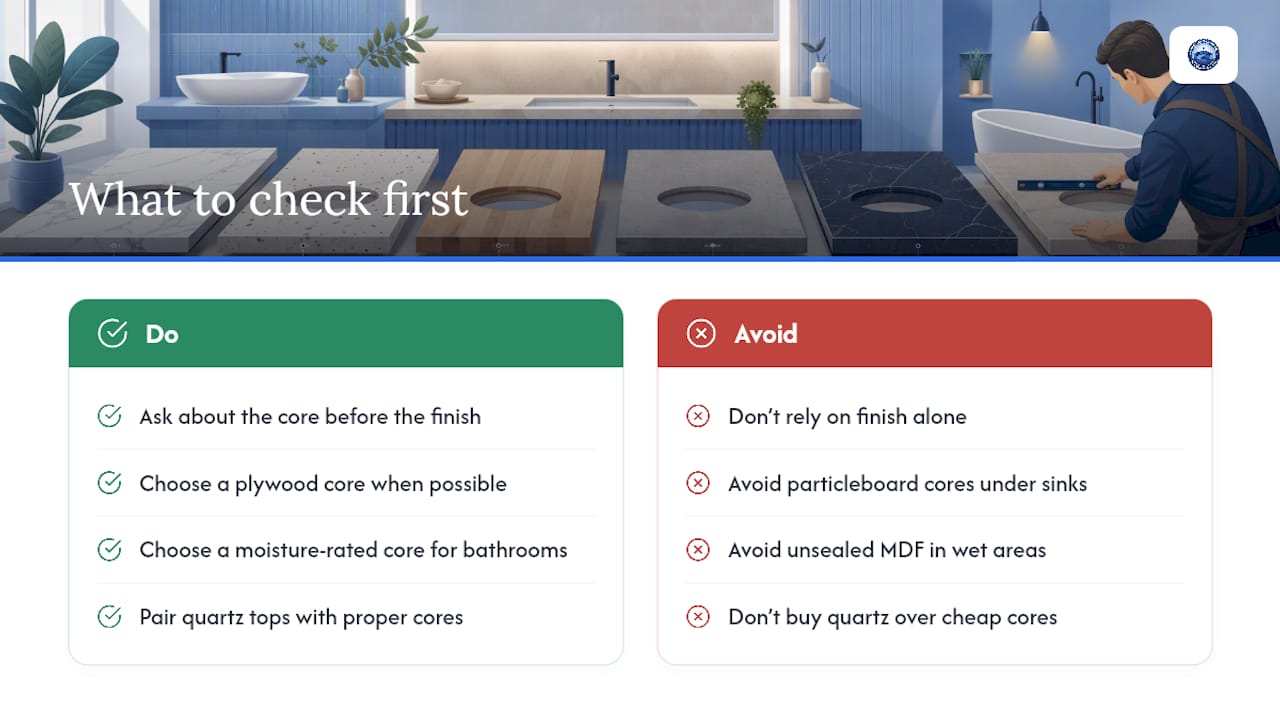
The conventional advice to "pick a style you love" isn't wrong, but it skips the step that determines whether you'll love that style in three years or be tearing it out. Particleboard and unsealed MDF dominate the entry-level vanity market because they're cheap to produce, and most buyers can't tell the difference between a plywood core and a particleboard core just by looking at a showroom floor model. The difference shows up later, at the sink cutout, after the first slow leak nobody noticed for a few weeks.
If you take one thing from this guide, take this: ask about the core before you ask about the finish. A beautiful quartz top on a particleboard box is a countdown, not a purchase. A plywood or moisture-rated core under a quartz top is a bathroom vanity that should outlast the next kitchen remodel.
— Nathan
Ready to Order Vanity Cabinets Built for Wet Rooms?
If everything above tells you plywood cores and solid wood doors are the safer bet, Best Cabinet Specialist builds exactly that, without the long lead times that stall most cabinetry orders. Instead of waiting weeks on a custom order or gambling on an unlabeled particleboard box from a big-box aisle, you get plywood construction and solid wood doors shipped fast, at prices built for homeowners and contractors working on a real timeline.
The lineup spans modern, traditional, and transitional styles, so choosing a moisture-resistant core doesn't mean settling on looks. Whether you're outfitting a single powder room or ordering in bulk for a multi-unit rental project, the construction stays consistent: plywood boxes, solid wood doors, and soft-close hardware. Browse bathroom vanity options built for every budget to compare styles, or head straight to Best Cabinet Specialist to check current inventory and get your project moving. If you're also weighing door materials for the rest of the room, this guide to bathroom-ready door materials is a useful next read.
Sources
- Best countertops for bathroom vanity | Consumer Reports
- ASTM standards (C615) for bathroom stone specifications | ASTM
- Best material for durable bathroom vanity | HouseDigest