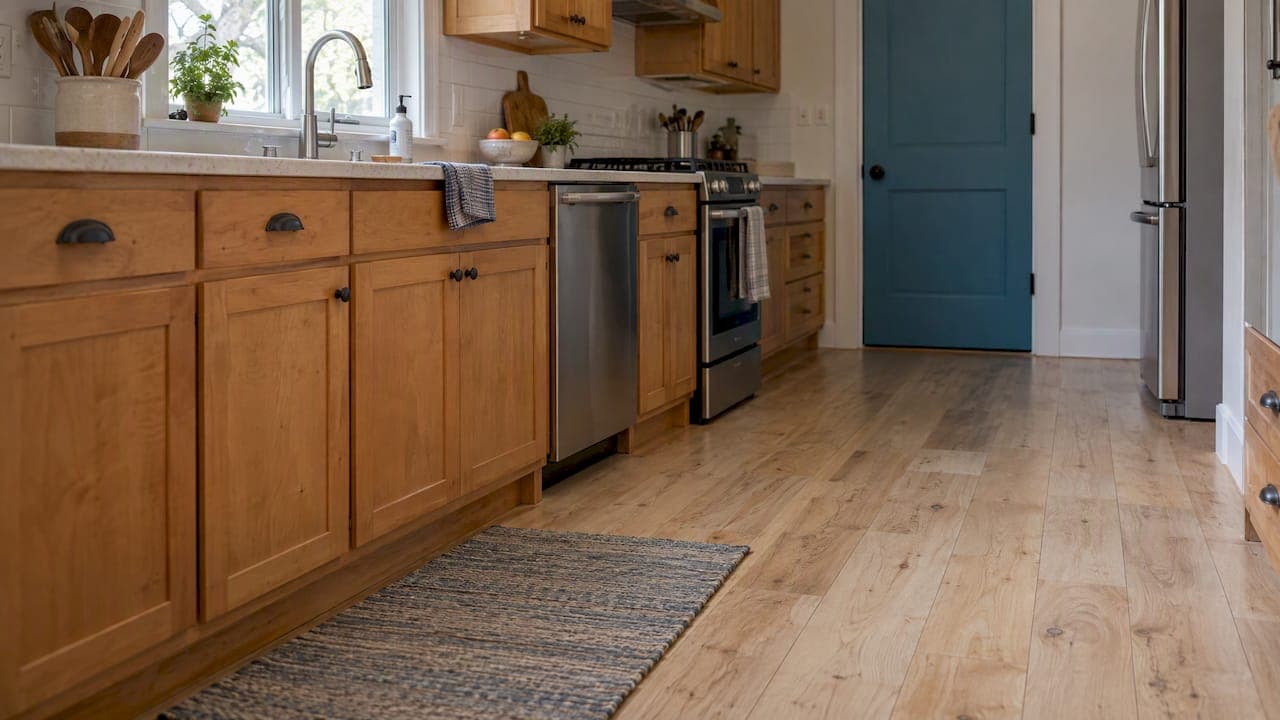
You do not need cabinets and floors to match exactly, and usually they look better when they don't. The pairing that works is either a clear contrast (lighter floors with darker cabinets, or the reverse) or a close harmony that shares the same warm or cool undertone. What fails is the in-between: two tones that are almost the same but not quite, so the kitchen looks like a mistake instead of a choice.
This guide walks through how to decide, step by step, whether you are renovating one kitchen, outfitting a rental, or specifying cabinets for a new build.
TL;DR
- Aim for intentional contrast or intentional harmony. Near-matches that are slightly off are the one combination to avoid.
- Match undertones (warm with warm, cool with cool) even when the depth of color is different.
- Small or dim kitchens usually need lighter floors, or lighter cabinets over dark floors, so the room does not feel heavy.
- Choose the floor first if it is staying, then pick cabinet color from physical samples viewed in your own light.
- A neutral floor gives you room to change cabinet color later without replacing the floor.
Table of Contents
- Why "matching" is the wrong goal
- Contrast or harmony: choosing your approach
- Start with undertones
- Pairing wood cabinets with wood floors
- Let kitchen size and light make the call
- Fit countertops into the picture
- Think about the next owner, or the next refresh
- Our perspective: choose the cabinets after you see them next to the floor
- See the match before you buy
- A simple checklist before you decide
- FAQ
- Sources
Why "matching" is the wrong goal
Many homeowners ask whether the cabinets should be the same color as the floor. Designers mostly say no. The American Hardwood Information Center reports that U.S. design professionals generally favor mixing rather than precisely matching wood colors, grains, stains and textures. One designer it cites suggests dark cabinets with lighter floors, and light cabinets with darker floors.
There is a practical reason. Wood and finishes never match perfectly across materials. A floor is sanded and sealed on site, while cabinet doors are finished in a factory, with different stain, sheen and grain. Trying to match them exactly means you will see every small difference. Choosing a clear relationship avoids that problem.
One guide to wood floor and cabinet combinations puts the goal simply: you want either harmony or intentional contrast. Both are valid. Which one fits depends on your kitchen, and the rest of this article helps you decide.
Contrast or harmony: choosing your approach
Contrast
Contrast means a noticeable jump in depth between floor and cabinets. A Baker Bros guide says high contrast creates drama and dimension: light floors make dark cabinetry stand out, while dark floors work best with light or white cabinets.
Contrast is the safer choice for most kitchens, for three reasons:
- The cabinets read as a separate surface from the floor, so the room has visible layers.
- You are not depending on two different materials to agree on a shade.
- It tends to look current and deliberate in photos and in person.
Harmony
Harmony means floors and cabinets sit close in depth and share the same character. It can look calm and cohesive, especially in a traditional or warm kitchen. It also takes more care. If you stay in the same tone, designers commonly add something to break it up: a rug, a contrasting countertop, a different backsplash. Without that, the room can feel flat.
A quick decision guide
| Your situation | Better approach | Why |
|---|---|---|
| Dark cabinets, any kitchen with decent light | Light or mid-tone floors | Keeps the room from feeling heavy |
| White or light cabinets | Mid or dark floors, or a warm natural wood | Grounds the room and defines the cabinetry |
| Small kitchen with little daylight | Light floors and light-to-mid cabinets | Helps the room feel more open |
| Floors you love and are keeping | Pick cabinets that contrast with them | Easiest way to avoid a near-match |
| Open-plan space with continuous flooring | Neutral floor, cabinet color as the accent | Flexible if you restyle later |
Start with undertones
Depth (light versus dark) is only half of the match. Undertone is the other half, and it is what makes two colors either feel related or feel off.
In U.S. residential design, the same guide to wood floor and cabinet combinations notes that warm undertones, with golden, reddish or amber hues, create a traditional, cozy atmosphere, while cool undertones such as gray, ash or beige give a modern, airy feel. Experts advise choosing floors and cabinets that share an underlying temperature, then using variations in grain or finish so the space is not overwhelmed by a single color or texture.

How to read an undertone
Hold your cabinet sample against a sheet of plain white paper or a light gray swatch. A UK-based kitchen flooring and cabinet color guide suggests this comparison: a yellow or earthy cast points to warm, while green, blue or gray points to cool. Do the same with the floor sample. If one reads warm and the other cool, the pair will probably fight, even if the depth is right.
Warm with warm, cool with cool
- Warm oak floors: pair well with cream, warm white, natural wood, sage or muted green cabinets.
- Gray or greige floors: pair well with white, soft gray, navy or charcoal cabinets.
- Dark brown floors: pair well with white, light gray or light natural-wood cabinets.
- Very light, nearly blond floors: pair well with deep green, navy or dark stained cabinets for contrast.
These are starting points, not rules. Your samples in your light decide.
Pairing wood cabinets with wood floors
Wood on wood is where people worry most, and it is also where the "don't match" advice helps most. The American Hardwood Information Center says the idea of mixing rather than matching applies to colors, grains, stains and textures alike.
A few practical points:
- Vary the species or the finish. If both floor and cabinets are red oak in the same stain, the room can feel like one big block of wood. Choose a lighter or darker stain, or a different species.
- Watch grain. Species with strong grain, such as hickory or red oak, add texture, while smoother species such as maple give a more contemporary look, according to the wood floor and cabinet guide above. A busy grain on the floor often works better with calmer cabinet doors, and the reverse.
- Don't repeat one stain on every plane. Designer Seth Ballard cautions in Architectural Digest against using the same stain color on more than one plane, because walls can close in.
If your existing floor has aged, patchy or mismatched color, correcting it can be a better move than changing the cabinets to suit it. A specialist in hardwood floor color correction can even out the tone so your cabinet choice has a stable base to work from.
If you are weighing cabinet species, our guides to maple versus birch cabinets and cherry wood cabinets cover how each takes paint or stain.
Let kitchen size and light make the call
Two kitchens with the same floor and cabinets can feel completely different, depending on size and daylight.
Small or dim kitchens
The Baker Bros guide says lighter flooring makes a small or poorly lit kitchen feel more open, and that dark cabinets pair well with light or medium floors to avoid a heavy look. Josie Medved of Symphony Group explains in the Homebuilding guide that dark floors need lighter or more reflective cabinetry, since dark surfaces do not reflect much light.
Dark cabinets are still possible in a small space. Better Homes & Gardens on dark kitchen cabinet colors notes that deep greens or charcoal can work in small or north-facing rooms when natural light and warm accent materials balance them. Benjamin Moore's Hannah Yeo, quoted there, says light level strongly affects how dark cabinetry feels, and that lighter surrounding colors and natural light keep a small kitchen from feeling cramped.
Keeping a dark floor
Architectural Digest documented a Los Angeles kitchen where existing rich Douglas fir flooring was kept and paired with brighter white-oak cabinetry, specifically to add brightness without darkening a shaded room. If your floor is staying and the room is dim, this is a useful model: let the cabinets do the brightening.

Test in your own light
North-facing rooms look cooler and grayer. South-facing rooms look warmer. Evening lighting changes both again. View samples in the morning, afternoon and at night, with your actual bulbs on.
Fit countertops into the picture
Countertops sit between the cabinets and floor visually, so they can tie the two together or break them apart. BuildDirect says countertops and floors do not need to match exactly and recommends complementary colors, neutral choices for counters and floors, and testing physical samples together in natural light.
A workable order:
- Lock in the item that is hardest or most expensive to change, usually the floor if it is staying, or the countertop if it is not.
- Choose cabinet color to contrast with or harmonize with that item.
- Pick the countertop to bridge the two, using one color already present in the floor or cabinets.
- Check the backsplash, hardware and wall color last. Our cabinet hardware finishes guide helps with that final layer.
Think about the next owner, or the next refresh
Baker Bros points out that a neutral floor, such as greige or natural wood, gives long-term flexibility: you can change cabinet color in the future without replacing the whole floor. That matters for rental units, flips and any kitchen you expect to restyle.
If resale is on your mind, see our guide to kitchen cabinet colors for resale. For current palettes, our kitchen cabinet color trends article is a good companion.
Our perspective: choose the cabinets after you see them next to the floor
Most color mistakes we hear about come from judging a cabinet color on a screen, then installing it next to a floor that looks nothing like the picture. Our advice is to treat the floor as a fixed fact and let the cabinets respond to it.
We build our cabinets with plywood boxes and solid wood doors, and we offer them in modern, traditional and transitional styles, with color and finish options. That range exists because the right door depends on the floor, the light and the budget, not on a single trend. For floors that are warm and busy, we usually point people to a simple door style and a calm finish. For plain, neutral floors, there is more freedom to choose a stronger color.
We also see contractors and property managers make a practical choice: a mid-tone floor and a neutral cabinet finish that suit many tenants and buyers, so the same plan works across several units. Whatever you are building, order a door sample, set it on the floor, and look at it for a few days before you commit.
— Nathan
See the match before you buy
Color is hard to judge from a photo, so we make it easy to check it in person. Our sample doors let you place a real door on your real floor, under your own lights, before you place an order.
When you are ready, browse our RTA cabinets in the Shaker, Classic and Slim series, or choose assembled cabinets if you want them built. Both come with plywood boxes, solid wood doors and soft-close hardware, with fast shipping for homeowners, contractors and builders. Shop Now to start your kitchen or bathroom project.

If you are still choosing a door profile, read our cabinet door styles guide. For tighter budgets, see modern kitchen cabinet ideas for every budget.
A simple checklist before you decide
- Is the floor staying? If so, treat it as the fixed point.
- Is the contrast clear, or are the two tones close but not the same?
- Do both samples lean warm, or both cool?
- Does the room get strong daylight, or is it small and dim?
- Have you viewed the samples together, in natural and evening light?
- Does your countertop pick up a color from the floor or cabinets?
- Would a neutral floor let you change cabinets later?
If the answers are mostly yes, you are on solid ground.
FAQ
Should kitchen cabinets be lighter or darker than the floor?
Either can work, as long as the difference is clear. Designers cited by the American Hardwood Information Center suggest dark cabinets with lighter floors and light cabinets with darker floors. In a small or dim kitchen, lighter floors usually keep the room feeling more open.
Do hardwood floors and wood cabinets need to be the same species?
No. The grain and species do not have to match, but they should complement each other. Varying the stain, finish or species keeps the room from reading as one block of wood.
What if my cabinets and floors are almost the same color?
Near-matches are the risky zone, because small differences look like errors. You can add contrast with a rug, a different countertop or backsplash, or switch to a clearly lighter or darker cabinet finish.
Do countertops have to match the floor or cabinets?
No. Countertops should complement both without copying either. Test physical samples together in natural light and pick a neutral that echoes one color already in the room.
Sources
- Mix – Don't Match – Wood Textures and Colors, American Hardwood Information Center
- Wood Floor and Cabinet Combinations: A Guide to Matching
- How to Coordinate Flooring and Cabinet Color, Baker Bros
- Are Dark Woods Making a Comeback?, Architectural Digest
- How to nail kitchen flooring and cabinet colour, Homebuilding
- The Best Dark Kitchen Cabinet Colors for a Moody Space, Better Homes & Gardens
- In This Geometric Echo Park Kitchen, Architectural Digest
- Matching Countertops and Floors: Is It Necessary?, BuildDirect