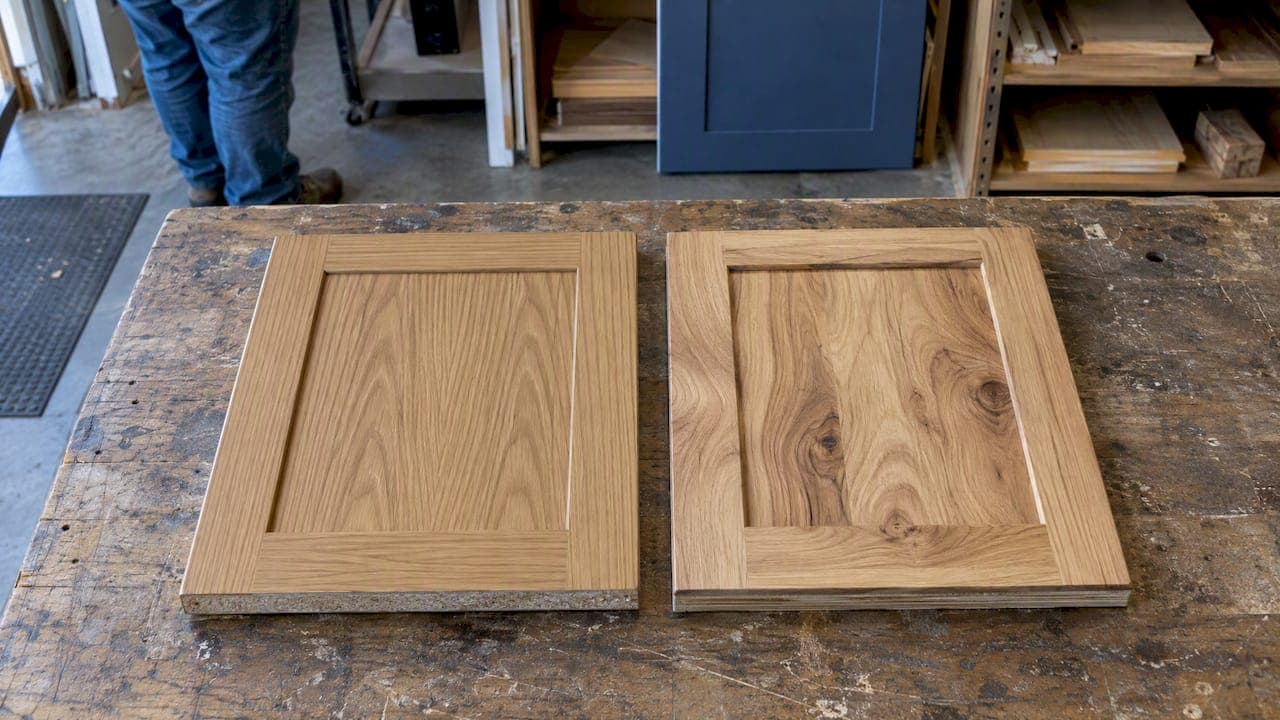
For most homeowners who want durable, low-maintenance cabinets on a budget, laminate is usually the practical choice. Veneer wins when an authentic wood look and the ability to refinish down the road matter more than upfront savings. Moisture exposure in kitchens and bathrooms can tip the decision either way, so the right pick depends on the room, the budget, and how long you want the cabinets to last.
TL;DR:
- HPL resists impact, scratches, heat, and moisture better than melamine; confirm the exact surface grade, because the labels can conceal major performance differences.
- Choose veneer when natural grain and future professional refinishing matter, but keep it in rooms with stable humidity and limited direct moisture exposure.
- A plywood core holds screws more securely and resists moisture better than particleboard, so request the core type alongside the finish specifications in writing.
- Use a soft cloth and mild cleaner on either finish, while keeping standing water away from laminate seams and avoiding abrasives that can strip veneer.
Table of Contents
- Laminate vs Veneer Cabinets: Appearance, Durability, Moisture, Maintenance, and Cost
- How to Tell Laminate and Veneer Apart on Cabinet Doors
- A Homeowner's Decision Checklist Before You Buy Cabinets
- How Cabinet Construction Changes Laminate and Veneer Performance
- What Homeowners Consistently Get Wrong About This Decision
- Shop Cabinets Built for Both Durability and Style
- FAQ
- Sources
Laminate vs Veneer Cabinets: Appearance, Durability, Moisture, Maintenance, and Cost
Choosing between laminate and veneer comes down to six practical factors: how each looks, how well it holds up, how it handles water, how you clean it, whether it can be repaired, and what it costs. We'll walk through each one so you can weigh them against your own kitchen or bathroom.
Appearance is often the first thing homeowners notice. Veneer is a thin slice of real hardwood, so every door shows natural grain variation, knots, and color shifts from one panel to the next. That variation is part of the appeal if you want a one-of-a-kind look. Laminate, by contrast, comes in several forms, including high-pressure laminate (HPL), melamine, and thermofoil, and typically offers a consistent, repeatable pattern across every door in the kitchen. Modern laminates also come in a wide range of finishes, from high-gloss to deep matte to textured surfaces that mimic wood pores, which narrows the visual gap with real wood more than it used to.
Durability is where construction quality really shows. HPL holds up well against daily wear: it resists impact, scratching, heat, and moisture better than textured melamine, according to surface trend research from Woodworking Network. Melamine is more brittle by comparison and can chip at edges and corners under repeated impact. Veneer, meanwhile, performs well in stable, climate-controlled kitchens but is more vulnerable to moisture swings, which can cause the thin wood layer to develop finish checking or small surface cracks over time.
Moisture and warping deserve their own explanation because they drive most long-term complaints about both materials. Warping in wood components, including veneered doors, mainly traces back to grain orientation and changes in moisture content rather than a flaw in the veneer itself, based on warp research from Woodworking Network. Gradual humidity shifts tend to cause less trouble than sudden swings, which is why stable cores, moisture-resistant finishes, and controlled storage conditions before installation all matter. Veneer cracking often stems from preexisting lathe checks in the raw veneer sheet or from unbalanced panel construction rather than the veneer failing on its own, according to Woodworking Network's veneer crack analysis. Balanced face and back construction, paired with a stable substrate, significantly lowers that risk. Our guide on which cabinet materials resist water best breaks down how core choice affects moisture performance across material types.
Maintenance routines differ slightly between the two. For laminate, Formica's own cleaning guidance recommends starting with a dry dusting pass, then using a soft, non-abrasive cloth with a manufacturer-approved cleaner, and avoiding standing water at seams, since moisture that penetrates a seam can swell the substrate underneath. Veneer needs a similarly gentle touch: a soft cloth and mild cleaner work best, and harsh chemicals or abrasive pads can strip the finish and expose bare wood to moisture. Our breakdown of cabinet finish durability covers simple tests you can run before committing to a finish.
Repairability often surprises homeowners. Veneer can usually be sanded, touched up, or even refinished by a professional, since it's real wood under the surface finish. Laminate doesn't offer that flexibility: a scratch or chip in lacquered melamine can't be repaired once it happens, and damaged sections typically need to be replaced rather than restored.
Cost generally favors laminate for homeowners working with a tighter budget, while veneer carries a modest premium that varies by wood species and the quality of the underlying construction.
- Laminate (HPL, melamine, thermofoil) typically costs less than veneer across comparable cabinet lines.
- Veneer pricing shifts with species choice, with premium hardwoods commanding a higher price than common species.
- Construction quality, such as plywood boxes versus particleboard, affects price more than the surface material alone.
One in-the-field distinction worth remembering: wood-fiber laminate runs roughly three times thicker than standard melamine and uses synchronized etching to reproduce realistic wood pores, giving it both better durability and closer visual resemblance to real wood, according to Woodworking Network's surface trend coverage.
Pro Tip: Ask any supplier for the exact core material and finish type in writing before you order. A plywood core with a specified HPL grade tells you far more about long-term performance than a glossy sample photo ever will.
How to Tell Laminate and Veneer Apart on Cabinet Doors
If you're standing in a showroom or inspecting cabinets already installed in a home you're buying, a few simple checks can tell you which material you're looking at without any special tools.
Start with the surface pattern. Laminate repeats the same wood grain pattern across multiple doors because it's printed or pressed from a template, while veneer shows natural variation from panel to panel since it comes from an actual tree. Gloss level is another clue: HPL and lacquered melamine tend to have a more uniform, often glossier sheen, while veneer shows subtle pores and slight texture differences that catch light unevenly.
Edge detail is one of the most reliable tells. Look at the door edges, inside cabinet cavities, or around hinge cutouts, where you can often spot exposed substrate or edge banding on laminate doors. Veneer doors usually show continuous wood grain wrapping around the edge, though some use separate edge banding too, so this check works best alongside the others.

A light touch test can help, though we'd avoid anything destructive. Running a fingertip across the surface can reveal the slight texture of real wood grain versus the smoother, more uniform feel of laminate. Tapping gently (without damaging anything) sometimes reveals a subtle difference in sound, though this test is the least reliable of the group and shouldn't be your deciding factor.
When you're working with a supplier directly, ask for specifics rather than relying on visual guesses:
- Confirm whether the surface is HPL or melamine, since the two look similar but perform very differently.
- Ask for the veneer species and the glue method used to bond it to the substrate.
- Request the substrate core material, whether MDF, plywood, or particleboard.
- Get the finish type in writing, including whether it's lacquered, matte, or electron beam cured.
- Check for edge banding details, since this affects both appearance and long-term moisture resistance.
Pro Tip: Bring a flashlight to any in-person inspection. Angled light makes grain variation, seams, and edge banding far easier to spot than overhead showroom lighting.
A Homeowner's Decision Checklist Before You Buy Cabinets
Turning everything above into an actual purchase decision gets easier when you follow a simple sequence: set your budget bracket, consider how much moisture the room sees, decide how important authentic wood appearance is to you, and factor in how long you want the cabinets to last.
A busy family kitchen with kids, pets, and heavy daily use tends to favor laminate, especially HPL, because it resists scratches and impact better and costs less to replace a damaged section if something does go wrong. A tight renovation budget or a desire for a uniform high-gloss look across every door also points toward laminate. Veneer makes more sense when you want the visual depth of real wood, when you're outfitting higher-end cabinetry where refinishing is a reasonable option down the road, or when the room has stable humidity and low direct moisture exposure.
Before you place an order, ask your supplier these questions directly:
- What grade of HPL or type of melamine is used on the doors and boxes?
- What species is the veneer, and how is it backed and bonded to the substrate?
- Is the core MDF, plywood, or particleboard, and does that match what's listed in the product description?
- What are the finish specifications, including sheen level and any protective coating?
- What edge banding is used, and is it rated for kitchen or bathroom humidity levels?
- What warranty terms cover finish defects, warping, or delamination?
Get the answers in writing. A short material spec sheet that lists core type, finish details, and any humidity or installation notes protects you if something doesn't hold up as expected. Our guide to cabinet finish types and our comparison of MDF versus plywood cores are both useful reading before you send that email. If you're weighing veneer against a solid wood door specifically, our buyer's guide to solid wood kitchen cabinet doors lays out the tradeoffs in more detail, and the team at One Day Doors & Closets has a useful take on when solid wood pays off versus when it doesn't.
A short sample message to a supplier might read: "Please confirm the core material, HPL or melamine grade, veneer species and glue type if applicable, finish specifications, edge banding type, and warranty terms before we finalize this order." Keep a copy of the reply with your purchase records.
How Cabinet Construction Changes Laminate and Veneer Performance
The surface material only tells half the story. What's underneath it, the box construction and the core, determines whether that laminate or veneer actually performs the way it's supposed to for years rather than months.

Plywood boxes resist moisture and hold screws more securely than particleboard, which reduces the kind of movement that leads to warping or delamination over time. Pairing a stable core with a controlled manufacturing process, including attention to moisture content before and during assembly, directly reduces the twist and cupping issues described in Woodworking Network's warping research. Solid wood doors benefit from the same logic: a well-built box underneath keeps the door square and functioning smoothly for years.
For homeowners evaluating a quote, we'd recommend asking about core type and humidity handling with the same seriousness you'd apply to the visible finish. A beautiful veneer on an unstable core will still move with the seasons.
Plywood boxes paired with solid wood doors give you a construction base that supports either a laminate or veneer finish without the early warping issues that come from cheaper cores.
What Homeowners Consistently Get Wrong About This Decision
Most homeowners spend their time comparing finishes and almost no time asking about the core. That's backwards. A premium veneer on a particleboard box will underperform a mid-grade laminate on plywood almost every time, especially in a kitchen with normal daily humidity swings from cooking and dishwashing.
The other common mistake is treating "real wood" as automatically superior. Veneer gives you authentic grain and refinishing potential, but it demands more careful handling, and it's not inherently tougher than a well-made HPL surface. Durability depends on the whole assembly, not just whether the top layer came from a tree.
If we had to narrow this down to one priority, it would be this: get the core material and finish grade in writing before the surface material. That single habit prevents more disappointment than any amount of showroom comparison.
— Nathan
Shop Cabinets Built for Both Durability and Style
Our cabinets are built around a plywood box and solid wood doors, providing a stable foundation that supports both laminate and veneer finishes. That construction approach pairs naturally with the finish guidance throughout this article, whether you lean toward a durable HPL surface for a busy kitchen or a veneer finish for a more traditional look.

We maintain fast shipping and keep our cabinets project-ready, which helps when coordinating renovation timelines with contractors or managing lead times. We bring a personal level of attention to every order, whether you're a homeowner outfitting one kitchen or a contractor managing several projects at once.
Browse our RTA Cabinets for ready-to-assemble options in the Shaker, Classic, and Slim series, or check out our Assembled Cabinets if you'd rather skip the assembly step entirely. Either way, you'll get the plywood box and solid door construction that supports the durability points we've covered here.
FAQ
What is a laminate table?
A laminate table has a surface made from layers of paper or fiber bonded together under heat and pressure with a resin coating, similar to the laminate used on cabinet doors and countertops. It offers a scratch and moisture resistant surface that costs less than solid wood while mimicking various finishes, including wood grain patterns.
Are laminate cabinets expensive?
Laminate cabinets are generally more affordable than veneer or solid wood options, making them a popular choice for budget-conscious renovations. Pricing still varies based on the grade of HPL or melamine used, the cabinet box construction, and any added features like soft-close hardware.
Is laminate better than melamine?
High-pressure laminate (HPL) generally outperforms melamine in impact resistance, heat resistance, and moisture resistance, according to surface research from Woodworking Network. Melamine can still work well in lower-impact areas, but it's more prone to chipping and, once lacquered melamine scratches, it can't be repaired.
What is the difference between wood and wood veneer?
Solid wood is a single piece of lumber throughout, while wood veneer is a thin slice of real hardwood bonded to a more stable substrate like plywood or MDF. Veneer gives you the natural grain appearance of solid wood at a lower cost and with less risk of the warping that can affect thicker solid wood panels.
How do I know if my existing cabinets have laminate or veneer doors?
Check the door edges and inside the cabinet cavity for exposed substrate or edge banding, which usually signals laminate, while continuous wood grain wrapping around edges often points to veneer. A repeating pattern across multiple doors is also a strong sign of laminate, since real wood veneer naturally varies from panel to panel.
Sources
- Texture and shine: Key surface trends shape modern cabinet design | Woodworking Network
- Laminate cleaning and maintenance | Formica Surfaces