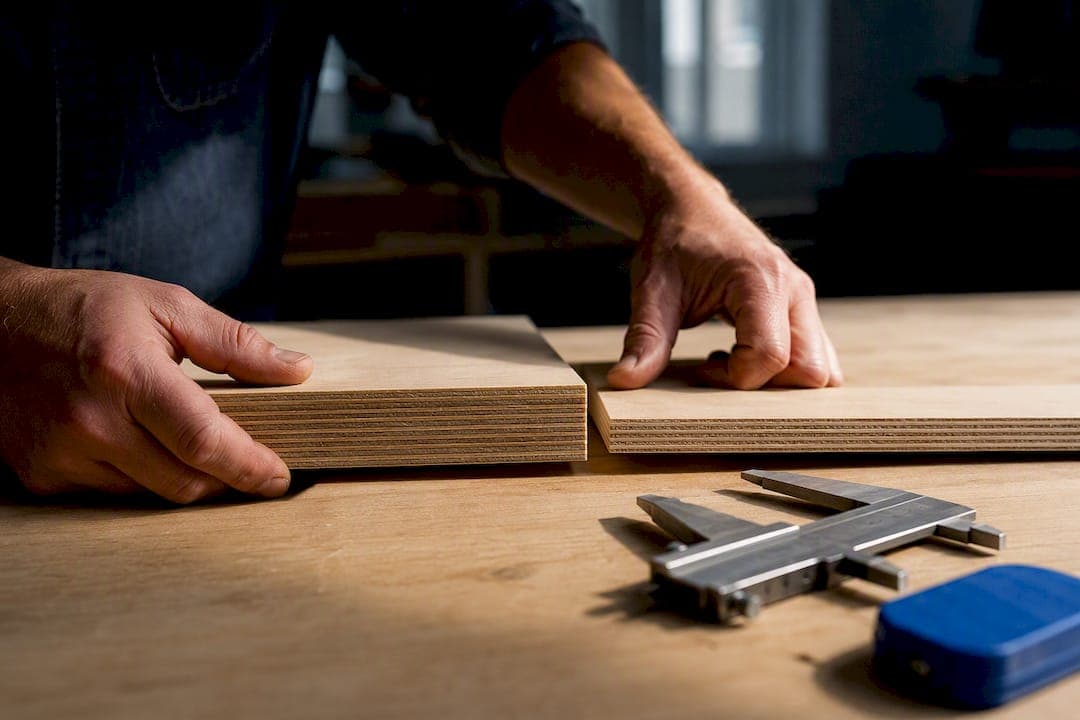
Choose 3/4" plywood for cabinet boxes, wide or heavily loaded shelves, workbench tops, and anything structural. Choose 1/2" plywood for drawer sides, some wall cabinet boxes, and short spans with light loads, but only after you check the span against a deflection guideline. When you're not sure which side of that line your project falls on, the reinforcement tricks and span rules below settle it fast.
TL;DR:
- Using 1/2" plywood for shelves over 24 inches without reinforcement risks excessive sag, especially with heavy loads or long spans.
- The actual thickness of 3/4" sheets is around 23/32" and for 1/2" sheets about 15/32", affecting fit and hardware installation.
- For interior panels, 3/4" plywood provides better screw-holding and durability, especially for load-bearing or hardware-intensive applications.
- Spanning beyond 36 inches or supporting heavy objects requires 3/4" or additional supports to prevent noticeable deflection.
- For moisture resistance and finish quality, plywood's veneer species, glue type, and sealing matter more than thickness alone.
Table of Contents
- 3/4 vs 1/2 Plywood: What Nominal Sizing Actually Gets You
- How Far Can Plywood Span Before It Sags?
- Does Thickness Change How Well Screws and Hardware Hold?
- Which Thickness Fits Your Project: Drawers, Shelves, Boxes, or a Workbench?
- What Do 3/4" and 1/2" Sheets Actually Cost You?
- A Four-Step Checklist for Picking the Right Thickness
- From the Cabinet Shop: How Best Cabinet Specialist Picks Plywood Thickness
- Does Plywood Thickness Change How It Handles Moisture?
- Which Thickness Takes Veneer and Laminate Best?
- What Sheet Sizes Are Actually Available at the Yard?
- How Does Thickness Affect Cutting and Machining?
- Are There Formaldehyde or Sustainability Differences Between Thicknesses?
- A Cabinetmaker's Take: Why the Trade Leans Toward 3/4"
- Skip the Sheet Goods: Order Finished Cabinet Boxes Instead
- Sources
- FAQ
3/4 vs 1/2 Plywood: What Nominal Sizing Actually Gets You
Plywood sold as "3/4 inch" or "1/2 inch" almost never measures that thickness on a tape. Manufacturers size sheets to a nominal target, then sand the face veneers, which shaves off real material. A sheet labeled 3/4" typically measures 23/32" actual, and a sheet labeled 1/2" typically measures 15/32" actual. That gap sounds small, but it changes how a dado fits, how deep a rabbet needs to be cut, and how a hinge plate seats against the panel edge.
Ply count matters just as much as raw thickness. A 3/4" sheet usually carries seven plies in cabinet-grade birch or Baltic birch, while a construction-grade CDX sheet of the same nominal thickness might get by with five thicker plies and voids you won't see until you cut into it. More plies at a given thickness generally means better screw-holding and less tendency to blow out at the edges when you drive a fastener close to the perimeter.
A few practical differences worth planning around:
- Dado depth: cut dados to match actual thickness, not the nominal label, or your shelves will rock in their slots.
- Hinge mounting: European-style cup hinges need enough meat in the door panel; 1/2" doors can work but leave less margin for adjustment screws.
- Edge banding: thinner panels show more visible ply lines at the edge, so edge banding becomes more important on 1/2" stock than on 3/4".
- Veneer species: birch and maple face veneers hold screws better than cheaper fir faces common on construction-grade sheets.
If you're also weighing whether to skip plywood entirely, it's worth reading how MDF compares to plywood for cabinet boxes, since MDF fails differently under the same span pressures.
How Far Can Plywood Span Before It Sags?
Shelf sag isn't linear, and that trips up a lot of first-time builders. Deflection increases with the fourth power of span and decreases with the cube of thickness, which means a shelf that's a few inches longer sags dramatically more than the math looks like it should, while bumping thickness only helps in a much smaller, diminishing way.
By the numbers: A 30" wide, 12" deep shelf built from 5/8" plywood carrying 30 pounds per foot of uniform load deflects under 0.02 inches. That's a shelf most people would call rock solid, and it's not even the full 3/4" thickness.
Rough field rules that hold up across most cabinet and shelving work:
- Up to 24" unsupported, light loads (books, folded linens): 1/2" plywood is usually fine.
- 24" to 36" spans, or moderate loads (dishes, canned goods): step up to 5/8" or add edge stiffening.
- Over 36", or heavy loads (tools, small appliances, gear): go 3/4" or break the span with a center support.
The Sagulator calculator lets you punch in your own span, thickness, and load and see the deflection in inches before you cut a single sheet. It's the fastest way to stop guessing on an unusual shelf size.
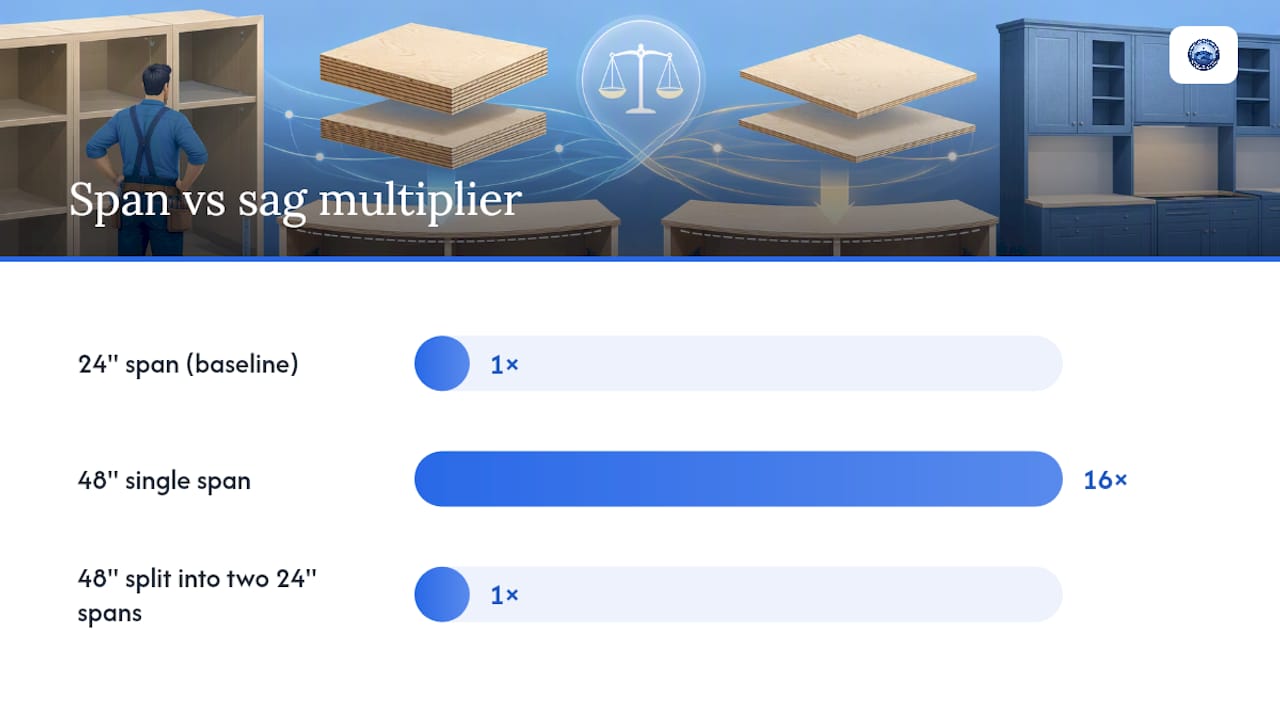
Here's the part most DIYers miss: shortening a span by even a couple of inches often beats jumping a full thickness grade. Cabinet shelving span data backs this up. Because deflection scales with span to the fourth power, adding one center support to a 48" shelf and turning it into two 24" spans cuts sag by roughly 16 times, not just half. That's usually cheaper and easier than re-cutting every shelf in thicker stock.
Does Thickness Change How Well Screws and Hardware Hold?
Yes, and it's one of the most common places 1/2" plywood gets misused. Screw withdrawal strength depends heavily on how much material surrounds the threads, so a 3/4" panel gives fasteners more to bite into than a 1/2" panel, especially near an edge where a thin panel can split before the screw seats.
That doesn't mean 1/2" is off the table for hardware-heavy parts. Cabinetmakers compensate a few reliable ways:
- Captured bottoms: drawer bottoms sit in a groove routed into the sides rather than relying on face screws, so the bottom panel can stay thin (often 1/4") without carrying structural load.
- Glued dadoes: a glued dado joint spreads load across the full width of the joint instead of concentrating it at a few screw points, letting 1/2" sides perform closer to what you'd expect from thicker stock.
- Backing blocks: a small hardwood or plywood block glued behind a hinge or slide mounting point gives screws extra depth to grab without upsizing the whole panel.
Pro Tip: Pre-drill every screw hole in plywood edges, even in 3/4" stock. Driving a screw straight into the edge grain of any plywood without a pilot hole is the single fastest way to blow out plies and strip the hole. Match screw length so at least 3/4 of the thread depth lands in solid material, not just the outer veneer.
Which Thickness Fits Your Project: Drawers, Shelves, Boxes, or a Workbench?
Match the panel to the job instead of defaulting to one thickness for everything in the shop.
- Drawer sides: 1/2" plywood is the standard choice, paired with a captured 1/4" bottom riding in a groove. Step up to 5/8" or 3/4" only for oversized drawers carrying heavy tools or cookware.
- Shelves, by span: spans up to 24" with light loads do fine in 1/2"; 24" to 36" call for 5/8" or a hardwood edge; anything past 36", or shelves under real weight, need 3/4" or a center support.
- Cabinet boxes: base cabinets, which carry counter loads and heavier storage, generally get 3/4" sides and bottoms, since those panels also carry the most hardware. Wall cabinets, which hold lighter items and hang from a rail, can often use 1/2" sides without issue, which is a pattern that shows up consistently across cabinet construction guides.
- Structural and shop surfaces: subfloors, workbench tops, and heavy-duty platforms almost always call for 3/4". The combination of impact resistance, screw-holding, and resistance to point loads from dropped tools or clamped work makes anything thinner a poor trade for the modest weight savings.
What Do 3/4" and 1/2" Sheets Actually Cost You?
A full 4x8 sheet of 3/4" cabinet-grade birch typically runs noticeably heavier and pricier than the same sheet in 1/2", and the weight difference matters more than most first-time builders expect. A 3/4" birch sheet can weigh close to 80 pounds; drop to 1/2" and you're often shaving off close to a third of that, which changes how many people you need to safely wrestle a sheet onto a table saw.
Paying more for 3/4" cabinet-grade stock over construction-grade CDX buys you fewer voids, better face veneer for a paint or stain finish, and hardware that mounts flat instead of sinking into a hidden gap. That translates into fewer callbacks on a job and less fiddling with backing blocks during install.
A few things worth checking at the lumberyard before you buy:
- Sight down the edge of the sheet for visible voids between plies.
- Ask whether the face veneer is rotary-cut or plain-sliced; plain-sliced faces take stain more evenly.
- Buy cabinet-grade for anything visible or load-bearing, and save construction-grade for jigs, templates, and backing.
A Four-Step Checklist for Picking the Right Thickness
Run through this before you order sheet goods, not after you've already cut parts.
- Measure the clear span and estimate the load. Measure the actual unsupported distance the panel needs to cross, then estimate what it will carry: books and folded linens are light, dishware and canned goods are moderate, tools and small appliances are heavy.
- Match span and load to a thickness guideline. Under 24" with light loads, 1/2" is fine. Mid-range spans of 24" to 36" usually call for 5/8" as the practical compromise. Wide spans or heavy loads point straight to 3/4".
- Pick grade, species, and reinforcement. Choose cabinet-grade birch or maple for anything visible, then add a glued hardwood edge or a back cleat if the span sits right at the edge of your guideline.
- When the numbers are borderline, default to 3/4". The added cost per sheet is small compared to the labor of rebuilding a shelf that sags within a year.
Pro Tip: Gluing a 1x2 hardwood strip to the front edge of a shelf does more than dress it up. It stiffens the panel like a small I-beam and can extend the usable span by roughly 15 to 25 percent, depending on the wood species and how well the glue joint is clamped.
From the Cabinet Shop: How Best Cabinet Specialist Picks Plywood Thickness
Cabinet boxes are built around span and load logic similar to that covered above, rather than a one-size-fits-all sheet. Base cabinets, which carry countertop weight, storage loads, and most of the mounting hardware, often use heavier 3/4" plywood sides and bottoms. Wall cabinets, which hang from a rail and typically hold lighter items, can use thinner panels where the engineering supports it, keeping the finished piece lighter without sacrificing necessary strength.
A few shop-level fixes show up again and again in production cabinetry:
- Solid-wood nosing glued to shelf fronts adds stiffness without switching every shelf to a heavier panel.
- Captured, glued bottoms on drawer boxes spread load across the joint instead of relying on a handful of screws.
- Backing blocks behind hinge mounting points give hardware more material to bite into on lighter panels.
These aren't theoretical fixes. They're the same adjustments any experienced shop makes daily to get lightweight and heavy-duty panels performing where each one belongs.
Does Plywood Thickness Change How It Handles Moisture?
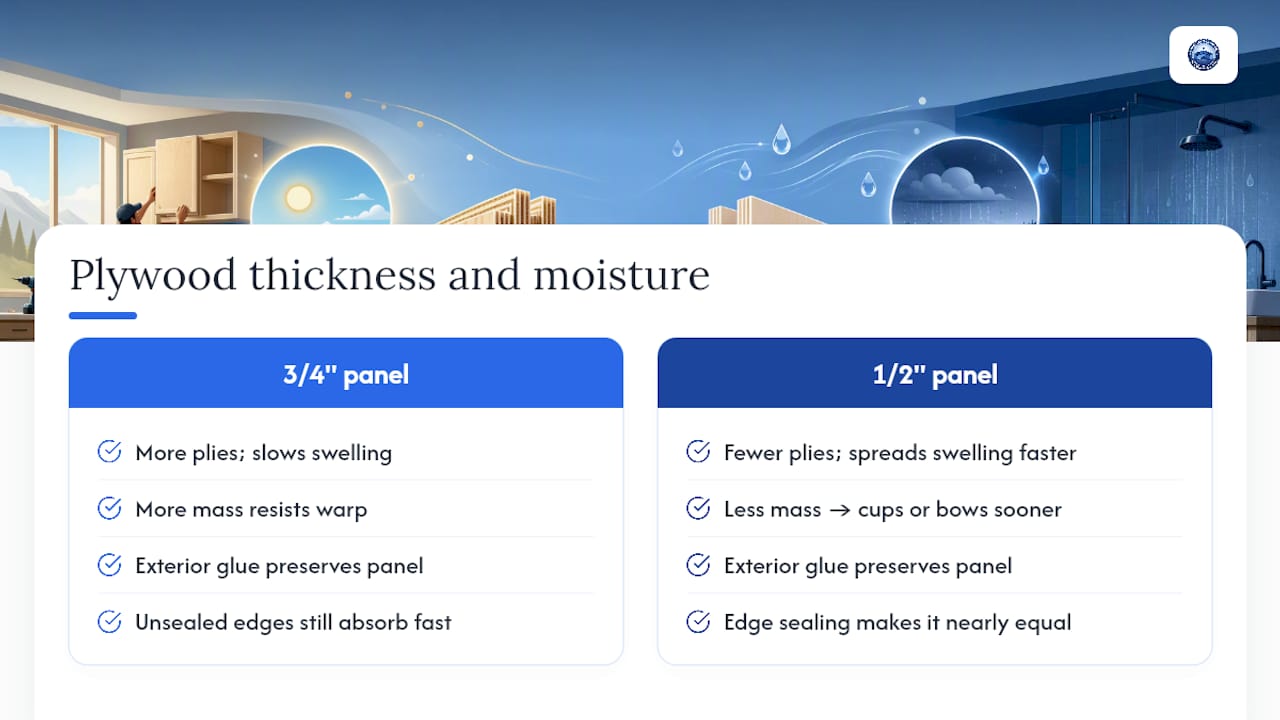
Thicker plywood isn't automatically more moisture-resistant; the veneer species, glue type, and exterior grading matter more than the raw dimension. That said, thickness still plays a role in how a panel behaves once moisture gets into it. A 3/4" panel has more plies stacked between the faces, which slows how quickly swelling at one edge telegraphs through to warp the whole sheet. A 1/2" panel has less mass to resist that movement, so it tends to cup or bow faster when exposed to humidity swings under a sink or near a dishwasher.
Glue type matters just as much. Exterior-grade and marine-grade plywood use waterproof adhesives regardless of thickness, while interior-grade sheets in either thickness will delaminate given enough sustained moisture. If you're building a bathroom vanity or a cabinet near a water source, buy for the glue rating first and the thickness second.
Edge sealing is the detail most DIYers skip. Raw plywood edges soak up moisture far faster than the faces, since you're exposing the end grain of every ply at once. A thin bead of edge banding or a coat of exterior-rated finish on cut edges protects a 1/2" panel almost as well as leaving a 3/4" panel unsealed, which tells you edge treatment often does more work than thickness alone.
For anything going into a kitchen or bath, checking how a cabinet line handles durability under real-world testing standards gives you a better read on long-term performance than thickness specs alone.
Which Thickness Takes Veneer and Laminate Best?
Face veneer quality has more to do with how a sheet finishes than the nominal thickness does, but thickness still shapes your options. Thicker 3/4" panels give you more room to sand out minor surface imperfections before applying a veneer or laminate without cutting through to the core plies underneath. Thinner 1/2" panels leave far less margin, so any sanding has to be light and even.
Cabinet-grade plywood, in either thickness, comes with a sanded, void-free face designed to take stain, paint, or a thin veneer cleanly. Construction-grade sheets, even at 3/4", often show patches, knots, or overlapping veneer seams that bleed through a laminate unless you add a layer of MDF or hardboard skin first.
Laminate adhesion depends more on how flat and stable the substrate stays than on thickness, but a 3/4" panel resists the minor flexing that can eventually crack a rigid laminate at stress points, particularly along an unsupported edge. For anything getting a laminate countertop-style surface or a rift-cut veneer face, 3/4" substrate is the safer bet on long panels; 1/2" can still work fine on smaller, well-supported pieces like drawer fronts or cabinet end panels that aren't spanning any real distance.
What Sheet Sizes Are Actually Available at the Yard?
Standard plywood ships in 4x8 sheets across both 3/4" and 1/2" thickness, and that size dominates what you'll find on the shelf at any home center or lumberyard. Larger 5x5 and 4x10 sheets exist for specialty runs, but expect to special-order them and pay a premium, since most retailers don't stock oversized sheets in cabinet-grade material.
Availability skews differently by grade. Construction-grade CDX in both thicknesses is easy to find almost anywhere lumber is sold. Cabinet-grade birch or maple in 3/4" is common at hardwood specialty suppliers and larger home centers, but 1/2" cabinet-grade sheets can be spottier depending on your region, since demand runs lower than for the 3/4" stock most cabinet boxes require.
If you can't find 1/2" cabinet-grade locally, ripping a 3/4" sheet isn't an option since you can't resaw plywood down through its plies without destroying it. Your realistic choices are ordering online, checking a specialty hardwood dealer, or adjusting your design to use 5/8" or 3/4" instead. Worth checking before you commit to a cut list that assumes a thickness your local supplier doesn't carry.
How Does Thickness Affect Cutting and Machining?
Thinner 1/2" plywood chips and splinters more easily than 3/4" stock, particularly on the underside of a cut where the blade exits the material. That's a function of ply thickness relative to the panel: each individual layer in a 1/2" sheet is thinner, so there's less material backing up the veneer face when a blade tears through it.
A sharp blade with a high tooth count matters more on 1/2" panels than on 3/4". A 60 to 80 tooth plywood or laminate blade minimizes tear out on thin sheets, while a standard 24 tooth combination blade that would leave a passable cut on 3/4" stock can leave a ragged edge on 1/2".
Sheet flex during cutting is the other issue. A full 4x8 sheet of 1/2" plywood sags and flexes more on a table saw or across sawhorses than the same sheet in 3/4", which makes it harder to keep a straight cut on long rips. Supporting the sheet fully, not just at the ends, matters more with thinner stock. Routing dados and rabbets in 1/2" panels also leaves less margin for error, since a bit set slightly too deep can blow through the panel or leave a paper-thin wall between the cut and the opposite face.
Are There Formaldehyde or Sustainability Differences Between Thicknesses?
Formaldehyde emissions come from the glue used to bond plies together, not from the thickness of the panel itself, so a 1/2" sheet isn't inherently cleaner or dirtier than a 3/4" sheet of the same grade and glue type. What matters is whether the panel meets a recognized emissions standard, since interior-grade plywood historically relied on urea formaldehyde adhesives that off-gas more than the phenol formaldehyde resins used in exterior grades.
Sustainability certification works the same way across thicknesses. A sheet certified by a forestry program applies to the wood sourcing and manufacturing process, not the dimension you cut it to, so a certified 1/2" sheet and a certified 3/4" sheet from the same mill carry the same sourcing credentials. If low emissions or certified sourcing matters for your project, especially in a kitchen or bedroom where off-gassing has more time to affect indoor air, check the panel's certification label rather than assuming thickness tells you anything about it.
A Cabinetmaker's Take: Why the Trade Leans Toward 3/4"
Tradespeople default to 3/4" because callbacks are expensive and a sagging shelf a year after install costs more than the extra material would have. That bias makes sense on a jobsite where labor dwarfs lumber cost.
But the honest compromise, when weight or budget matters, is often 5/8" with a glued hardwood edge, not a blanket downgrade to 1/2". It holds up under moderate loads and saves real weight over 3/4".
If your project doesn't match any rule of thumb cleanly, run it through Sagulator before you buy sheets. Five minutes with real numbers beats guessing every time.
— Nathan
Skip the Sheet Goods: Order Finished Cabinet Boxes Instead
Building cabinet boxes from sheet goods gives you full control over thickness and joinery, but it also means buying full sheets, running your own span calculations, and living with whatever tear out or squareness issues show up along the way. Finished cabinet boxes are built with plywood construction sized correctly for base versus wall cabinets, paired with solid wood doors and soft-close hardware, then shipped promptly to help keep renovation timelines on track.

Ordering finished cabinets is beneficial when timelines are tight, when matching boxes are needed across a kitchen or bath without cutting each by hand, or when a consistent, warrantied product is preferred over managing plywood grading and hardware sourcing manually. Pricing and bulk ordering options can accommodate both contractors managing multiple jobs and homeowners tackling single renovations. For styles, finishes, and pricing, visit a cabinet supplier's website and request a project quote before your next sheet-goods order.
Sources
- Sagulator (Woodbin calculators)
- DIY Stack Exchange — how thick should kitchen cabinet shelves be? (2022)
- Plywood thickness chart (BertaStore)
- Free span limits of cabinet shelving (Woodweb knowledge base)
FAQ
Should I use 1/2" or 3/4" plywood for drawers?
Use 1/2" for drawer sides with a captured 1/4" bottom; reserve 3/4" for oversized drawers carrying heavy tools or cookware.
Should I use 1/2" or 3/4" plywood for garage shelves?
For garage shelves holding tools or heavy gear, use 3/4" plywood or add a center support; 1/2" is only reliable for light storage under short spans.
Is 1/2" plywood strong enough to walk on?
No. Half-inch plywood flexes too much across a normal joist span and isn't rated for foot traffic; use 3/4" for subfloors or any surface people will stand on.
Is 3/4" plywood strong enough to sit on?
Yes, when properly supported by a frame or cabinet base, 3/4" plywood handles the point load of sitting or standing without noticeable deflection, which is why it's the standard for workbench tops and platforms.