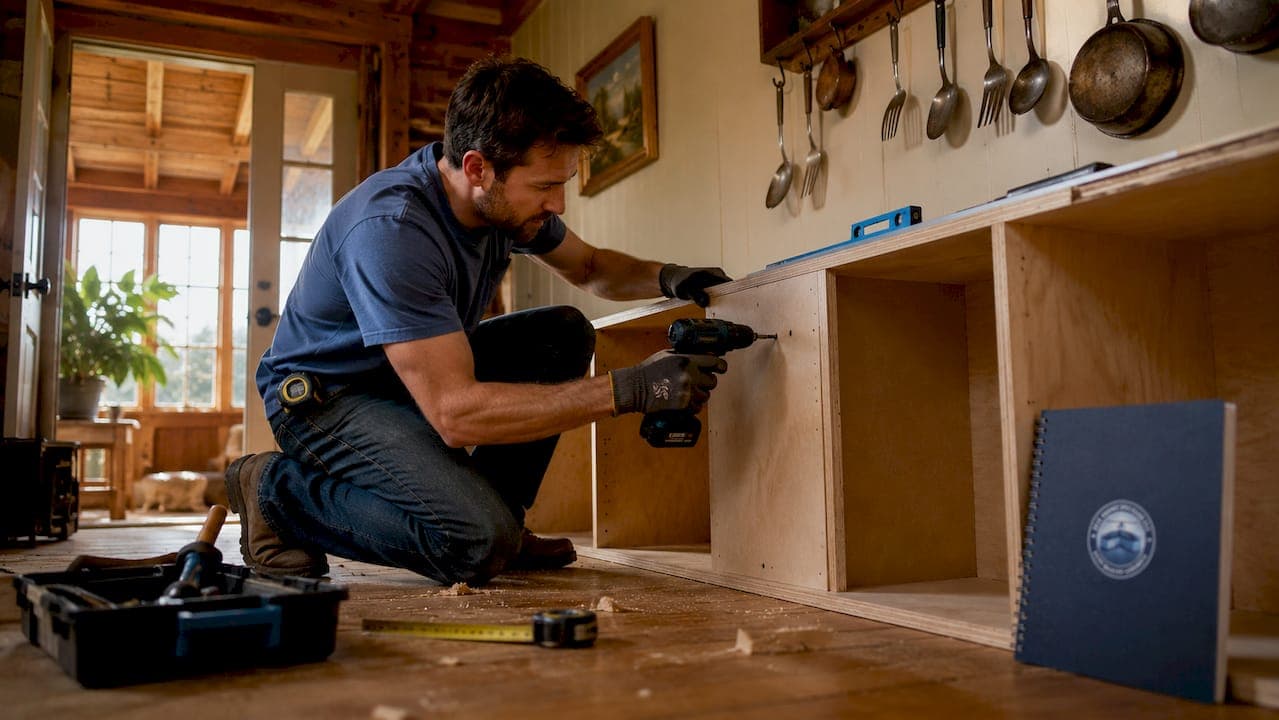
Plywood kitchen cabinets are the most durable and cost-effective choice for kitchen renovations, outlasting MDF and particleboard by a wide margin. High-end plywood cabinets last 20–30 years, compared to just 8–10 years for MDF or particleboard alternatives. That difference comes down to cross-grain construction, where alternating wood layers lock together to resist warping, swelling, and moisture damage. For homeowners and DIY renovators working with a real budget, understanding plywood grades, core types, and finish options is the fastest path to a kitchen that holds up for decades.
1. Why plywood kitchen cabinets outperform the alternatives
Plywood beats MDF and particleboard in kitchens because of how it is built. Each sheet stacks multiple wood veneers with the grain running perpendicular between layers. Cross-grain construction keeps plywood stable against humidity swings, which is exactly the condition every kitchen creates daily.
MDF swells when it absorbs moisture and rarely recovers its original shape. Particleboard is even more vulnerable, especially around sinks and dishwashers. Plywood holds its form because the alternating grain layers work against each other, preventing expansion in any single direction.
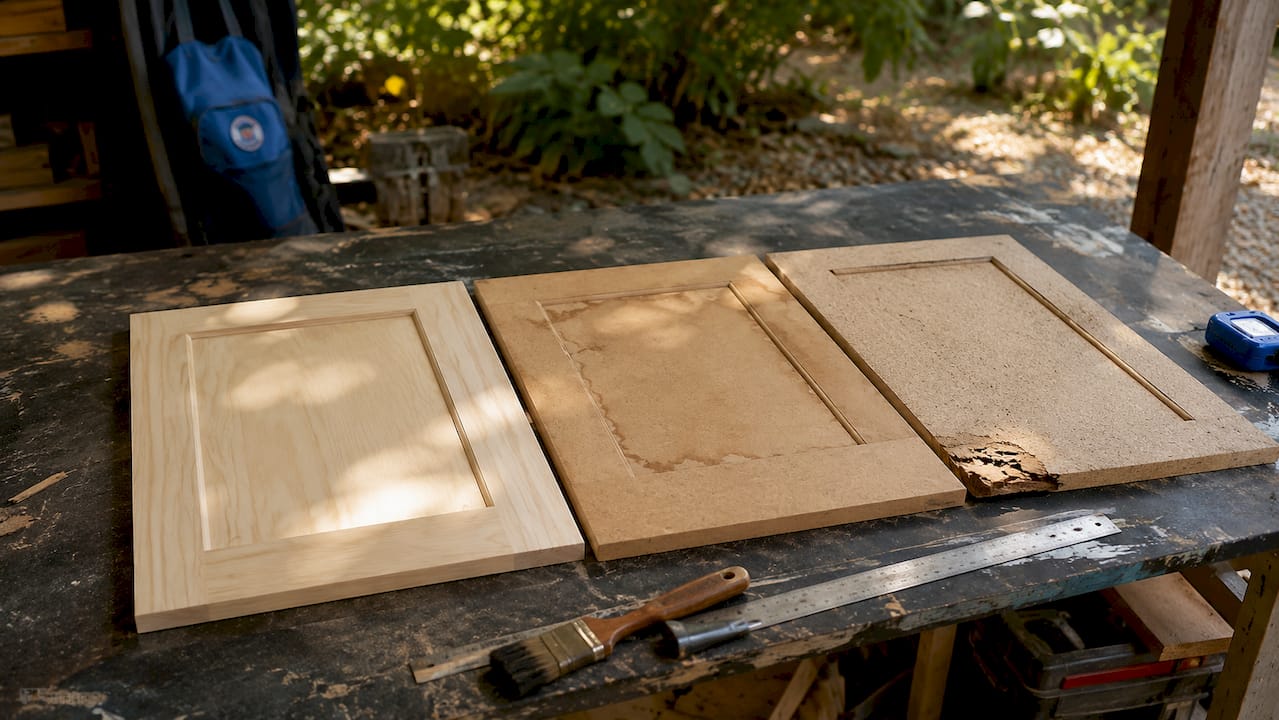
Plywood weighs roughly 15% less than MDF of the same thickness. That matters for DIYers hanging upper cabinets alone or managing a full kitchen install without a crew.
2. The most important plywood grades for cabinet boxes
Plywood grade determines surface quality and structural reliability. The grade system uses letter pairs to rate the face and back veneer separately.
- B/BB grade: One smooth, nearly defect-free face and one face with minor repairs. Use this for visible interiors like open shelving or glass-front cabinets.
- BB/BB grade: Both faces have small repairs but remain structurally sound. BB/BB grade is recommended for standard closed cabinet boxes where the interior is not visible.
- Baltic birch (all-birch core): Multiple thin birch plies with no voids. The gold standard for cabinet carcasses that need reliable screw holding and clean edge appearance.
- Combi core: A mix of veneer plies and a thicker lumber core. Lighter than all-veneer plywood but still strong. Good for large cabinet panels where weight is a concern.
Pro Tip: Use B/BB or Baltic birch for any cabinet section you can see, including shelf interiors and face frames. Save BB/BB for hidden carcass walls where appearance does not matter.
3. How plywood is constructed to outlast other materials
The structural advantage of plywood comes from its layered core, not just its face veneer. Standard veneer-core plywood stacks thin wood sheets with alternating grain direction, then bonds them under heat and pressure. The result is a panel that resists bending, splitting, and moisture absorption far better than a homogeneous sheet of MDF.
The one weakness in standard veneer-core plywood is voids. Gaps between inner plies create weak points where screws can strip and edges can delaminate. Baltic birch cores are preferred for void-free strength, especially in visible edges and areas that carry heavy loads like base cabinet floors.
| Property | Plywood | MDF | Particleboard |
|---|---|---|---|
| Moisture resistance | High | Low | Very low |
| Screw holding | Strong | Moderate | Weak |
| Weight | Moderate | Heavy | Heavy |
| Lifespan | 20–30 years | 8–10 years | 8–10 years |
| Edge quality | Good (Baltic birch) | Smooth | Poor |
Pro Tip: Ask your lumber supplier specifically for "void-free" or "Baltic birch" plywood. Standard cabinet-grade birch from a big-box store may contain voids that are not visible until you cut into the sheet.
4. Standard plywood thicknesses for kitchen cabinet parts
Thickness selection affects both cost and structural performance. Using the right thickness in the right location keeps your build strong without overspending on material.
3/4" (18mm) thickness is standard for cabinet box walls, floors, and tops. It provides the rigidity needed to support countertops and heavy dish loads without flexing. Cabinet backs and drawer bottoms typically use 1/2" (12mm) plywood, which reduces weight and cost without sacrificing function.
Drawer boxes are the one place where thinner plywood pays off. A 1/2" drawer box in Baltic birch holds screws and dovetail joints reliably. Going thinner than 1/2" on drawer sides risks splitting at the joint over time.
5. What plywood grades cost and how to budget your project
Cabinet-grade birch plywood typically costs $65–$90 per 4x8 sheet at lumberyards, with the full range running $50–$120 depending on species and grade. Baltic birch sits at the higher end of that range. Standard birch BB/BB falls in the middle and works well for most closed cabinet boxes.
A typical 10-foot by 10-foot kitchen layout uses roughly 15–20 sheets of plywood for the cabinet carcasses. Budgeting $1,200–$1,800 for raw plywood material is realistic for a mid-size kitchen using cabinet-grade birch. That cost rises with Baltic birch and drops with lower-grade options used in hidden areas.
The smartest budget move is to mix grades strategically. Spend on Baltic birch for base cabinet floors, drawer boxes, and any visible interior. Use BB/BB for upper cabinet walls and backs where no one looks.
6. Design and finish options for plywood cabinet boxes
Plywood is primarily a structural material. The face you see in a finished kitchen usually comes from the door and drawer front, not the carcass itself.
Premium kitchens use plywood for cabinet boxes and MDF or solid wood for door faces to balance structural strength with smooth, paintable surfaces. MDF doors take paint exceptionally well because the surface has no grain to telegraph through the finish. Solid wood doors add warmth and character but cost more and require more careful finishing.
Common finish and style combinations that work well with plywood carcasses:
- Shaker style: Solid wood or MDF shaker doors paired with a plywood box. Works in both traditional and modern kitchens.
- Modern slab: Flat MDF or thermofoil doors on a plywood carcass. Clean lines, easy to clean, and budget-friendly.
- Open shelving: Plywood with a clear coat or hardwood veneer face for a natural wood look. Baltic birch edges look sharp with a simple sanded finish.
- Painted finish: MDF door faces with a plywood box, painted in a single color. Interior designers recommend this combination for smooth, modern cabinet finishes.
- Laminate wrap: A cost-effective option where a plastic laminate covers the plywood face for durability and easy cleaning.
The plywood carcass does not limit your design options. You can pair the same box construction with nearly any door style, hardware finish, or color palette.
7. How to choose the right plywood cabinets for your renovation
Choosing the right kitchen plywood cabinets comes down to four factors: your budget, your kitchen's moisture exposure, how much of the cabinet interior is visible, and how long you plan to stay in the home.
- Assess moisture exposure first. Cabinets near the sink, dishwasher, or refrigerator water line need void-free Baltic birch or a moisture-resistant plywood grade. Standard veneer-core plywood works fine for upper cabinets away from water sources.
- Match grade to visibility. Different grades apply to visible and hidden areas to control cost without cutting structural corners. B/BB for open shelves, BB/BB for closed boxes.
- Check for voids before you buy. Look at the sheet edges at the lumberyard. Visible gaps between plies signal a lower-quality core that will cause problems at screw points and joints.
- Factor in warranty and longevity. If you plan to stay in your home for 15 or more years, investing in Baltic birch pays off. For a short-term renovation before selling, BB/BB cabinet-grade birch delivers solid performance at a lower price point.
- Consider ready-to-assemble cabinet options if you want plywood box construction without cutting and assembling sheets yourself. Many RTA cabinet lines now use plywood carcasses with solid wood doors, giving you the durability of site-built cabinets at a fraction of the labor cost.
Key takeaways
Plywood kitchen cabinets last 20–30 years because cross-grain construction resists moisture, warping, and screw failure better than MDF or particleboard.
| Point | Details |
|---|---|
| Lifespan advantage | Plywood lasts 20–30 years versus 8–10 years for MDF or particleboard. |
| Best core for strength | Baltic birch void-free cores hold screws reliably and resist edge delamination. |
| Grade strategy | Use B/BB for visible interiors and BB/BB for hidden cabinet walls to control cost. |
| Standard thickness | 3/4" for box walls and floors, 1/2" for backs and drawer parts. |
| Design flexibility | Plywood carcasses pair with any door style, from shaker solid wood to modern MDF slab. |
Why I always recommend starting with the core, not the door
Most homeowners walk into a kitchen showroom and fall in love with a door style. That is the wrong place to start. The door is the easiest thing to change. The carcass is what you are stuck with for 20 years.
I have seen kitchens where the doors looked beautiful on day one but the particleboard boxes were sagging within five years. The hinges pulled out, the shelves bowed, and the whole thing needed replacing. Meanwhile, a kitchen built on a solid plywood carcass with basic painted MDF doors still looks and functions perfectly after 15 years of daily use.
The advice I give every homeowner is this: spend your money on the box, then choose the door that fits your budget. A Baltic birch carcass with a simple shaker MDF door will outlast and outperform a fancy door on a weak box every single time. Core quality is the one place you should not cut corners.
The other mistake I see constantly is buying the same grade for every part of the cabinet. You do not need Baltic birch on the back wall of an upper cabinet that no one ever sees. Save it for the base cabinet floors, the drawer boxes, and the areas near water. That single decision can cut your material cost by 20% without touching structural integrity.
— Nathan
Affordable plywood cabinets, ready to ship from Best Cabinet Specialist
You now know what separates a cabinet that lasts from one that fails in five years. The next step is finding a source that builds to those standards without the premium price tag.
Best Cabinet Specialist offers durable plywood cabinet options built with plywood boxes and solid wood doors, designed for homeowners and contractors who want quality construction at competitive prices. As a women-owned and veteran-owned business, Best Cabinet Specialist focuses on fast shipping and honest craftsmanship, so your renovation stays on schedule and on budget. Browse the full selection and find project-ready cabinets that match your kitchen style.
FAQ
How long do plywood kitchen cabinets last?
Plywood cabinets last 20–30 years with normal use and proper care. That is roughly twice the lifespan of MDF or particleboard cabinet boxes.
What plywood grade is best for kitchen cabinets?
Baltic birch with a void-free core is the best choice for base cabinets and drawer boxes. BB/BB grade cabinet birch works well for upper cabinet carcasses where the interior is not visible.
Is plywood or MDF better for kitchen cabinet doors?
MDF is better for painted cabinet doors because its smooth surface takes paint without showing grain. Plywood is better for the cabinet box because it holds screws and resists moisture far more effectively than MDF.
What thickness of plywood should I use for cabinet boxes?
3/4" plywood is standard for cabinet walls, floors, and tops. Use 1/2" for backs and drawer bottoms to reduce weight and cost without losing structural performance.
Are plywood cabinets worth the extra cost over particleboard?
Yes. The longer lifespan, better moisture resistance, and stronger screw holding make plywood the better value over any renovation timeline longer than five years.