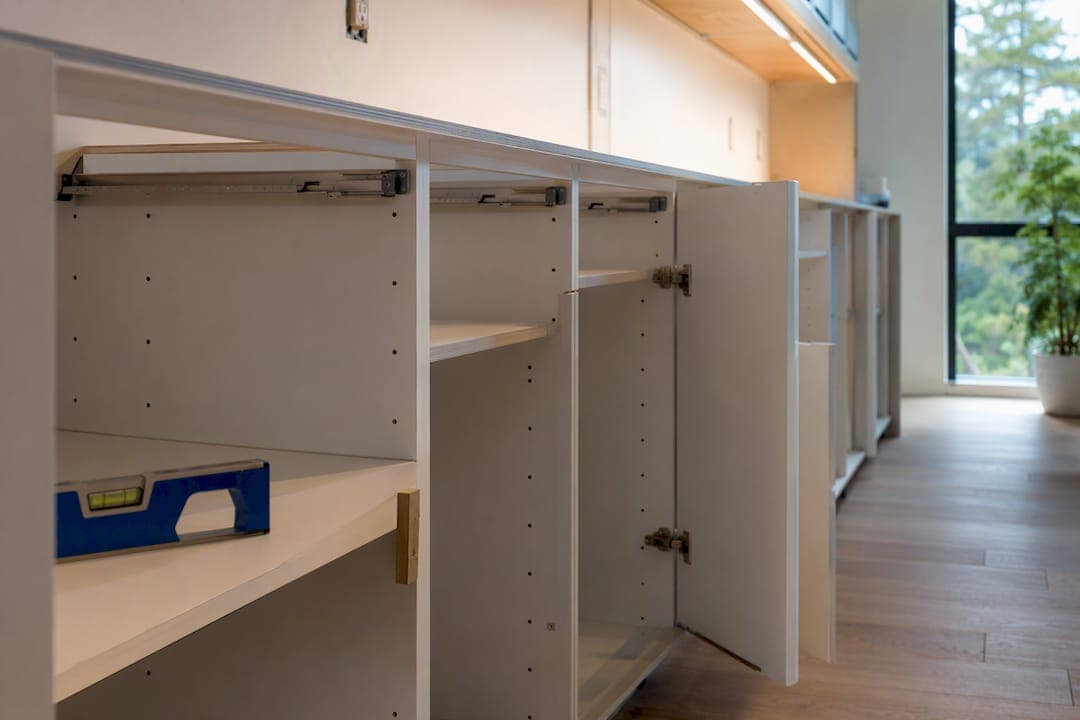
Frameless cabinets are the better choice if you want maximum storage, a clean modern look, and walls that are actually plumb and square. They struggle in older homes with wavy walls, and they cost more for the same materials because of tighter manufacturing tolerances. The Kitchen Cabinet Manufacturers Association sets the durability benchmarks worth checking, and Best Cabinet Specialist builds both styles on plywood boxes so you're not choosing between storage and strength.
TL;DR:
- Frameless cabinets offer about 15% to 20% more usable interior storage due to the absence of a face frame, allowing wider drawers and a sleek, flush front.
- A precise wall measurement is essential before installation, as deviations over a quarter inch can lead to visible gaps or door binding in frameless cabinetry.
- High-quality plywood or engineered panels are crucial for long-term hinge durability and proper support for full-extension drawer slides.
- Frameless cabinets are best suited for modern, straight-walled homes built after the 1980s, while traditional or uneven spaces benefit from framed construction.
- Proper installation requires careful wall assessment, skilled shimming, and quality hardware, as poor workmanship directly impacts functionality and appearance.
Table of Contents
- Pros: Measurable, Day-to-Day Advantages of Frameless Cabinets
- Cons: What Can Go Wrong or Cost More With Frameless Cabinetry
- How to Decide: A Concise Checklist and Key Questions to Ask
- Materials and Hardware That Make Frameless Cabinets Last
- Installation and Common Issues: What Installers Must Do Well
- Publisher's Perspective and Proof Points: Where Best Cabinet Specialist Fits
- Frameless vs. Framed Cabinets: Function and Look Side by Side
- Impact on Resale Value or Home Marketability
- Environmental Impact and Sustainability Considerations
- Suitability for Older or Out-of-Square Homes
- Author Perspective: Common Homeowner Trade-Offs
- If You Chose Frameless: How Best Cabinet Specialist Can Help
- Sources
- FAQ
Pros: Measurable, Day-to-Day Advantages of Frameless Cabinets
Frameless boxes drop the face frame entirely, so the whole opening becomes usable space. That single change is why frameless cabinetry gets called the "full access" style in trade circles.
Pro Tip: If you bake often, open a frameless drawer and a framed drawer side by side at a showroom. The width difference for sheet pans and mixer bowls is obvious in about ten seconds.
Frameless construction delivers roughly 15% to 20% more usable interior storage than a comparable framed box, simply because there's no 1.5 inch frame eating into the opening.
That gain shows up in three concrete ways for anyone comparing frameless cabinet advantages against a traditional layout:
- Wider drawers that fit standard sheet pans, mixer bowls, and stacked plates without wasted edge space.
- A continuous, flush front plane that reads as clean and modern, especially with slab doors or integrated panels.
- Compatibility with concealed three-way adjustable hinges and full-extension slides, which lets you fine-tune doors after they're hung.
- Easy-release hinges that pop free for wipe-downs, a small feature that makes routine cleaning noticeably faster.
Kitchen designers following NKBA planning standards often build storage layouts around this drawer-first approach, stacking wide, shallow drawers instead of deep cabinets with lazy susans.
Cons: What Can Go Wrong or Cost More With Frameless Cabinetry
The trade-off for that clean look is precision. Frameless boxes have no face frame to hide small gaps, so every wall imperfection becomes visible.
Pro Tip: Before you commit to frameless, run a 4-foot level along your kitchen walls in three spots. If you see more than a quarter inch of variation, budget extra time for shimming.
The real cons of frameless cabinets tend to cluster around four issues:
- Out-of-square or wavy walls create visible wedge-shaped gaps between cabinets, or force doors to bind against each other.
- Hinge screws mount directly into the cabinet gable rather than a thick frame, so stripped screws are harder to repair than on framed boxes.
- Frameless runs typically cost more for the same grade of materials and hardware, since thicker panels and tighter manufacturing tolerances drive up production cost.
- Inset doors, a popular traditional look, aren't compatible with frameless construction, and some manufacturers offer a narrower range of frameless door styles and finishes.
None of this makes frameless a bad choice. It just means the installer's skill matters more than it does with a forgiving face-frame box.
How to Decide: A Concise Checklist and Key Questions to Ask
Work through four steps before you sign a cabinet order, whether you're leaning frameless or still weighing framed vs. frameless cabinets:
- Measure your walls. Check plumb and square in at least three spots per wall run. Variations under a quarter inch are manageable; more than that means extra labor for shimming and scribing.
- Rank your priority. Decide whether maximum storage and a modern face matter more to you than the traditional look of inset or partial-overlay doors.
- Set a realistic budget. Price in the frameless premium for panels and hinges, plus installer time for precision leveling.
- Vet the installer. Ask specifically whether they've hung frameless runs before, not just cabinets in general.
When you talk to a supplier or contractor, ask about box material (plywood versus particleboard), hinge brand and adjustability, and any warranty covering hardware mounts and box edges. Ask to see photos of past frameless installs, not just framed work.
Walk away if a supplier can't answer hinge or warranty questions, refuses an on-site mock-up before final install, or quotes boxes made from low-grade particleboard with no mention of edge banding.
Materials and Hardware That Make Frameless Cabinets Last
The box material decides whether your hinges hold up over time. Plywood or higher-grade engineered panels grip screws far better than low-grade particleboard, which strips out and loosens under repeated door use.
Three-way adjustable concealed hinges are standard on quality frameless boxes. They let an installer adjust a door up and down, side to side, and in and out after hanging, which is how a continuous front plane actually gets dialed in.
For drawers, full-extension undermount slides or heavy-duty side-mount slides matter more on frameless boxes since there's no frame to help support weight at the opening.
Door and finish pairings that work well with the style:
- Slab doors for a minimalist, seamless look.
- High-pressure laminate for durability in high-traffic kitchens.
- Wood veneer for warmth without the cost of solid slab construction.
Plywood construction pays off most on frameless runs. Our plywood cabinet guide breaks down why box material affects long-term hinge performance more than most buyers expect.
Installation and Common Issues: What Installers Must Do Well
Good frameless installation starts before the first cabinet goes up. Installers should check wall plumb and level, mark level reference lines, and use suspension rails to hang upper cabinets at a consistent height before shimming and scribing base units to the floor.
Two mistakes show up again and again. Bowed walls that weren't shimmed properly leave wedge-shaped gaps at the seams. Poor shimming under base cabinets causes binding drawers that stick or won't close flush.
- Set hinges vertically first to align door height.
- Adjust laterally to close side gaps.
- Fine-tune the reveal last for an even, continuous line across the whole run.
Pro Tip: Skipping that order, or using budget hinges that won't hold adjustment, is the single most common reason frameless doors look uneven six months after install.
Hire a specialist for full kitchen runs; a confident DIYer can usually handle a single vanity or small run with a good level and patience.
Publisher's Perspective and Proof Points: Where Best Cabinet Specialist Fits
Best Cabinet Specialist builds both frameless and framed lines on plywood boxes with solid wood doors, soft-close hardware, and fast shipping, so a storage-driven renovation isn't stuck waiting months for cabinets. As a women-owned and veteran-owned business, the company serves homeowners, contractors, and builders who need project-ready cabinetry without long lead times.
Modern renovations, trade packages, and projects on a tight schedule tend to be the strongest fit. For more on finish choices, see our finish durability guide and door style breakdown.
Frameless vs. Framed Cabinets: Function and Look Side by Side
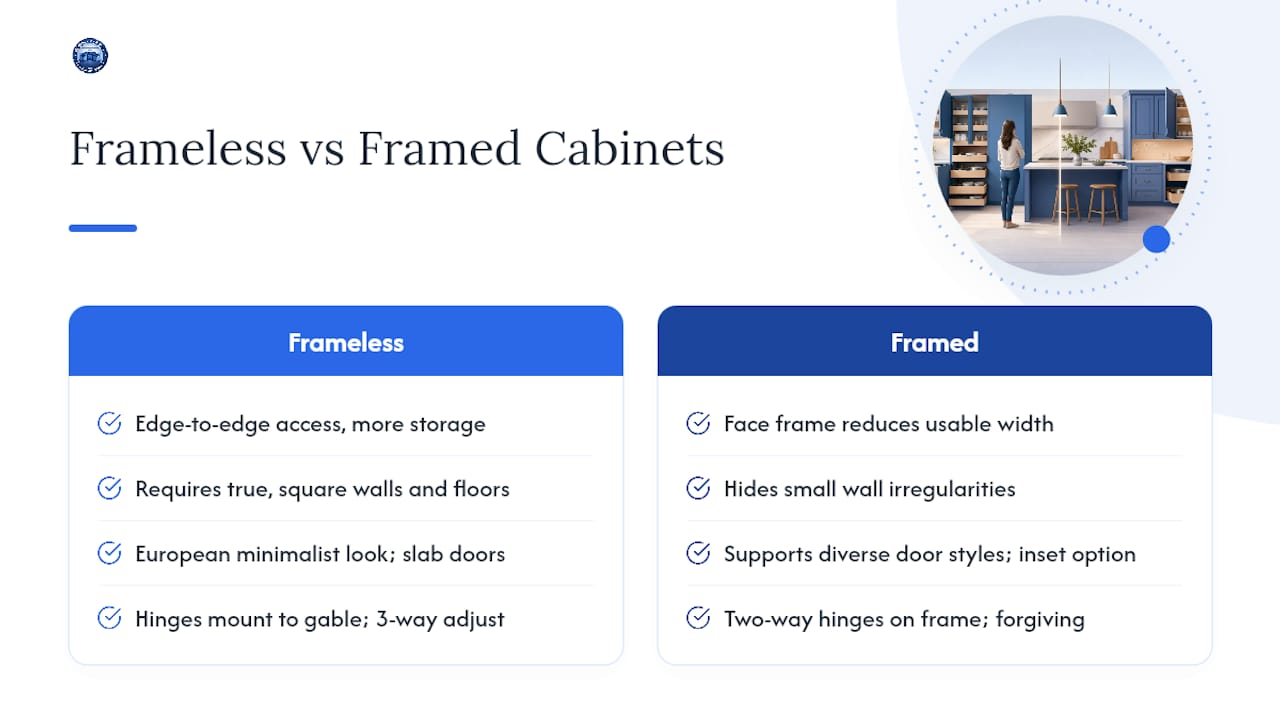
The functional gap between the two styles comes down to access and tolerance for imperfection. Frameless cabinets open fully edge to edge, which is why they store more, but they demand walls and floors that are close to true. Framed cabinets keep a face frame across the front, which trims usable width but hides small wall irregularities behind the frame's shadow line.
Aesthetically, frameless leans European and minimalist, with slab doors and a flush, continuous plane across the whole run. Framed cabinetry supports a wider range of door styles, including inset doors, which sit flush inside the frame for a furniture-like, traditional look that frameless construction simply can't replicate.
Hardware behaves differently too. Framed cabinets often use two-way hinges mounted to the sturdy frame itself, forgiving minor mounting imperfections. Frameless hinges mount into the cabinet gable directly and rely on three-way adjustability to correct for any variance, which is more capable but less forgiving of cheap hardware or sloppy installation.
Neither style is objectively "better" for every kitchen. A 1920s bungalow with settled, out-of-square walls usually looks and performs better with forgiving framed construction, while a new-build or gut renovation with true walls is where frameless earns its reputation. The decision should follow your walls and your storage priorities, not just current design trends.
Impact on Resale Value or Home Marketability
Cabinet style rarely makes or breaks a home sale by itself, but it does shape a buyer's first impression of the kitchen. A flush, modern frameless layout photographs well and tends to read as recently updated, which matters in listing photos where buyers make snap judgments scrolling online.
That said, frameless cabinetry isn't a universal upgrade in every market. In neighborhoods full of traditional or historic homes, a fully modern European-style kitchen can feel out of place next to the home's original architecture, and some buyers specifically want the inset-door, furniture-style look that only framed construction offers.
What consistently helps marketability regardless of style is build quality. Soft-close hardware, solid wood doors, and plywood boxes signal durability to buyers and inspectors alike, and cabinets that have held their alignment over years of use say more than the style label on the box. A poorly installed frameless kitchen with visible gaps or sticking drawers will hurt a sale far more than the choice between frameless and framed ever would.
Environmental Impact and Sustainability Considerations
Cabinet sustainability comes down largely to the box material and finish, not whether the cabinet has a frame. Plywood boxes generally use wood more efficiently than solid lumber framing, since manufacturers can produce them from thinner veneer layers bonded together, reducing waste per cabinet.
Frameless construction's efficient material use cuts both ways. It uses less wood overall per box since there's no separate frame component, but the tighter tolerances required often mean more precise (and sometimes more wasteful) cutting during manufacturing to avoid warping or misalignment.
Finish choice matters more than style category. Low-VOC finishes and formaldehyde-free adhesives in plywood construction reduce indoor air quality concerns, a factor increasingly relevant to homeowners renovating kitchens where cooking already generates airborne particles. Solid wood doors, whether on a frameless or framed box, tend to last longer than thin laminate wraps, which lowers the odds of a full cabinet replacement within a decade. Longevity is the biggest sustainability lever in cabinetry: a kitchen that lasts 20 years instead of 10 cuts landfill waste in half regardless of which construction style you chose.
Suitability for Older or Out-of-Square Homes
Older homes are where frameless cabinetry runs into its biggest limitation. Decades of settling, humidity swings, and foundation shifts leave walls and floors that are rarely true anymore, and frameless boxes have no face frame to visually absorb those irregularities.
Design experts generally agree that frameless suits modern, straight-walled rooms best, while framed construction remains the more forgiving choice in older, uneven spaces. That's not a hard rule, though. A skilled installer can still hang frameless cabinets in an older home using suspension rails, aggressive shimming, and scribe panels cut to match wall contours, but it takes more labor hours and a bigger contingency budget than a straightforward new-build install.
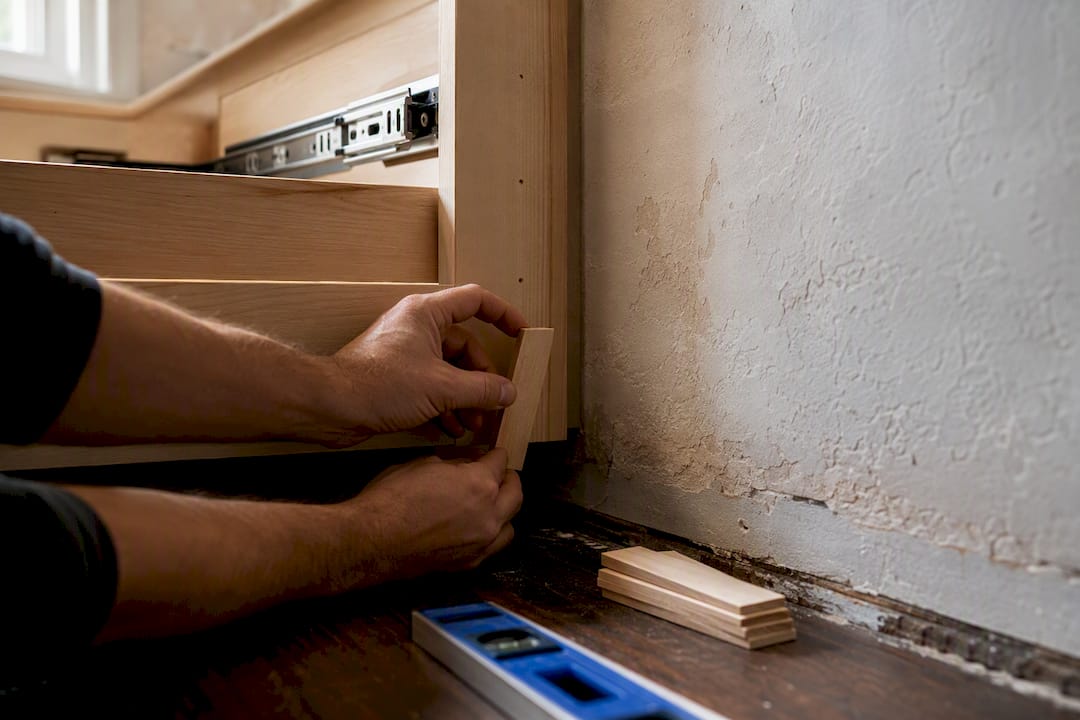
If your home was built before the 1980s and hasn't had a structural renovation, budget for a contractor to do a full plumb and square check before you commit to frameless. If the walls are off by more than half an inch across a run, either plan for scribe work or seriously consider framed cabinets, which tolerate that variance far more gracefully without visible gaps at the seams.
Author Perspective: Common Homeowner Trade-Offs
Most regret with frameless cabinets traces back to cheap hinges, not the style itself. Spend the extra money on plywood boxes and quality three-way hinges before you spend it on trim details. If you're weighing your options seriously, the next section walks through what to look for.
— Nathan
If You Chose Frameless: How Best Cabinet Specialist Can Help
Once you've decided frameless is right for your walls and your storage goals, the next question is where to source cabinets that won't let you down at the hinge screw. Some cabinet suppliers build RTA and fully assembled cabinets on plywood boxes with solid wood doors and soft-close hardware, so the frame you're skipping doesn't cost you durability.
Contractors and builders may benefit from trade pricing on bulk packages, and fast shipping helps keep frameless kitchen renovations on schedule without stalling for backordered boxes. Whether you need a single vanity run or a full kitchen package, browse frameless-capable cabinet options at Best Cabinet Specialist and request a quote before your installer's schedule opens up.
Sources
- Frameless Cabinets vs. Framed: Construction, Pros and Cons, and How to Choose
- Face frame vs frameless cabinet hinges
- KCMA certifications
- Frameless kitchen and bath cabinets
- What are frameless kitchen cabinets?
FAQ
What is the hottest trend in kitchen cabinets right now?
Slab-door frameless cabinets with a continuous, flush front plane are the dominant modern trend, often paired with integrated panel appliances and minimal hardware.
What is the best material for frameless cabinets?
Plywood boxes outperform particleboard for frameless construction because they hold screws better at the gable, where hinges mount directly without a supporting frame.
What are the disadvantages of frameless doors?
The main drawbacks are higher sensitivity to out-of-square walls, stripped hinge screws being harder to repair, a higher price for comparable materials, and no compatibility with inset door styles.
Which type of kitchen cabinet is better, framed or frameless?
Neither wins universally. Frameless suits modern, storage-focused kitchens with true walls, while framed cabinets are more forgiving in older or out-of-square homes and support traditional inset-door styling.