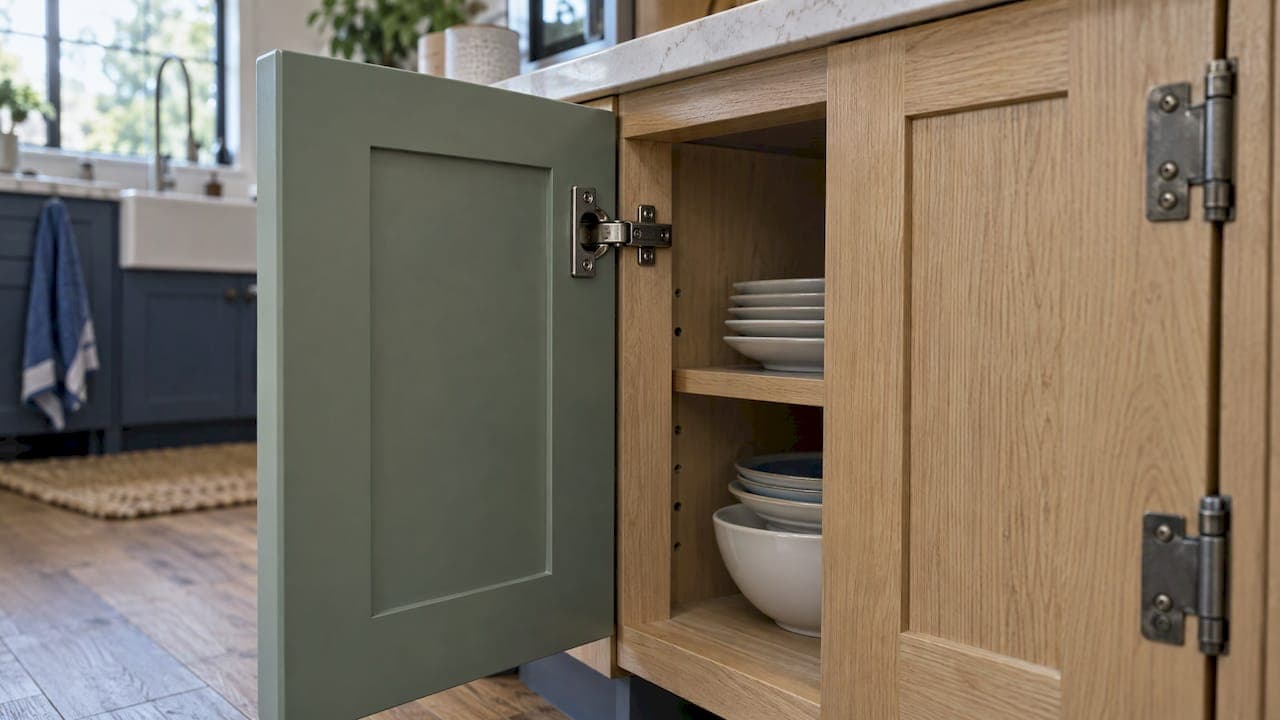
Concealed hinges disappear when the door is closed, adjust in several directions and often include soft-close. Exposed hinges stay visible on the door face and add character, with simple, durable mechanics. For most modern kitchens and bathrooms, concealed hinges are the practical default. For traditional, farmhouse or utility-style cabinets, exposed hinges can be a deliberate design choice. Below we break down how each type looks, works, fits your cabinet construction and affects your project.
TL;DR
- Concealed (European or cup) hinges are fully hidden when the door is closed, which gives a clean, minimal look.
- Exposed hinges are fully visible on the outside of the door and work as a decorative detail on traditional and farmhouse styles.
- Semi-concealed hinges sit in between: part of the hinge shows, usually the frame wing.
- Concealed hinges are adjustable after installation and often include soft-close. Exposed hinges are mechanically simpler.
- Your cabinet construction (frameless or face frame) and door overlay narrow the choice more than most buyers expect.
Table of Contents
- The difference in one minute
- Side-by-side comparison
- How each type changes the look of your kitchen
- Which hinge fits your cabinet construction
- Adjustment: where concealed hinges pull ahead
- Soft-close and durability
- What each option costs
- Installation: what to know before you start
- Perspective: why we favor concealed, soft-close hardware
- How to choose: a short decision list
- Shop cabinets built for project-ready installs
- Common mistakes to avoid
- FAQ
- Sources
The difference in one minute
There are three groups to know, and the names are easier than they sound.
Concealed hinges are often called European or cup hinges. According to a guide from an industry price comparison site, they are entirely hidden when cabinet doors are closed, while exposed hinges are fully visible from the outside. The hinge arm has a cup that sits in a 35mm round recess in the back of the door, and a mounting plate attaches to the cabinet side or face frame, as WOOD Magazine explains.
Exposed (surface-mount) hinges mount on the outside of the door and cabinet. Both leaves show. The Spruce notes that these hinges can come in attractive colors or designs and act as cabinet accents.
Semi-concealed hinges are partly visible. The Spruce describes the frame wing as mostly visible and the door wing as concealed. Finishes such as chrome or matte black can turn the visible part into a deliberate decorative detail.

If you want a deeper look at hinge anatomy and 35mm measurements, our cabinet hinge types guide walks through each style.
Side-by-side comparison
| Factor | Concealed hinges | Exposed hinges |
|---|---|---|
| Visibility when closed | Hidden | Fully visible |
| Best style fit | Modern, transitional, minimalist | Traditional, rustic, farmhouse, utility |
| Adjustment after install | Typically adjustable in three directions | Generally fixed once screwed in |
| Soft-close | Available built into the hinge | Not built in |
| Installation | Needs a 35mm cup hole in the door | Surface screws, no cup hole |
| Moving parts | More | Fewer |
| Cost | Quality models usually cost more per hinge | Plain styles are usually lower, decorative finishes can close the gap |
The rest of this article explains each row so you can weigh it against your own project.
How each type changes the look of your kitchen
Hinges are small, but on a run of twenty doors they add up to a visible pattern.
Concealed hinges keep the focus on the door
WOOD Magazine describes European hinges as concealed inside the cabinet, placing the visual focus on the beauty of the door instead of the hardware. That matters most when your door itself is the feature: a rich wood grain, a painted Shaker profile or a clean slab front. With no hardware on the face, the door fronts read as one uninterrupted surface.
This is why concealed hinges suit modern and transitional kitchens. They also work well in bathrooms, where vanity doors are often simple and the hardware is limited to a pull or none at all.
Exposed hinges become part of the design
Exposed hinges are a statement. A black strap hinge on a painted door, or a brushed brass butt hinge on a natural wood door, signals a farmhouse, cottage or period look. If you choose them, treat them like you would a pull or knob: match the metal finish across the room, and keep the size in proportion to the door.
The Spruce points out that semi-concealed hinges give you a middle route. You get a hint of metal without a large visible hinge.
A quick style guide
- Flat or Shaker doors in a modern or transitional kitchen: concealed.
- Farmhouse, cottage or rustic kitchen with painted or distressed doors: exposed or semi-concealed in a matching finish.
- Utility room, garage or workshop cabinets: exposed is a practical option.
- Rental units and builder-grade projects: concealed with soft-close, because tenants and buyers expect quiet doors and clean lines.
Not sure which door style pairs with which hinge? Our cabinet door styles guide shows how profiles change the overall look.
Which hinge fits your cabinet construction
Before you fall in love with a hinge, check what your cabinet box and door overlay allow.
Frameless and face frame cabinets
Frameless cabinets have no front frame. The hinge plate mounts directly to the inside of the cabinet side. Face frame cabinets have a solid wood frame across the front, and the hinge attaches to that frame.
WOOD Magazine explains the mounting detail. On frameless cabinets, clips mount to the cabinet side. For inset doors on face frame cabinets, they attach to the rear face of the stile, and for overlay doors, to the edge of the stile.
The good news: a concealed hinge system is not tied to one construction type. Blum's CLIP top hinges are designed for both frameless and face frame cabinets, with tool-free clip-on installation and removal.
Face frame cabinets give you the most freedom. The National Kitchen & Bath Association says face-frame cabinets can use decorative fully exposed hinges or semi-concealed hinges, and concealed hinges are also available. So on face frame cabinets, hinge visibility is a design decision, not a limit of the box.
For help choosing between the two box styles, see our comparison of face frame and frameless cabinets.
Door overlay matters
Overlay describes how much of the cabinet opening or frame the door covers: full overlay, partial overlay or inset. Each needs a hinge with the correct crank, the bend in the arm that sets how far the door sits over the box. Buying the wrong crank is one of the most common hinge mistakes, and it shows up as doors that will not sit flush. Our cabinet door overlay guide explains how to measure yours.
Adjustment: where concealed hinges pull ahead
Aligned doors are what make a kitchen look finished. Uneven gaps are noticeable from across the room.
WOOD Magazine says European hinges allow three-axis adjustment: you can move a door in and out, side to side and up and down. That helps you keep door fronts aligned and reveals even, even after the cabinets settle or the humidity changes.
Exposed hinges are generally not adjustable. The holes have to be drilled precisely so the doors hang straight and in line. That is manageable on a handful of doors, but it asks more of the person installing them. On a full kitchen, small errors show.
If your concealed hinges ever need a tweak, our guide to adjusting soft close hinges covers the screws and the order to turn them.
Soft-close and durability
Soft-close is easiest with concealed hinges
Soft-close keeps doors from slamming, which protects the finish, the box and your ears. Blum's COMPACT BLUMOTION hinge, for example, integrates soft-close into the cup as a one-piece concealed hinge for US face frame cabinets. That is a good example of why the feature has become standard on concealed hinges: the mechanism hides inside the hinge body, so nothing changes about the look.
With exposed hinges, soft-close usually comes from separate add-on dampers or catches. That works, but it adds visible hardware, which defeats part of the reason some people choose exposed hinges.
To understand how soft-close and self-close differ, and how warranty length plays in, read our post on soft close vs self close hinges. If you are comparing models, our soft close hinge roundup lays out the options.

Exposed hinges are simple and long-lived
A plain exposed hinge has very few parts. Fewer parts means fewer things to wear out. That is why they hold up well in utility spaces, workshops and farmhouse cabinets that see rough daily use. There is no spring or damper to weaken over time.
That said, a good concealed hinge is built for daily use too, and the ability to adjust it means a door that has shifted can be set right in minutes instead of being re-drilled.
What each option costs
Cost depends on quality, finish and quantity, so a single price for either type would mislead you. The pattern is more useful than a number:
- Plain exposed hinges are usually the lowest-cost option per hinge and are quick to install because they screw onto the surface.
- Decorative exposed hinges in premium finishes can cost as much as concealed hinges, so they are not automatically the budget route.
- Quality concealed hinges usually cost more per hinge, particularly soft-close models, and installation needs a 35mm Forstner bit to bore the cup hole in each door. Mounting jigs make the job faster and more accurate.
For a full kitchen, count your hinges first. Most standard doors use two. Taller doors, such as pantry and utility cabinets, often need three or more depending on height and weight. Multiply that by your hinge choice and you will see how a small price difference per hinge turns into a real budget line.
When the hinges come already installed on the cabinet, the drilling and tools question goes away. That is often the better value for contractors working to a schedule.
Installation: what to know before you start
Concealed hinges
- Bore the 35mm cup hole in the door at the right distance from the edge, using a Forstner bit or a drilling jig.
- Set the hinge in the cup and screw it to the door.
- Attach the mounting plate to the cabinet side or face frame.
- Clip or screw the hinge arm onto the plate, then adjust depth, height and side-to-side until the gaps are even.
The drilling step is where mistakes happen. A cup hole that is too deep weakens the door, and one that is crooked leaves the hinge unable to sit flat.
Exposed hinges
- Mark hinge positions on the door and cabinet, keeping both sides identical.
- Pre-drill pilot holes to avoid splitting solid wood.
- Fix the hinge to the door first, then hold the door in position and fix it to the cabinet.
There is no cup to bore, but there is no adjustment either, so the marking has to be right the first time.
Perspective: why we favor concealed, soft-close hardware
We build our cabinets for people who want a finished kitchen without a long wait or an inflated price. That shapes how we think about hinges.
Most of our customers are homeowners on a budget, contractors on a deadline and builders outfitting many units. For them, a door that hangs straight on day one and stays straight matters more than a decorative detail. Our cabinets come with soft-close hardware, because quiet, controlled doors are what people notice every day after the install is done.
We pair that hardware with plywood boxes and solid wood doors. The hinge is only as good as what it is screwed into, and a sturdy box holds screws and keeps doors aligned. If a door ever needs a small adjustment, the process should be simple enough that you do not need to call anyone.
Hinge choice also should not slow down a project. That is why we focus on fast shipping and project-ready cabinets. You decide on the look of the door, and the hardware supports it.
Nathan
How to choose: a short decision list
Work through these questions in order.
- What is the style of the room? Modern, transitional or minimalist leans concealed. Farmhouse or rustic leans exposed or semi-concealed.
- Is the cabinet frameless or face frame? Frameless points to concealed. Face frame lets you choose any type.
- What is the door overlay? Confirm full overlay, partial overlay or inset before you buy any hinge.
- Do you want soft-close? If yes, concealed is the straightforward route.
- Who installs the cabinets? If a contractor installs hardware on site, adjustability saves time. If you are matching vintage pieces, exposed hinges may be right.
- What is the budget per hinge? Compare finish and quality, not just type.
Shop cabinets built for project-ready installs
If you would rather skip the hinge research and start with a cabinet that is ready to hang, browse our RTA cabinets in Shaker, Classic and Slim series, or choose assembled cabinets if you want boxes that arrive built. Both come with plywood boxes, solid wood doors and soft-close hardware, and we offer bulk package options and special pricing for trade professionals.

Not sure about a finish? Order sample doors to see the color and grain in your own light before you commit. When you are ready, Shop Now for kitchen and bathroom cabinets with fast shipping.
Common mistakes to avoid
- Buying hinges before confirming overlay. The wrong crank means doors that will not sit flush.
- Mixing hinge finishes. Exposed hinges should match your pulls and knobs.
- Skipping the jig. Hand-marking 35mm holes across a whole kitchen invites misalignment.
- Using too few hinges on tall doors. Pantry and utility doors are heavier and need extra support.
- Choosing exposed hinges on frameless cabinets without checking. Frameless boxes are designed around concealed hinge plates on the side panels.
FAQ
Are concealed hinges better than exposed hinges?
Neither is better in every case. Concealed hinges offer a clean look, three-way adjustment and built-in soft-close, which suits most modern kitchens and bathrooms. Exposed hinges are simple, durable and right for traditional or utility cabinets where visible hardware is part of the design.
Can I use exposed hinges on frameless cabinets?
It is not the usual setup. Frameless cabinets are built around hinge plates that mount to the cabinet side and a concealed hinge on the door. Face frame cabinets are far more flexible, and the NKBA notes they can take exposed, semi-concealed or concealed hinges.
Are concealed hinges harder to install?
They take more preparation, because each door needs a 35mm cup hole, and a jig helps keep the holes consistent. Once mounted, though, they can be adjusted to line up the doors, which makes the final fitting easier than with fixed exposed hinges.
Do concealed hinges cost more?
Quality concealed hinges, especially soft-close models, generally cost more per hinge than plain exposed ones. Decorative exposed hinges in premium finishes can narrow or erase that gap, so compare the specific finish and quality of each option.
What is a semi-concealed hinge?
A semi-concealed hinge is partly visible when the door is closed. Typically the frame wing shows while the door wing is hidden. It is a middle option when you want a hint of hardware without a full exposed hinge.
Sources
- 10 Types of Cabinet Hinges and How to Choose, The Spruce
- Cabinet Hinge Types, Upgraded Home
- European Hinges, WOOD Magazine
- Kitchen Cabinet Hardware: Hinges, Shelf Supports, and Pulls, NKBA
- CLIP top hinges, Blum
- COMPACT BLUMOTION hinges, Blum