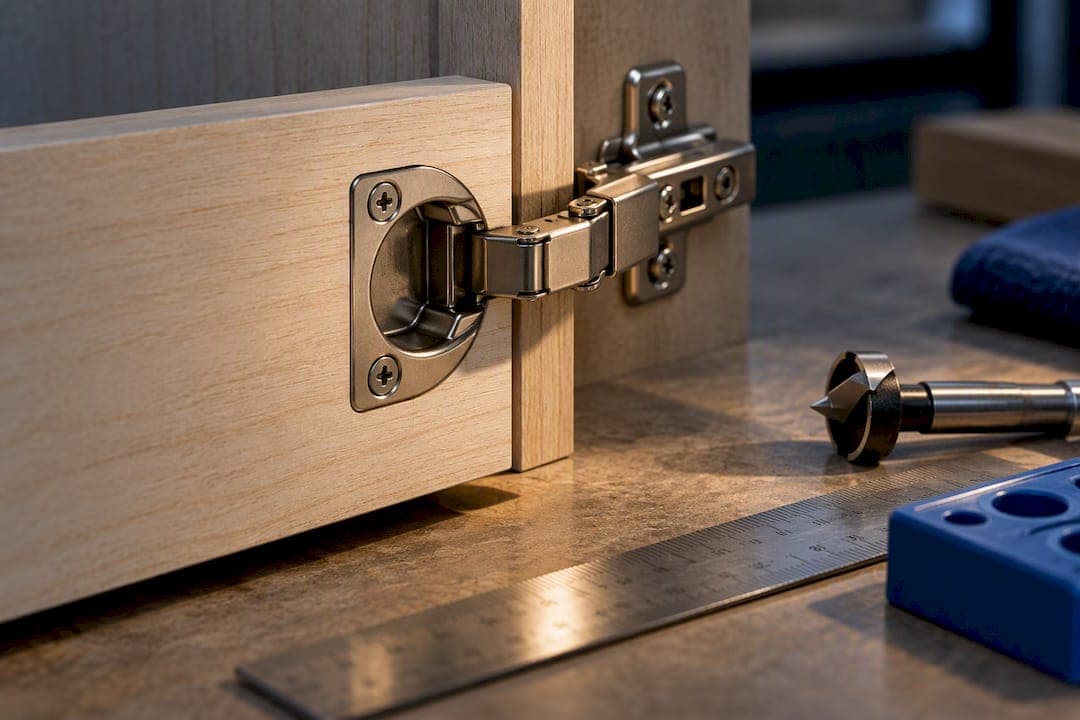
For frameless full-overlay cabinets, choose European or concealed hinges. For face-frame overlays, pick semi-concealed or wrap-around styles. Inset and traditional doors call for butt or flush hinges, while pivot or knife hinges suit specialty and restaurant-style doors. Before you buy, check your cup bore (35mm is standard), your overlay type, and your door's width and weight. Details on measurements and installation follow below.
TL;DR:
- Most concealed hinges use a standard 35mm cup bore, making them compatible across brands, but variation in arm shape determines overlay and opening angle.
- European hinges are ideal for frameless full-overlay cabinets, with options for soft-close, wide-angle open, and integrated dampers, depending on door weight and intended use.
- Face-frame cabinets generally require semi-concealed or wrap-around hinges, which mount to the face or wrap around the frame, simplifying retrofit projects.
- Proper installation depends on precise measurements of the cup bore, screw spacing, door thickness, and weight, with guides available for accurate drilling and mounting procedures.
- Cabinets built with hinge-ready doors or preset cup holes streamline installation, reducing guesswork and ensuring compatibility with standard hardware specifications.
Table of Contents
- Cabinet Hinge Anatomy and the Terms You Need to Know
- Common Cabinet Hinge Families and Where Each One Fits
- How to Choose the Right Hinge for Your Cabinets
- Drilling and Mounting: The Measurements That Matter
- Soft-Close, Self-Close, and Retrofit Options
- Hinge Family at a Glance
- Tools, Materials, and Quick Fixes for a Clean Install
- Why We Build Every Door With Hinge Compatibility in Mind
- Another Route: Hinge-Ready Cabinets Built to Save You a Step
- Where These Measurements and Guidelines Come From
- Sources
- FAQ
Cabinet Hinge Anatomy and the Terms You Need to Know
Before picking a replacement hinge, it helps to know the parts you're working with. A concealed hinge has three main pieces: the cup (the round body that sits inside a bored hole in the door), the arm (the metal piece connecting cup to mounting plate), and the mounting plate (attached to the cabinet frame). Most concealed hinges offer three adjustment points, side to side, up and down, and in and out, so you can align a door after installation without redrilling anything.
Hinges also fall into two installation categories. Mortised hinges require a bored hole, usually the 35mm cup common on modern cabinetry. Surface-mounted hinges skip the boring step entirely and screw directly onto the face of the door and frame. Within these categories, visibility varies too: exposed hinges show entirely from the outside, semi-concealed hinges show a small portion, and concealed hinges disappear completely once the door closes.
Overlay type matters just as much as hinge family. An inset door sits flush inside the cabinet frame. A partial overlay door covers part of the frame, leaving a visible reveal. A full overlay door covers the frame almost entirely, common in frameless cabinetry. The hinge arm's crank shape, whether straight, half-cranked, or full-cranked, is what determines which overlay a given hinge supports, so matching arm type to overlay is one of the first checks you should make. Our guide to cabinet door overlay breaks this down further if you're unsure which category your cabinets fall into.
Key terms to keep straight:
- Cup: the round housing bored into the door, standardized at 35mm on most modern hinges.
- Arm: connects the cup to the mounting plate and determines overlay type through its crank shape.
- Mounting plate: attaches to the cabinet frame and allows fine adjustment of the door position.
- Adjustment axes: side, height, and depth screws let you fine-tune alignment after the door is hung.
Nearly every modern concealed hinge uses a 35mm cup bore and the 32mm system, which means the door-side hole is close to universal across brands, even when the arm and plate are not.
Common Cabinet Hinge Families and Where Each One Fits
Cabinet hinges break down into a handful of families, each suited to a specific cabinet style, overlay, and visual preference. Knowing which family matches your setup saves you from buying the wrong part twice.
- European or concealed hinges mount inside a bored 35mm cup and disappear entirely when the door closes, making them the standard choice for frameless full-overlay cabinets. They typically open to 110 degrees, with narrower 95 to 100 degree versions for thick or molding-trimmed doors, and wide-angle 155 to 170 degree versions for corner cabinets or doors that need to clear pull-out shelving, according to Super Arbor's compatibility guide. Many modern versions include integrated soft-close.
- Semi-concealed hinges show a small visible portion on the outside of the door while the rest tucks behind the face frame, a natural fit for face-frame cabinets with partial or full overlay. They mount with screws rather than a bored cup, so no drilling template is required.
- Surface-mounted hinges attach entirely to the face of the door and frame with no boring at all, making them the simplest option for retrofits, cabinets or older furniture pieces where you want a fully exposed, decorative look.
- Wrap-around hinges are a surface-mounted variant built for face-frame cabinets, wrapping around the frame edge for added stability on heavier overlay doors. They handle more weight than a standard semi-concealed hinge because the wrap distributes stress across a wider surface.
- Butt hinges are the classic mortised hinge pair, one leaf recessed into the door edge and one into the frame, used almost exclusively on inset and traditional cabinet doors where the door sits flush with the frame.
- Flush hinges are a lighter-duty alternative to butt hinges, with one leaf sized to nest inside the other, requiring no mortising. They suit lighter inset doors and cabinets where minimal hardware visibility matters but full concealment isn't necessary.
- Inset hinges, sometimes a specific concealed hinge subtype, are engineered for zero-overlay applications where the door sits perfectly flush inside the frame opening on all sides.
- Pivot or knife hinges mount top and bottom rather than along the door edge, creating a nearly invisible hinge line. They suit specialty cabinetry, restaurant-style doors, and furniture pieces where a clean edge matters more than adjustability.
- Barrel hinges are small cylindrical hinges often used on jewelry boxes, small cabinet doors, or lightweight decorative pieces rather than full-size kitchen cabinets.
- Piano or continuous hinges run the full length of a door or lid, distributing weight evenly, and are common on cabinet lids, toy boxes, and long drop-front doors that need support across their entire span.
- Strap or decorative hinges are exposed, often forged-look hinges chosen for rustic, farmhouse, or traditional cabinetry where the hardware itself is part of the design.
Pro Tip: Before ordering a replacement, measure your existing cup diameter and cup-screw spacing rather than assuming brand compatibility. Most concealed hinges share the 35mm cup, but the arm-to-plate interface is often proprietary, so you may need a new plate even when the cup fits.
How to Choose the Right Hinge for Your Cabinets
Picking the correct hinge is mostly a measuring exercise. Work through these checks in order and you'll avoid ordering the wrong part.
- Identify your cabinet style and overlay. Frameless cabinets almost always take European concealed hinges; face-frame cabinets can use semi-concealed, wrap-around, or concealed hinges depending on overlay; inset and traditional doors need butt or flush hinges.
- Measure the cup bore and screw spacing. Confirm a 35mm cup diameter and note whether the mounting screws sit 45mm or 48mm apart, since replacement hinges need to match both measurements to avoid exposing old holes.
- Check door thickness and weight. Standard 7/8 inch doors work with typical hinge hardware, but thicker or heavier doors may need reinforced hinges or an added third hinge.
- Choose your opening angle. Stick with the standard 110 degrees for most cabinets, drop to 95 to 100 degrees for thick or molding-trimmed doors, and go wide-angle (155 to 170 degrees) for corner cabinets or doors that need extra clearance.
- Apply the rule-of-thumb hinge count. NKBA guidance notes that standard European hinges hold about 20 pounds each, and two hinges typically suffice for a standard 7/8 inch door up to 24 by 25 inches; larger or heavier doors call for three or more hinges.
- Decide between integrated soft-close and add-on dampers. Integrated soft-close hinges tend to offer more consistent long-term performance, while add-on dampers are a cheaper way to upgrade hinges you already own.
- Confirm plate compatibility before ordering. Even when the cup and screw spacing match, mounting plates are frequently brand-specific, so check the plate height and part series against your existing hardware.
Our how to measure for new cabinet doors guide walks through the measuring process in more detail if you're replacing doors alongside hinges.
Drilling and Mounting: The Measurements That Matter
Getting the cup bore and plate placement right is what separates a clean install from a wobbly door. Manufacturer installation guides, including Blum's CLIP top BLUMOTION manual, lay out a consistent process that applies across most modern concealed hinges.
- Bore the cup with a 35mm bit to a depth of roughly 11.5 to 13mm, using a Forstner bit chucked in a drill press or hinge jig for a clean, flat-bottomed hole.
- Note older cabinets may use a 26mm cup, an older standard you'll encounter in some vintage or imported pieces, so confirm bore size before assuming 35mm.
- Reference a 37mm centerline from the door edge when positioning the mounting plate, a common horizontal guide across most hinge systems.
- Pre-drill mounting holes at about 3mm (1/8 inch) for the plate screws, then drive in screws sized around #6 by 5/8 inch or #8 by 3/4 inch depending on your specific hardware.
- Follow the install sequence: mark your centerlines, bore the cup, attach the cup to the door, screw the mounting plate to the frame, clip the hinge arm onto the plate, then fine-tune the side, height, and depth adjustment screws.
Standard cup bore depth runs 11.5 to 13mm, and getting this depth consistent across all doors on a project is what keeps every door sitting flush at the same reveal.
Plate height also plays a role in fine-tuning overlay. Blum's technical hinge tables list common plate heights of 0mm, 3mm, and 6mm, which let you adjust a door's position without redrilling, a useful trick when doors in the same run don't sit quite even.

Soft-Close, Self-Close, and Retrofit Options
Motion control comes in two forms: integrated soft-close hinges, which build the damping mechanism directly into the hinge arm, and add-on dampers, small clip-on units that slow a door's final swing without replacing the hinge itself. Integrated versions tend to hold up better over years of daily use, while add-on dampers are the faster, cheaper way to upgrade hinges you already own, according to Blum's installation documentation.

Opening angle affects which motion hardware fits. The standard 110 degree hinge works for most cabinet doors, but thick doors or applied molding often need a 95 to 100 degree version, and blind corner cabinets or doors clearing interior pull-outs typically need 155 to 170 degrees. Before retrofitting, check whether your existing arm accepts a clip-on damper or whether the hinge design requires a full arm-and-plate swap. Our soft-close versus self-close comparison covers warranty differences worth knowing before you buy.
Pro Tip: If your doors already close firmly but slam, an add-on damper is usually the fastest fix. If the hinge itself is worn or the arm doesn't accept a damper clip, replace the full hinge instead of patching around it.
Hinge Family at a Glance
Tools, Materials, and Quick Fixes for a Clean Install
A hinge install goes faster with the right kit on hand. Gather a drill or drill press, a 35mm Forstner bit, a 3mm (1/8 inch) pilot bit, a hinge boring jig if you're doing multiple doors, a screwdriver or drill driver, and screws sized to your hinge system.
- Wrong overlay: if a door doesn't sit right, check the arm crank type against your overlay before assuming the hinge is defective.
- Mixed plates: swapping brands without matching plate height causes doors to sit crooked, since plate height controls fine overlay adjustment.
- Shallow or deep cup bore: a bore that's too shallow won't seat the cup fully, while one that's too deep weakens the door face.
- Finish and hardware color: match hinge finish to your other cabinet hardware for a consistent look, and confirm the finish is rated for kitchen or bath humidity.
- Call a professional if you're working with antique hardware, structural cabinet repairs, or doors that require custom mortising.
Pro Tip: Keep one properly hung door nearby as a reference while adjusting the rest of the run. It's the fastest way to catch a plate height mismatch before you've hung every door.
Why We Build Every Door With Hinge Compatibility in Mind
Getting a hinge to sit right starts with the door itself, which is why we pay close attention to standard measurements when we build ours. Every cabinet we ship is designed around common overlay and cup-bore standards, so you're not stuck guessing whether a replacement or upgrade hinge will fit down the line. We recommend checking your overlay type and cup measurements against the specs on any door before ordering hardware, and our support team is glad to answer compatibility questions before you buy.
— Nathan
Another Route: Hinge-Ready Cabinets Built to Save You a Step
If you'd rather skip the guesswork on cup bores and plate compatibility altogether, ute kök solutions from Doman Bygg och Anläggning are worth a look. "Hinge-ready" means the doors arrive with cup holes already bored to standard spacing, overlay prep already accounted for, and in some cases mounting plates already fitted, so installation is mostly a matter of clipping hardware into place.

Some cabinets come with this kind of prep in mind, whether ordering ready-to-assemble or fully assembled pieces.
- Cup holes bored to standard spacing on applicable door styles.
- Overlay type accounted for during construction.
- Options across our RTA Cabinets, Shaker Series, Classic Series, and Slim Series lines.
You can browse current RTA cabinet options or check our assembled cabinet lineup to see which fits your project and timeline.
Where These Measurements and Guidelines Come From
- NKBA kitchen hardware guidance on hinge load ratings and hinge counts.
- Blum CLIP top BLUMOTION installation manual for drilling and mounting sequence.
- Blum technical hinge tables for plate height and overlay mapping.
- The Spruce's hinge type overview for style-to-hinge matching.
Check manufacturer documentation for brand-specific tolerances before ordering replacement hardware.
Sources
- Kitchen Cabinet Hardware: Hinges, Shelf Supports, and Pulls - NKBA
- Cabinet Hinges: Overlay, Cup Size and Compatibility – Super Arbor
- Blum technical hinge tables and part mappings - Blum
- Types of Cabinet Hinges - The Spruce
FAQ
How do I find out which hinge works for my cabinet?
Start by identifying your cabinet style, frameless, face-frame, or inset, since that narrows your choice to European/concealed, semi-concealed or wrap-around, or butt/flush hinges. Then measure your cup bore diameter and screw spacing against common 35mm cup and 45mm or 48mm spacing standards to confirm compatibility.
What are the five different types of hinges?
Definitions vary by source, but a common grouping includes concealed (European), semi-concealed, surface-mounted, butt, and pivot hinges, with wrap-around, flush, barrel, and piano hinges often listed as additional families. Your choice depends mainly on cabinet style, overlay, and how much of the hinge you want visible.
Which type of hinges are best for kitchen cabinets?
For most modern kitchens with frameless full-overlay doors, European or concealed hinges are the standard choice because they disappear when closed and commonly include soft-close options. Face-frame kitchens typically use semi-concealed or wrap-around hinges instead, since these mount without a bored cup.
What are the three types of hinges?
A simplified grouping often used for cabinetry separates hinges into concealed, semi-concealed, and surface-mounted, based on how much of the hardware shows once the door is closed. Within each group, further distinctions like overlay type and opening angle determine the exact hinge you need.