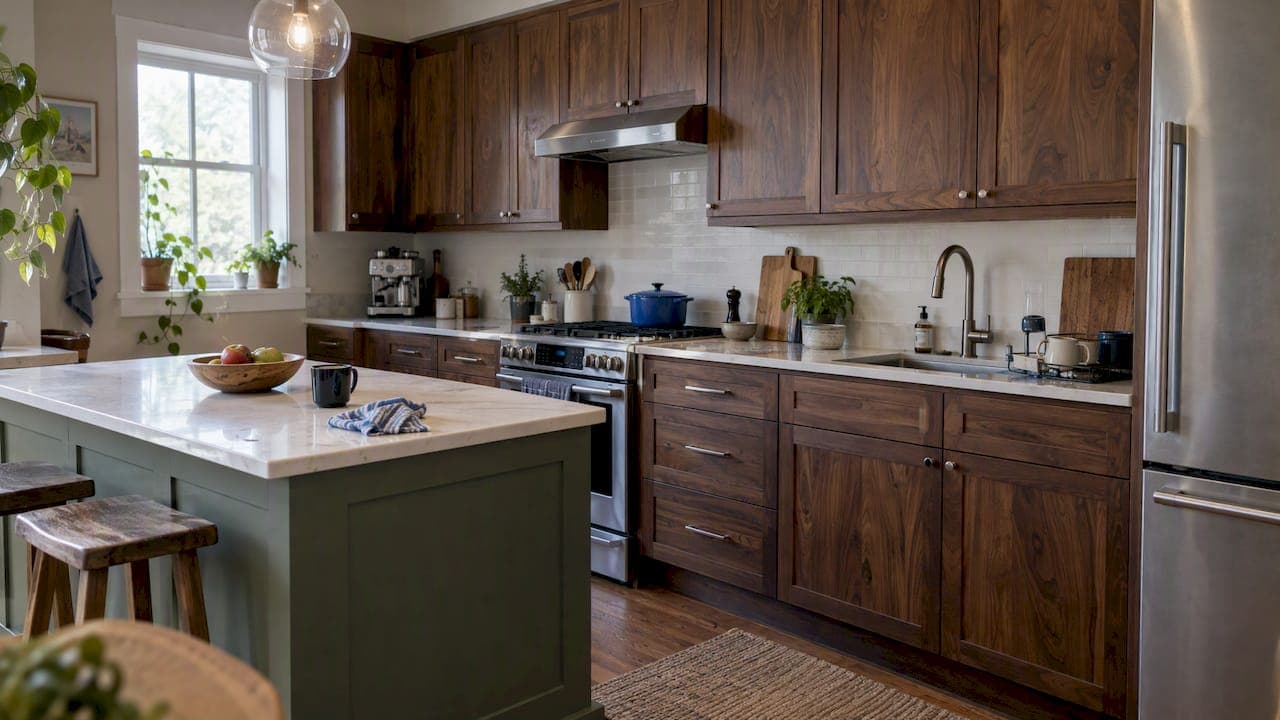
Walnut kitchen cabinets give you a deep, chocolate-brown look with a straight, flowing grain. They suit modern slab doors and shaker doors equally well. Before you order, you need to know four things: how much the color varies from board to board, whether the doors are solid wood or veneer, how the finish handles light, and what drives the price. This guide covers all four. It also covers rift white oak and walnut vs. oak, since many buyers compare the two.
TL;DR
- Walnut runs from creamy sapwood to light-brown and dark-chocolate heartwood, so expect natural variation in every kitchen.
- Ask whether a door is solid walnut or walnut veneer over a stable core. The answer shapes cost, stability and repair options.
- Walnut suits slab and shaker doors. Rift white oak is the calmer, lighter alternative with a straight, uniform grain.
- Cost and lead time depend on grade, door style, box construction and how long the order takes to ship. Compare these before you compare sticker prices.
- Order sample doors first and judge color in your own kitchen light.
Table of Contents
- What walnut looks like in a kitchen
- Solid walnut vs. walnut veneer doors
- Styles and door designs for walnut
- Light, finish and care
- Rift white oak: the calmer alternative
- What affects the cost and timing
- Our perspective: get the look, protect the budget
- Plan your kitchen with us
- How to order walnut-look cabinets with confidence
- FAQ
- Sources
What walnut looks like in a kitchen
Walnut is one of the most recognizable cabinet woods. The National Hardwood Lumber Association describes walnut as having creamy-white sapwood and heartwood that ranges from light brown to dark chocolate, with generally straight grain that can turn wavy or curly. That range is the first thing to understand. Two doors cut from different boards can sit noticeably apart in tone, and a kitchen full of walnut will show that movement across the room.
For many homeowners, that movement is the appeal. It reads as warm and natural rather than flat. If you want a perfectly uniform look, you have two choices: ask for tighter color matching on your order, or consider a straighter-grained species such as rift white oak (covered below).

Why sapwood and steaming matter
The pale sapwood is the part buyers notice most. According to a Purdue University Extension publication on black walnut, commercial producers steam green lumber to darken the sapwood and make the heartwood color more uniform. So the even, deep-brown tone you see in a showroom is partly the result of processing, not only of the tree. Ask any supplier how their walnut is sorted and whether you will see pale streaks.
Grain and figure
Straight grain gives walnut doors a calm, linear look. Figured grain, with curls or waves, adds drama. The same Purdue publication notes that large figured walnut logs can be very valuable as veneer, which is one reason figured walnut shows up on high-end panels and feature pieces rather than on every door. If you like seeing how walnut grain reads across a flat surface, this walnut grain on cutting boards comparison shows the pattern up close.

Solid walnut vs. walnut veneer doors
This is the question that changes your price more than any other. A "walnut" cabinet can mean several constructions:
| Construction | What it is | What to ask |
|---|---|---|
| Solid walnut door | Frame and panel made from walnut boards | Is the center panel solid or veneered? How is the grain matched? |
| Walnut veneer door | Thin walnut face bonded to a stable core | What is the core: plywood, MDF or particleboard? |
| Walnut-look laminate | Printed or textured surface | Is the core moisture resistant? |
Veneer is not a lesser option when it is done well. It lets a door carry a continuous, matched grain across a wide flat slab, which is hard to achieve with glued-up solid boards. What matters is the core underneath. Our guide on laminate vs. veneer cabinets explains how to check the core before you buy, and our solid wood kitchen cabinet doors buyer's guide covers frame-and-panel construction in detail.
Grades and what they mean for you
Lumber is sorted into grades based on how much clear, usable wood a board yields. Higher grades have fewer knots, color streaks and defects. For cabinet doors, a premium grade gives you cleaner faces and more consistent color. A lower grade can add character, including mineral streaks and pale sapwood, and can lower the cost. Ask your supplier which grade is quoted, because two "walnut" quotes may not be comparing the same thing.
The box matters as much as the door
The door is what you see, but the cabinet box carries the weight of your countertops, dishes and daily use. We build our cabinets with plywood boxes and solid wood doors, designed to stay stable and hold up through years of kitchen use. When you price any wood cabinet line, compare the box material, drawer construction and hardware, not just the door species. Soft-close hinges and drawer glides are worth confirming in writing.
Styles and door designs for walnut
Walnut works in more styles than most buyers expect.
Slab doors
Flat slab doors let the grain do all the work. They suit modern and minimalist kitchens and are easy to wipe clean. Because there is no frame, the grain continuity across the door is the main design feature, and book-matched or sequence-matched panels are what people mean by a high-end walnut kitchen.
Walnut shaker cabinets
Shaker doors use a five-piece frame with a flat center panel. In walnut, the frame reads as a quiet outline and the grain shows through the panel. This is the transitional choice: warmer than a painted shaker, less severe than a slab. If you are weighing styles, our cabinet door styles guide walks through what each one does to the look and maintenance of a kitchen.
Slim shaker
A slim shaker has a narrower frame, which gives a cleaner and more contemporary face. It sits between full shaker and slab, and it is a good fit when you want a wood-tone kitchen without a traditional feel.
Pairing walnut with other finishes
Dark walnut uppers or islands look strong against painted white or black bases. You can anchor a kitchen with a single walnut element, like an island or a tall pantry run, and keep the rest painted. That also keeps your budget in check, since you are buying wood doors for only part of the room. You can see how painted and natural finishes pair in our shaker series.
Light, finish and care
Walnut is a wood that changes with its environment. Natural finishes show the grain best, and a clear topcoat protects the surface from daily splashes and wear. Direct sun is the main variable to plan for. Walnut tends to shift in tone over time with light exposure, so a window-lit run of cabinets can age differently from a shaded one. If your kitchen has a large south or west window, think about window treatments and ask your supplier what finish protection is applied.
For care, a few habits keep any wood cabinet looking its best:
- Wipe spills promptly, especially around the sink and dishwasher.
- Use a soft damp cloth and a mild cleaner, then dry the surface.
- Avoid abrasive pads and harsh solvents on the finish.
- Keep hinges and drawer glides adjusted so doors close evenly.
Follow the care sheet that comes with your specific finish. Manufacturers differ.
Rift white oak: the calmer alternative
If walnut's variation feels like too much, rift white oak is the other wood that appears in most of the same conversations. In rift-sawn (also called rift-cut) oak, the boards are cut so the grain runs in a tight, straight line with little of the cathedral pattern you see in plain-sawn oak. The result is a quiet, linear look that works well in contemporary and Scandinavian-inspired kitchens. It also removes the flecking, which is why designers choose it when they want texture without busyness.
Walnut vs. oak
| Walnut | Rift white oak | |
|---|---|---|
| Color | Light brown to dark chocolate, with pale sapwood | Light to medium brown, often with an olive cast |
| Grain | Straight, wavy or curly | Tight, straight and uniform |
| Mood | Rich, warm, dramatic | Calm, light, understated |
| Best for | Statement islands, modern and transitional kitchens | Whole-room consistency, minimal looks |
The practical rule: pick walnut if you want depth and variation, pick rift white oak if you want a consistent, lighter tone. Check the species guide for each wood before you decide, and compare real samples side by side.
White oak bathroom vanities
The same logic carries into the bathroom. A white oak vanity brings a light, natural tone that pairs well with white tile and brushed metal. In a bathroom, moisture is the design constraint. Look for a sealed finish, a stable box, and a sink base that is designed for plumbing. Walnut works in the bath too, particularly for a floating vanity under good lighting. Our bathroom line includes vanity drawer bases such as the White Slim Shaker vanity drawer base, which you can pair with the finish of your choice.
What affects the cost and timing
We do not publish a single "walnut price" because no honest one exists. The final figure depends on the choices below.
- Solid vs. veneer. Solid walnut frames and panels use more premium material than veneered slabs.
- Grade. Cleaner, more consistent boards cost more.
- Door style. Slab, shaker and slim shaker use different amounts of material and labor.
- Assembly. Ready-to-assemble boxes usually cost less to ship and buy than fully assembled units. Assembled options save you labor on site.
- Box construction. Plywood boxes cost more than thin particleboard, but hold screws, hinges and weight better.
- Layout. Every extra corner, tall pantry or specialty base adds cost.
- Lead time. Custom-made walnut often takes weeks. Ask for the production time and shipping time separately.
For the best result, set a budget for the entire kitchen and decide where wood matters most. Many buyers use walnut on an island and a feature wall, then use painted or lighter finishes elsewhere.
Our perspective: get the look, protect the budget
We talk to homeowners, contractors and property managers every week, and the same two worries come up: cost and waiting. Many people love walnut in photos, then discover the quote is far above their budget or the delivery window is months out. Our view is that a good kitchen starts with a strong box, solid wood doors you can see and touch, and a timeline you can plan around.
That is why we build with plywood boxes and solid wood doors, offer soft-close hardware, and focus on fast shipping. We sell both ready-to-assemble and assembled cabinets in modern, traditional and transitional styles, with color and finish options, accessories and bulk packages for trade buyers. If you are chasing the warm, natural-wood feel, we suggest ordering sample doors first, because tone looks different under your lighting than on a screen. Our natural-toned shaker pieces, like the Natural Shaker utility cabinet, let you test how a wood tone sits next to your counters and floors before you commit to a full kitchen.
As a women-owned and veteran-owned business, we answer to the people who build with our cabinets, so we aim to make the ordering process clear and the product project-ready.
— Nathan
Plan your kitchen with us
Whether you are a homeowner updating one kitchen, a contractor outfitting a job, or a property manager equipping rentals, our RTA cabinets and assembled cabinets are designed to be project-ready, with durable construction and fast shipping. Browse the lines, compare door styles and request samples. Shop Now.

If you buy in volume for new construction or rentals, ask about our bulk package options and trade pricing when you place your order.
How to order walnut-look cabinets with confidence
- Measure and sketch your layout. Note appliances, windows and plumbing locations.
- Pick the door style first. Slab, shaker or slim shaker sets the overall look.
- Decide solid or veneer. Ask what is under the face and which grade is quoted.
- Request samples. View them in morning and evening light.
- Confirm the box and hardware. Plywood construction and soft-close hinges are the details to verify.
- Ask about lead time. Get production and shipping times in writing.
- Check the delivery. Inspect each carton on arrival and report damage promptly.
If you are also comparing other woods, our guides on cherry wood cabinets and maple vs. birch cabinets cover style, durability and cost for each.
FAQ
Are walnut kitchen cabinets worth it?
Walnut is worth it if you want rich color and visible grain, and you accept natural variation between doors. Many buyers limit it to an island or a feature run to control cost. If you need a uniform look at a lower price, consider a painted or lighter finish.
Is walnut darker than oak?
Usually, yes. The National Hardwood Lumber Association describes walnut heartwood as ranging from light brown to dark chocolate, while rift white oak typically sits in a lighter, olive-tinged brown. Always check physical samples because finish changes the final tone.
What is rift white oak?
Rift white oak is oak sawn so the grain runs tight and straight, without the swirling cathedral pattern of plain-sawn boards. That uniform grain is why it is popular for modern kitchens and vanities. Rift-cut and rift-sawn mean the same thing.
Can I get walnut shaker cabinets?
Walnut shaker cabinets are a common request, using a five-piece frame and flat panel. Because availability and construction vary by supplier, ask whether the door is solid or veneer and which grade you are quoted. You can compare finish tones with our sample doors.
Sources
- Walnut species guide, National Hardwood Lumber Association
- Hardwood Lumber and Veneer Series: Black Walnut, Purdue University Extension