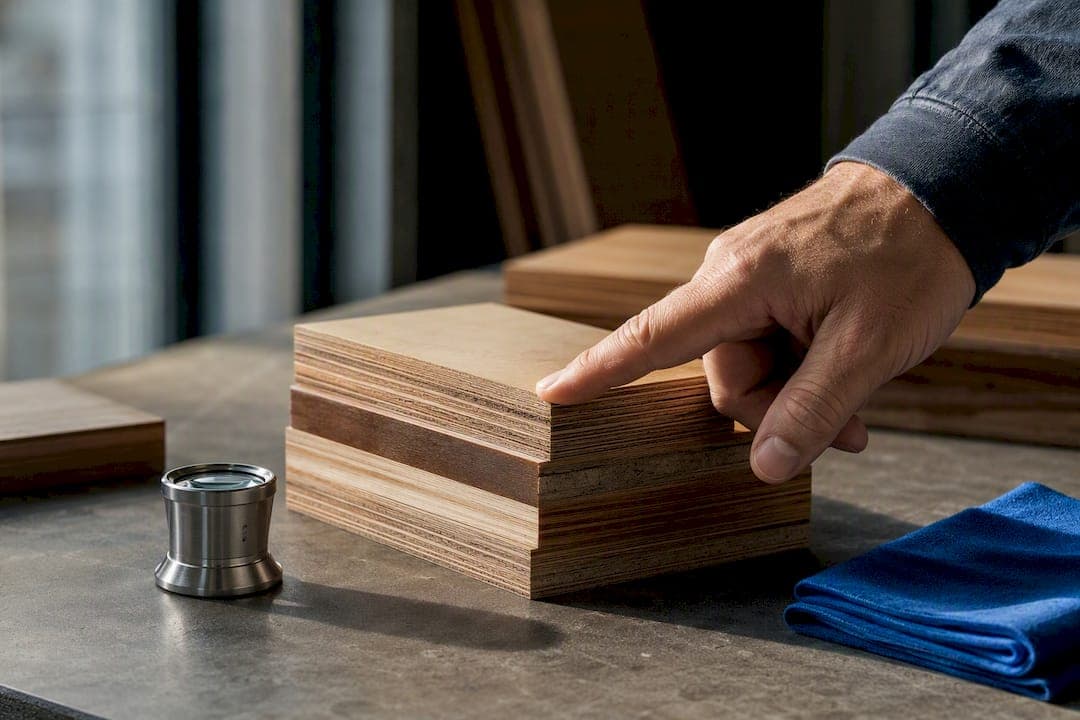
An eco-friendly kitchen cabinet comes down to three verifiable factors: materials sourced from certified, responsibly managed forests or renewable sources, finishes and adhesives with low or no VOCs and no added formaldehyde, and a third-party certification that backs up the claim. Some cabinet providers build cabinets around these same priorities and can walk you through certification details on request. Marketing language like "green" or "natural" means nothing without paperwork behind it.
TL;DR:
- Verify all wood materials with FSC or PEFC certification numbers and chain-of-custody documentation to ensure responsible forest management.
- Choose low- or zero-VOC finishes and adhesives that meet formaldehyde emission standards, and confirm finishing methods are factory-applied to reduce indoor air pollution.
- Prioritize solid wood or reclaimed wood cabinets for longevity and recyclability, but assess each supplier's certifications and durability claims carefully.
- Expect higher upfront costs for durable, certified, and refinished cabinets, as well as a longer lifespan that reduces replacement needs and waste over time.
- Request specific documentation such as MSDS sheets and test reports before purchasing to avoid unverified "eco-friendly" claims.
Table of Contents
- What Are the Most Sustainable Cabinet Materials?
- Which Finishes and Adhesives Reduce Indoor VOCs?
- Which Certifications Actually Prove a Cabinet Is Sustainable?
- How Do Durability and Lifecycle Costs Compare?
- How Do You Evaluate a Manufacturer Before You Buy?
- How Do You Clean Eco-Friendly Cabinets Without Damaging the Finish?
- What Happens to Eco-Friendly Cabinets at the End of Their Life?
- Custom-Built vs. Prefab Cabinets: Which Has a Smaller Environmental Footprint?
- What Should You Know About VOCs and Formaldehyde in Your Kitchen?
- Best Cabinet Specialist's Approach to Sustainable, Non-Toxic Cabinets
- Ready to Choose Cabinets Built for a Healthier Kitchen?
- Sources
What Are the Most Sustainable Cabinet Materials?
Not every material marketed as "natural" or "renewable" earns that label once you look at how it's grown, harvested, and processed. Here's how the main options actually compare.
FSC or PEFC certified solid wood carries the strongest track record. Wood is renewable, recyclable, and biodegradable, and when it's harvested from responsibly managed forests with documented chain-of-custody tracking, you get a material that regenerates rather than depletes. The chain-of-custody piece matters more than most shoppers realize. It's the paper trail proving the wood in your cabinet actually came from the certified forest listed on the label, not a mixed batch from unverified sources.
Reclaimed wood carries almost no new embodied carbon since it's pulled from old barns, factories, or demolished structures rather than freshly cut. The tradeoff is inconsistency. Reclaimed boards vary in moisture content, hardness, and old finish residue, so expect more finishing work and less predictable grain matching than new stock.
Bamboo grows back in a few years instead of decades, which makes it genuinely renewable. But bamboo has to be processed into strips and laminated before it becomes cabinet-grade material, and that processing method varies widely by manufacturer. Ask suppliers directly about their manufacturing process rather than assuming all bamboo cabinetry performs the same way.
Formaldehyde-free plywood and recycled-content panels deserve a closer look at label wording. "No added formaldehyde" means the manufacturer didn't intentionally introduce it during production, while "formaldehyde-free" is a stronger claim that trace-level testing should back up.
- Ask for the wood species and forest of origin
- Request the FSC or PEFC certificate number
- Confirm panel thickness and core material for plywood or engineered options
Pro Tip: Save every certificate number a supplier gives you. You can usually verify it directly through the certifying body's own registry in under five minutes.
Which Finishes and Adhesives Reduce Indoor VOCs?
The finish on a cabinet door affects your indoor air for months after installation, not just on delivery day. VOCs, or volatile organic compounds, are common indoor air pollutants released by paints, stains, and lacquers, and some off-gas at a slow rate long after the product looks and smells dry.
- Choose water-based, low-VOC, or zero-VOC lacquers and stains over solvent-based alternatives
- Look for natural oil finishes on solid wood where a harder topcoat isn't required
- Check that adhesives meet CARB Phase 2 or TSCA Title VI formaldehyde limits
- Ask whether finishing happens at the factory or on-site, since factory-applied finishes typically cure under controlled conditions and off-gas less into your home
Formaldehyde is classified as a known human carcinogen, which is exactly why the distinction between "no added formaldehyde" and independently tested "formaldehyde-free" adhesives matters more than it sounds. Edge banding matters too. Poorly sealed edges on engineered panels expose raw core material where emissions escape fastest, so tight, factory-applied edge banding is a small detail with an outsized payoff for air quality.
Which Certifications Actually Prove a Cabinet Is Sustainable?
Certifications exist because "eco-friendly" isn't a regulated term. Anyone can print it on a box. These four marks are the ones worth checking for:
- FSC or PEFC: Verify responsible forest management and chain-of-custody from forest to finished cabinet.
- KCMA Environmental Stewardship Program (ESP): Cabinet-specific criteria covering wood sourcing, air emissions, and manufacturing practices, evaluated at the plant level rather than just the material level.
- GREENGUARD: Independent low-emission testing for finished products, a useful checkpoint since a cabinet can use good materials but still off-gas from poor assembly.
- Cradle to Cradle (C2C): Evaluates material health and circularity, a more rigorous standard for shoppers who want to look past sourcing into what happens to the cabinet at end-of-life.
Certificate numbers should be checkable through the certifying body's own online registry. If a supplier can't produce one, treat the "eco-friendly" label as unverified. Our KCMA-certified cabinets guide breaks down what the ESP seal covers in more detail.
How Do Durability and Lifecycle Costs Compare?
The most sustainable cabinet is often the one you never have to replace, which is why lifecycle thinking matters more than sticker price. Solid wood cabinets, properly maintained, routinely outlast plywood or particleboard construction by decades and can be refinished multiple times rather than discarded. Bamboo holds up well against moisture but can show wear at high-stress joints faster than hardwood. Reclaimed wood's durability depends entirely on the condition of the source material, so ask about structural inspection before buying.
- Solid wood: longest lifespan, refinishable, higher upfront cost
- Plywood boxes with solid wood doors: strong durability-to-cost ratio, KCMA guidance treats this combination as a durable, verifiable middle ground
- Bamboo: renewable and lightweight, moderate durability at joints
- Reclaimed wood: variable durability, lowest embodied carbon
Repairability is an underrated sustainability signal. A cabinet with replaceable doors and accessible hardware avoids a full landfill trip when only one drawer front cracks. A longer warranty period often correlates with a manufacturer's confidence in its own materials and joinery, so treat warranty length as a rough proxy for expected lifespan.
How Do You Evaluate a Manufacturer Before You Buy?
Verification takes less time than most homeowners expect, and it's the single fastest way to separate real sustainability claims from marketing copy. Work through this order:
- Request certification documents with certificate numbers you can look up independently.
- Ask for MSDS sheets on the specific finish used on your cabinet line, not a generic company-wide sheet.
- Confirm adhesive specs, including CARB Phase 2 compliance or formaldehyde emission test results for plywood cores.
- Check the warranty length and what it actually covers, since a short or vague warranty often signals lower confidence in materials.
- Ask about the finishing process, factory-applied versus site-finished, and expected off-gassing time before installation.
- Ask about end-of-life options, including whether components are recyclable or whether the company has a takeback or reuse program.
Watch for red flags: vague phrases like "eco-conscious" with no certificate attached, pricing that seems too low for the certifications claimed, or a supplier who can't produce a VOC test report on request. Our wholesale cabinet buying guide covers more of these evaluation steps for contractors and homeowners sourcing in bulk.
Pro Tip: When you email a supplier, ask one specific question at a time, like "Can you send the CARB Phase 2 compliance certificate for this plywood core?" Specific requests get specific answers. Vague questions get vague marketing replies.
How Do You Clean Eco-Friendly Cabinets Without Damaging the Finish?
Low-VOC and water-based finishes are gentler on your indoor air, but they're also more sensitive to harsh cleaning products than older solvent-based lacquers. A microfiber cloth with warm water and a mild dish soap handles most daily grease and fingerprints without stripping the finish. Avoid ammonia-based cleaners, bleach, and abrasive scrub pads. These break down water-based topcoats faster than they would a traditional polyurethane finish.
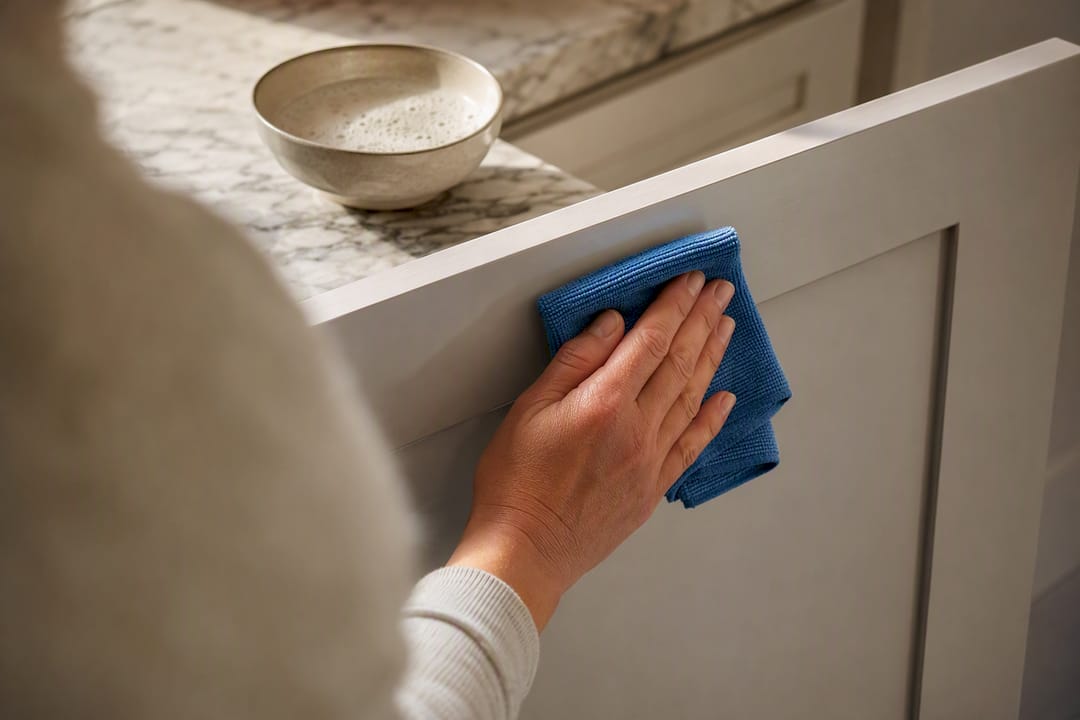
For solid wood cabinets finished with natural oils, occasional reconditioning with a food-safe oil keeps the wood from drying out and cracking, especially near the stove and sink where humidity swings are constant. Wipe spills quickly rather than letting water sit on any seam or edge, since water-based finishes on engineered panels are more vulnerable to swelling at the core if moisture gets past the surface.
Skip steam cleaners entirely. The heat and moisture combination can lift veneers and soften adhesives faster than standard cleaning ever would. If a cabinet came with manufacturer care instructions, follow those over generic online advice. Formulations vary enough between brands that a cleaning method safe on one finish can dull or discolor another.
What Happens to Eco-Friendly Cabinets at the End of Their Life?
Solid wood and plywood cabinets built with formaldehyde-free adhesives are far easier to repurpose or recycle than particleboard cabinets bonded with conventional resins. Solid wood doors and face frames can often be salvaged whole for a second project, resold through architectural salvage yards, or repurposed into shelving, benches, or smaller furniture pieces.
Many municipalities accept clean wood waste at construction and demolition recycling facilities, though acceptance depends on whether hardware and non-wood components have been removed first. Check with your local waste authority before hauling old cabinets to the curb, since some areas require separation of wood from laminate, metal hardware, and any composite materials.
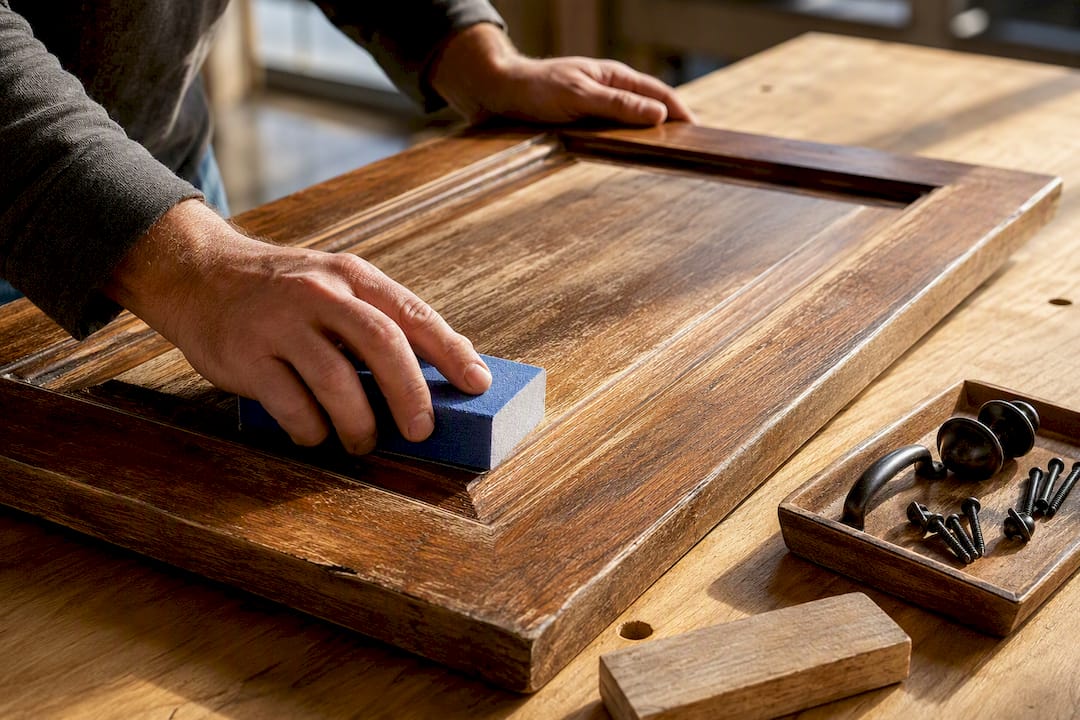
Reclaimed and repairable cabinets have an advantage here that engineered cabinets don't: a solid wood door with worn finish can be sanded and refinished rather than discarded, extending its usable life by years before recycling ever becomes necessary. If a full replacement is unavoidable, ask your new supplier about takeback or donation programs. Habitat for Humanity ReStore locations and similar organizations frequently accept usable cabinet boxes and doors for resale, keeping them out of landfills entirely.
Custom-Built vs. Prefab Cabinets: Which Has a Smaller Environmental Footprint?
Custom-built cabinets are often assumed to be the greener choice since they're made to exact specifications with no waste from resizing. That assumption doesn't always hold up. Custom shops frequently work with lower production volume, which can mean less efficient material sourcing and more offcut waste per project compared to a manufacturer running standardized, high-volume production lines.
Prefabricated cabinets, particularly ready-to-assemble designs, benefit from economies of scale. Manufacturers buying certified wood and panel material in bulk can negotiate better sourcing terms and standardize finishing processes for consistent low-emission results across every unit. Flat-pack shipping also reduces transport volume and fuel use per cabinet compared to custom pieces often shipped assembled or built on-site.
The real deciding factor isn't custom versus prefab. It's whether either option uses certified materials and low-VOC finishes. A custom cabinet built with uncertified particleboard and solvent-based lacquer has a worse footprint than a prefab cabinet with FSC-certified plywood and water-based finish, regardless of how it was built. Judge by materials and certification first, production method second.
What Should You Know About VOCs and Formaldehyde in Your Kitchen?
Kitchen cabinets sit close to where you cook, eat, and breathe for hours every day, which makes indoor air quality a bigger deal here than in a rarely used closet. VOCs off-gas from finishes, adhesives, and sealants, and that off-gassing tends to be highest in the first weeks after installation, tapering off over months.
Formaldehyde exposure carries particular concern since it's linked to respiratory irritation and long-term health risks at elevated exposure levels. Cheaper particleboard cores bonded with urea-formaldehyde resin are typically the biggest source in a kitchen, more so than the visible painted or stained surface.
A few practical mitigation steps help regardless of what cabinets you already have:
- Run kitchen ventilation or exhaust fans during and after installation
- Increase fresh air exchange for the first several weeks after new cabinets go in
- Choose formaldehyde-free core panels and low-VOC finishes on any future purchase
- Ask suppliers for VOC test reports rather than relying on scent as an indicator, since low-VOC doesn't always mean odorless and some odorless finishes still off-gas
Pairing low-VOC cabinetry with good kitchen ventilation, including range hoods and general HVAC airflow, does more for long-term air quality than either measure alone.
Best Cabinet Specialist's Approach to Sustainable, Non-Toxic Cabinets
Some cabinet providers build cabinets around plywood boxes and solid wood doors, a combination that holds up structurally while giving a real wood surface to finish and maintain over time. These providers may focus on fast shipping and honest craftsmanship rather than on vague marketing claims.
If you're evaluating a purchase and want finish MSDS sheets or certification numbers, ask before you order. Reasonable documentation requests are part of a normal buying process, not an inconvenience. We'd rather you verify what you're getting than take a label at face value.
— Nathan
Ready to Choose Cabinets Built for a Healthier Kitchen?
Some suppliers offer plywood-box, solid-wood-door cabinetry without the long lead times that stall most renovation timelines, helping you select the right pantry door for a cohesive kitchen design. While custom shops may quote weeks of waiting and big-box stores limit choices to floor stock, some catalogs ship quickly and offer real wood doors, soft-close hardware, and a range of finish options to match various kitchen styles.
If low-VOC finishing or certification documentation matters to your decision, ask for it directly when you request a quote. We'll walk you through what's available for your specific cabinet line before you commit. For a look at how plywood construction holds up over time, our plywood cabinet buyer's guide covers the tradeoffs in more depth, and our solid wood door guide breaks down door construction options.
Start by browsing current cabinet packages and pricing and reach out with your finish and documentation questions before your order ships.
Sources
- Buyer’s Guide: Choosing Eco-Friendly Kitchen Cabinets | KCMA
- What are volatile organic compounds (VOCs)? | EPA
- Formaldehyde fact sheet | National Cancer Institute
- FSC standards | FSC
- GREENGUARD certification