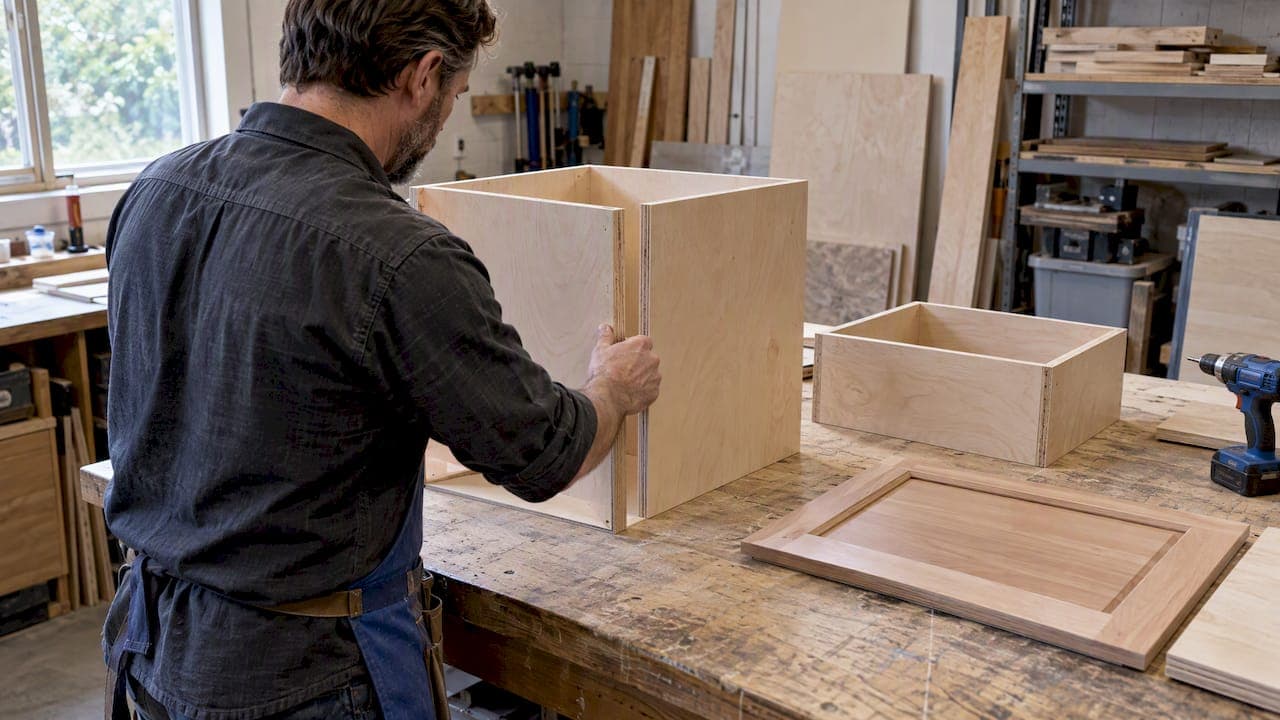
Cabinet grade plywood is a panel finished to a consistent face and back veneer grade, built on a core designed to stay flat and hold screws, so it is suitable for cabinet boxes, doors, and shelving. The single buying rule that matters most: specify the face and back grade, the core type, and the bond class when you order, never just "cabinet grade." For most boxes, a 3/4 inch veneer core panel with A or B faces on the visible parts and a lower grade on hidden parts gets you the right balance of cost and looks.
TL;DR:
- Specifying face and back grades, core type, and bond class is essential for reliable cabinet plywood, as "cabinet grade" alone varies widely by supplier.
- Most cabinet plywood uses veneer core for screw holding and warp resistance, with Baltic birch offering strong edges and clean looks for exposed edges.
- For boxes and shelves, 3/4 inch thickness is standard, while 1/4 inch and 1/2 inch are suitable for backs, drawer bottoms, and supports, but actual thickness should always be measured before cutting.
- Buyers should inspect sheets for voids, warping, and mill stamps referencing HP-1, and avoid panels without clear grading or with significantly under nominal thickness.
- Local lumberyards provide the best selection and expert advice, but online and big-box stores offer convenience with limited grading options, and prefinished panels can save finishing time.
Table of Contents
- What "cabinet grade" actually means: grades, markings, and standards
- Common types and constructions used for cabinets
- Thickness and sheet sizes: what to order for each component
- How to choose: a step-by-step selection checklist
- Where to buy and price expectations
- Storage, acclimation, and simple installation tips
- How Best Cabinet Specialist builds with plywood
- A cabinet maker's view on spending where it shows
- An alternative to sourcing and cutting your own panels
- Sources
- FAQ
What "cabinet grade" actually means: grades, markings, and standards
"Cabinet grade" is not an official term. It is a shorthand that lumberyards and suppliers use loosely, and that is exactly the problem: two panels both labeled "cabinet grade" can look different once you unwrap them. The real specification comes from face and back veneer grades, which range from AA (best, nearly flawless) down to E (lowest appearance grade, often used where the panel will be hidden or painted). Back grades run from 1 to 4, with 1 being the closest match to a premium face.
The ANSI/HPVA HP-1 standard is the voluntary North American standard that defines these face grades, back grades, core types, bond classes, and emissions limits for hardwood and decorative plywood. A mill stamp referencing HP-1 tells you the panel was manufactured against a known set of rules, not just sold under a flattering name.
Before you order, request in writing:
- Face grade and back grade (for example, A face, 2 back).
- Core type (veneer, MDF, combination, or Baltic birch).
- Bond or exposure class, since appearance grade says nothing about water resistance.
- Species of the face veneer and the mill number if available.
"Manufactured to HP-1" is the phrase that converts marketing language into a checkable spec, and HP-1 defines exactly which grades and classes a supplier is claiming when they use it.
Common types and constructions used for cabinets
Most cabinet plywood falls into four construction types, and each one fits a different job. Veneer core, built from thin layers of wood veneer glued in alternating grain directions, holds screws well and resists warping, which makes it the standard choice for boxes and shelves. MDF core swaps the inner veneer layers for medium-density fiberboard, giving a dead-flat panel that machines cleanly but holds screws less securely and adds weight. Combination core blends veneer faces with an MDF or particleboard middle, splitting the difference between flatness and screw-holding. Baltic birch uses void-free birch veneer throughout the core, in thin plies, which gives strong edges and a clean look when the edge itself stays exposed, such as on drawer sides.
Species choice follows visibility. Birch and maple take paint and clear finish well and show a tight, even grain, which is why they dominate cabinet work. Oak shows a more open grain that reads as traditional, and it is a common choice when the cabinet will stay unpainted.
- Veneer core: strong screw-holding, resists warping, the default for boxes.
- MDF core: very flat, smooth for paint, weaker at holding screws over time.
- Combination core: balances flatness with better screw-holding than pure MDF.
- Baltic birch: void-free edges, good for drawer boxes and exposed plywood edges.
Finish choice matters as much as the wood itself. Prefinished melamine panels arrive ready to assemble and skip the finishing step entirely, which suits painted interiors and shelving. Raw veneer panels cost less upfront but need sanding, priming, and finishing on your own schedule, which gives more control over the final color and sheen.
Pro Tip: Use Baltic birch for drawer boxes where the edge grain will show, since it machines cleanly and does not need edge banding to look finished.
Thickness and sheet sizes: what to order for each component
Plywood ships almost universally in 4 by 8 foot sheets, with a handful of common thickness classes: 3/4 inch, 23/32 inch, 1/2 inch, and 1/4 inch. The nominal thickness printed on the panel and the actual measured thickness are not always the same number, and that gap matters once you start cutting dado joints or sizing edge banding.
- Use 3/4 inch (or the 23/32 actual equivalent) for cabinet boxes, bottoms, and long shelves, since this thickness carries weight without sagging.
- Use 1/4 inch for captured backs and drawer bottoms, where the panel sits inside a frame and does not need to span unsupported.
- Use 1/2 inch for lighter components that have support nearby, such as drawer sides or secondary shelving.
- Confirm actual thickness with a caliper before cutting, since a dado sized for a true 3/4 inch panel will leave a sloppy joint on a 23/32 panel.
Popular Woodworking's breakdown of plywood choices confirms this same component-level logic: 3/4 inch as the workhorse thickness for boxes and shelves, 1/4 inch for backs and drawer bottoms, with core type and price scaling from there. Our own guide to choosing 3/4 inch versus 1/2 inch plywood walks through this decision in more detail if you are sizing an entire kitchen run.
How to choose: a step-by-step selection checklist
Walking into a lumberyard or home center without a written spec is how most DIYers end up with mismatched panels or an unpleasant surprise once the sheet gets cut. Bring a short checklist instead of a mental impression of "the good stuff."
Order checklist, in writing or on your phone:
- Face grade and back grade (A/B faces for visible cabinet parts, lower grades for hidden ones).
- Core type: veneer, MDF, combination, or Baltic birch.
- Bond or exposure class, since the USDA Forest Products Laboratory's chapter on wood-based panels explains that bond classification, not appearance grade, determines how a panel holds up against moisture.
- Emissions documentation (CARB or TSCA compliance) if the project will sit in an occupied space.
- Measured, not just nominal, thickness.
Once you are standing in front of the actual sheets, inspect them before you pay. Check the edges for voids between plies, which show up as gaps when you look straight at the cut edge. Run a hand across the face for sanded-through spots or filled repairs that will show once stained. Sight down the length of the sheet for bow or twist, since a panel that is already cupped will fight you through the entire build. Look for the mill stamp referencing HP-1, which confirms the supplier is grading against a real standard rather than an in-house guess.
Red flags that should stop a purchase: no visible mill stamp, a seller who cannot say the bond class, a thickness that measures noticeably under nominal, or a panel with face veneer so thin it shows the glue line when scuffed. ANSI/HPVA HP-1 itself notes that grade markings describe an allowable range, so two panels stamped the same grade can still differ, which is exactly why the in-person check still matters even after you have a written spec.
Where to buy and price expectations
Local lumberyards that specialize in hardwood plywood tend to carry the deepest grade selection and the staff to explain bond class and species differences, though hours and stock can be limited compared to a big-box store. Home centers carry a narrower range, usually limited to a couple of face grades and core types, but they offer convenience and same-day pickup for smaller projects. Online specialty suppliers often ship cut-to-size panels and prefinished options, which saves shop time but adds freight cost and removes the chance to inspect the sheet before it arrives.
- Lumberyards: best selection and grading knowledge, variable hours.
- Home centers: convenient and fast, limited grade and core options.
- Online suppliers: cut-to-size and prefinished choices, no in-person inspection before delivery.
When ordering cut-to-size or prefinished panels, confirm the cut tolerance and ask whether the supplier inspects for warp before shipping, since a damaged sheet is harder to return once it has traveled. For a sense of real-world cost tradeoffs by cabinet type, our budget buyer's guide to plywood kitchen cabinets breaks down where spending more on face grade shows up in the finished kitchen and where it does not.
Storage, acclimation, and simple installation tips
Store sheets flat, off the floor, and stacked on stickers (thin spacer strips) so air can move between them. The USDA Forest Products Laboratory's guidance on drying and moisture control recommends conditioning panels to the humidity of the space where they will live before cutting, which heads off warping and checking after installation. Let sheets sit in your shop or house for a few days before you cut.

Seal exposed edges and backs in any wet location, since appearance grade alone does not make a panel water-resistant, a point our guide to which cabinet materials actually resist water covers in more depth. Edge-band or use solid-wood edging anywhere a raw core would otherwise show.

Pro Tip: Pre-drill screw holes near panel edges, especially on MDF-core sheets, since the fiber core splits more easily than veneer core under direct screw pressure.
How Best Cabinet Specialist builds with plywood
We build our cabinet boxes from plywood and pair them with solid wood doors, following the same assignment-by-component logic covered above: 3/4 inch veneer-core for boxes, A or B faces on doors, and edge banding anywhere a core would otherwise be visible. Our guide comparing MDF and plywood for kitchen cabinets walks through that same decision in more depth.
A cabinet maker's view on spending where it shows
Spend on face grade where eyes land first: door panels, exposed ends, and any surface under a clear finish. Save on hidden parts like interior box sides and the backs of drawers, where a lower grade costs less and nobody will ever see it. A painted kitchen can lean on B or C faces throughout, since primer and paint hide most veneer character, while a clear-finish kitchen needs A faces on every visible surface to look intentional rather than patched together. Combination core is worth a look when you want better screw-holding than MDF gives without paying full veneer-core price on every sheet.
— Nathan
An alternative to sourcing and cutting your own panels
Sourcing sheet goods, grading faces, and cutting boxes square takes shop space, tools, and time that not every project can spare. If your timeline or workshop does not support that, assembled or ready-to-assemble cabinets built from plywood boxes with solid wood doors skip the sourcing and fabrication steps entirely and arrive finish-ready.
Some cabinet suppliers build both options from plywood boxes with solid wood doors, supported by fast shipping and a commitment to craftsmanship. Browse the RTA cabinets lineup to see sizes and styles ready to ship.
Sources
- American National Standard for Hardwood and Decorative Plywood (ANSI/HPVA HP-1-2024)
- Wood Handbook — Chapter 10: Wood-Based Composites and Panel Products (USDA Forest Products Laboratory)
- Popular Woodworking — choose the right plywood
FAQ
What is considered cabinet grade plywood?
Cabinet grade plywood generally means a panel with an A or B face grade, a veneer or combination core, and construction that follows the ANSI/HPVA HP-1 standard for grading and bond class. Since the term itself is not official, the safest move is to request the face grade, core type, and bond class by name rather than trusting the label alone.
Does Home Depot sell cabinet grade plywood?
Home centers typically stock a limited range of hardwood plywood, often birch or maple veneer core in common thicknesses like 3/4 inch and 1/2 inch, which works for many cabinet boxes. Selection and face grade options are narrower than what a dedicated lumberyard carries, so check the grade stamp before buying.
Where can I buy cabinet grade plywood?
Specialty lumberyards offer the widest range of face grades, core types, and species, along with staff who can explain bond class and grading. Home centers and online suppliers also carry cabinet-suitable panels, with online options often providing cut-to-size and prefinished choices.
Does Lowes sell cabinet grade plywood?
Lowe's carries hardwood plywood sheets in common cabinet thicknesses and core types, similar to other home centers, though stock varies by location. As with any home center purchase, confirm the face grade and core type on the panel itself rather than assuming "plywood" and "cabinet grade" mean the same thing.