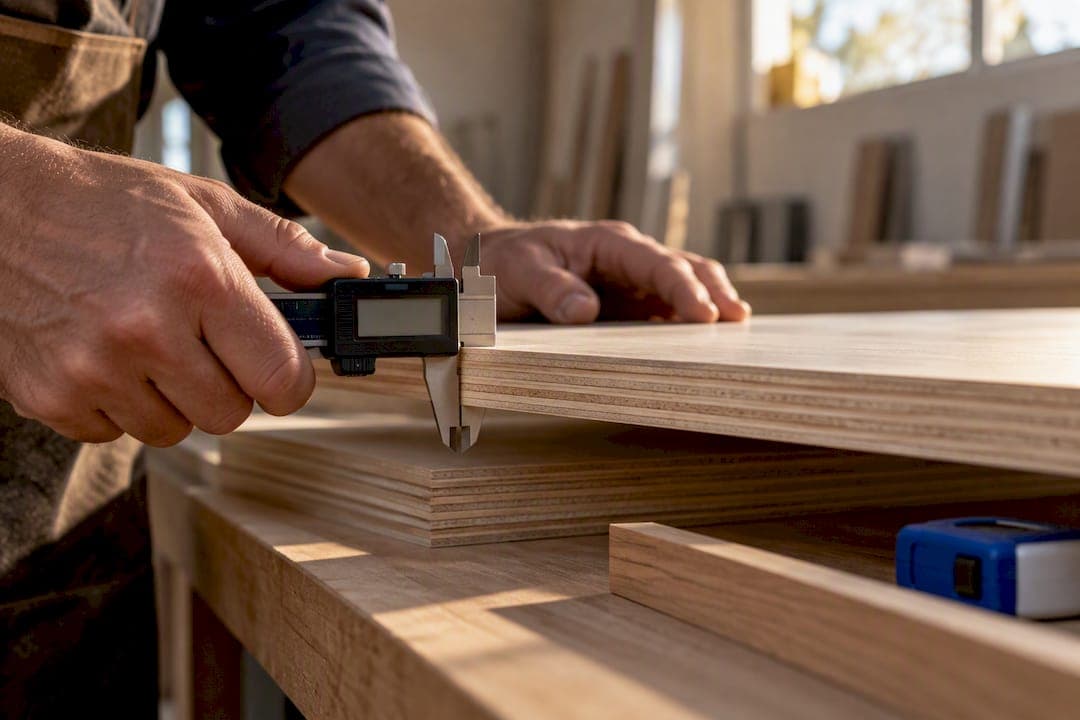
Three-quarter inch (18 to 19mm) plywood is the safest default for nearly every cabinet shelf you'll build or buy, and it's the standard for good reason: it resists sag, holds screws reliably, and works with standard shelf pins and hardware. The main exceptions are short display shelves, where 1/2" or 5/8" stock is fine, and wide or heavy-use shelves, which need thicker panels or added support. Industry groups like the Kitchen Cabinet Manufacturers Association (KCMA) and the Architectural Woodwork Institute (AWI) back this baseline, and it's the same recommendation Nathan and the team at Best Cabinet Specialist give in the shop every day.
TL;DR:
- Shelves spanning over 36 inches or carrying heavy loads should use 1-inch plywood panels or include additional supports to prevent sagging.
- Always measure actual plywood thickness with calipers, as nominal 3/4-inch sheets often measure around 23/32 inch, affecting hardware fit and joint quality.
- Thicker materials increase resistance to sag exponentially, with doubling thickness providing roughly eight times the support against bending.
- Using 3/4-inch plywood is standard for most cabinet shelves, but 5/8-inch can suffice for short spans under about 24 inches, provided load and support are appropriate.
- Confirm hardware compatibility with actual panel thickness to avoid wobble, pull-through, and fastener failure, especially when trimming or modifying panels.
Table of Contents
- Cabinet Shelf Thickness by Material
- How Span and Load Change the Thickness You Need
- Shop Rules That Prevent Sagging Shelves
- A Shop-Proven Checklist From Nathan
- Why 3/4 Inch Wins Most Arguments in the Shop
- Get Project-Ready Cabinets Built to the 3/4-Inch Standard
- Sources
- FAQ
Cabinet Shelf Thickness by Material
The right thickness depends heavily on what the shelf is made of, since plywood, MDF, particleboard, and solid wood all behave differently under load.
Plywood is the shop favorite for a reason. For kitchen cabinet construction, 3/4-inch plywood is the industry standard for carcass sides, tops, bottoms, and adjustable shelves, because it holds screws well and resists warping over time. You can drop to 5/8" for short spans under about 24 inches, but for wide pantry or garage shelves carrying real weight, step up to a full inch rather than pushing 3/4" past its limit.
MDF and particleboard flex more than plywood at the same thickness, so matching plywood's stiffness usually means going thicker or shortening the span. A 3/4" MDF shelf often performs closer to what a 5/8" plywood shelf does under the same load, which matters if you're substituting materials mid-project. Our guide on MDF versus plywood breaks down where each material makes sense.
Solid wood shelves need extra care because of seasonal movement. Wood expands and contracts across the grain with humidity, so a solid wood shelf that fits snugly in July can bind or gap by January. For longer spans, thicker stock helps, but pairing a slightly thinner panel with hardwood front lipping or edge banding often solves both the strength and the movement problem at once.
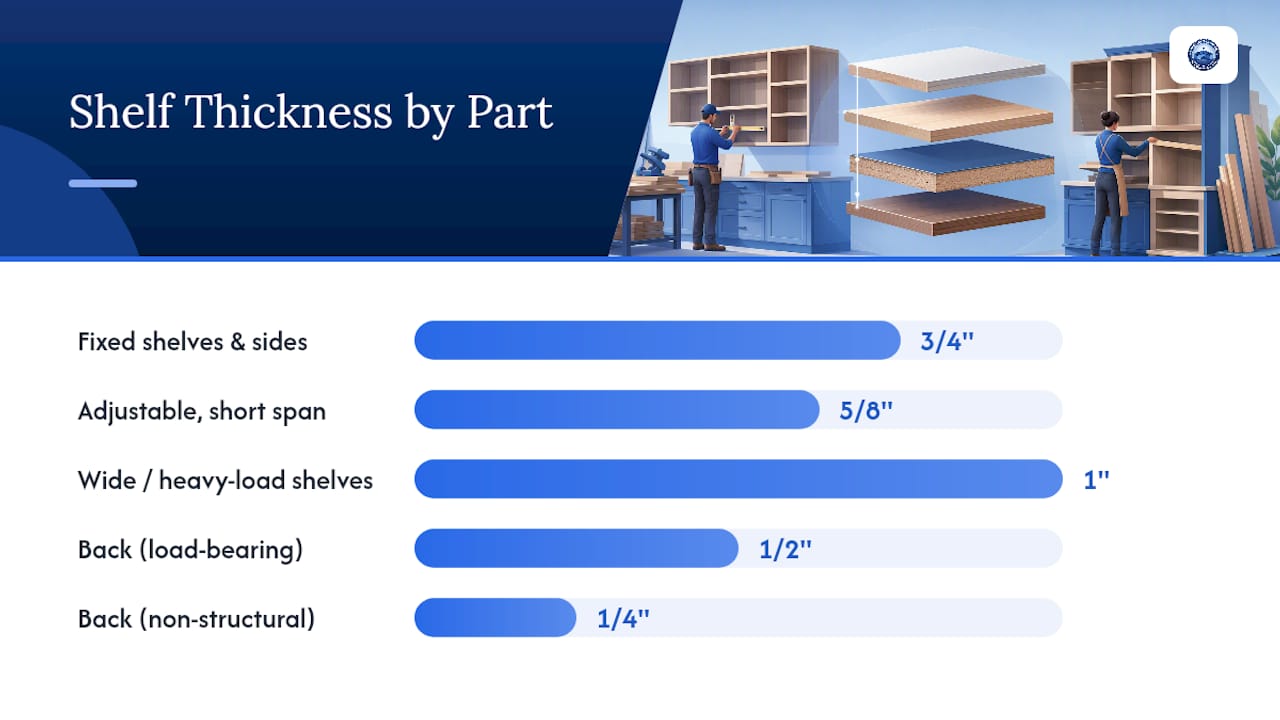
Backs and drawer parts don't need shelf-grade thickness. A cabinet back that helps carry hanger loads typically runs 1/2 inch, while a captured back on a budget or RTA unit can drop to 1/4 inch since it isn't doing structural work.
Quick reference by part:
- Fixed shelves and sides: 3/4" plywood
- Adjustable shelves, short span: 5/8" acceptable
- Wide or heavy-load shelves: 1" or reinforced 3/4"
- Cabinet backs (load-bearing): 1/2"
- Cabinet backs (non-structural, RTA-style): 1/4"
How Span and Load Change the Thickness You Need
Thin panels don't fail gradually. They sag a little, then a little more, then noticeably, because bending resistance scales with roughly the cube of a panel's thickness. Doubling the thickness of a shelf increases its resistance to sag by around eight times, which is why moving from 1/2" to 3/4" fixes far more sag than the numbers alone suggest.
Span is the other half of the equation. Here's how it typically plays out on a jobsite:
- Under 24 inches: 3/4" plywood handles almost any household load without reinforcement.
- 24 to 36 inches: 3/4" still works for light to medium loads, but add a front cleat or a hardwood lip if you're storing anything heavy like cookbooks, small appliances, or canned goods.
- Over 36 inches: don't rely on unsupported 3/4" stock. Free-span guidance puts the ceiling on unsupported shelving around this mark, so step up to 1" panels, add an intermediate support, or shorten the span with a center divider.
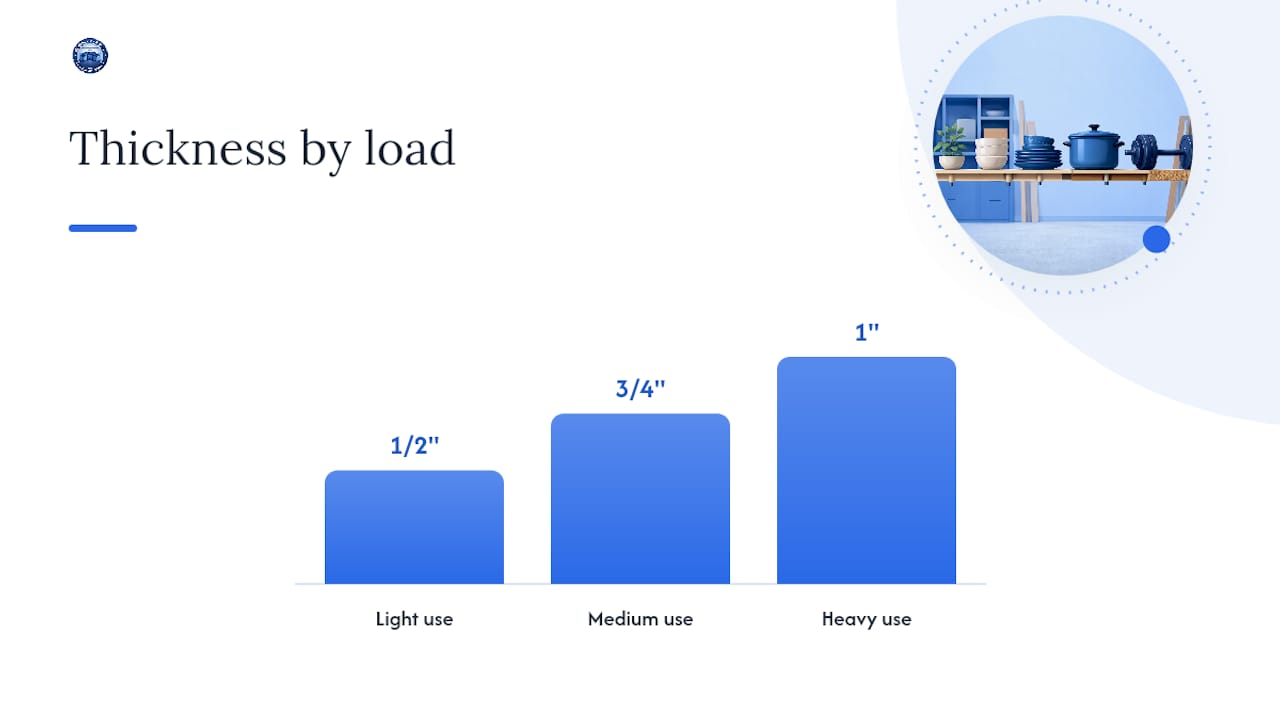
Load matters just as much as span. Light use, like a linen closet or a display shelf, gives you room to go thinner. Medium use, such as everyday kitchen dishware, is where 3/4" earns its reputation as the safe middle ground. Heavy use, think stacked mixing bowls, small appliances, or a garage full of paint cans, is where you need either 1" material or a shorter span with cleats doing part of the work.
Pro Tip: If you're unsure which category your shelf falls into, run the numbers through a plywood thickness calculator before you buy sheet goods. Span and load calculators consistently show recommended thickness shifting from 1/2" up to 3/4" as either number increases, and it's faster than guessing.
Shop Rules That Prevent Sagging Shelves
Getting the thickness right on paper doesn't help if the actual board doesn't match. Nominal "3/4-inch" plywood commonly measures closer to 23/32 inch, and that small gap throws off shelf-pin fit and joinery if you cut to the nominal number. Always measure your actual stock with calipers before cutting dado joints or drilling pin holes.
A few other habits separate a shelf that lasts from one that eventually droops:
- Add a front lipping or cleat on any shelf approaching the upper end of its span range. A 3/4" strip of hardwood glued to the front edge adds real stiffness without the cost of moving to 1" stock, a trick detailed in this cabinet material thickness guide.
- Break up long runs with an intermediate vertical support rather than fighting a single unsupported span.
- Match hardware to panel thickness. Shelf pins are typically sized for 3/4" material; drop to 1/2" without adjusting, and pins can wobble or pull through over time.
- Watch pocket-screw and confirmat screw depth. Thinner panels don't have the meat to hold long fasteners securely, so shorten screw length as panel thickness drops.
- Frameless cabinets carry more of the load through the panels themselves, since there's no face frame to help. That's often a reason to hold the line at 3/4" rather than trimming down, where a face-frame cabinet might tolerate a slightly thinner shelf.
Our piece on the 3/4 versus 1/2 plywood decision walks through this trade-off in more detail if you're weighing cost against long-term stiffness on a specific project.
A Shop-Proven Checklist From Nathan
Twenty years of watching shelves sag (or not) boils down to a short sequence you can run on any project:
- Measure your actual stock with calipers, not the label on the sheet.
- Decide the span and load category before you decide the thickness.
- Default to 3/4" unless you have a specific reason to go thinner.
- Add cleats, lipping, or intermediate supports if the span pushes past 30 inches.
- Confirm your shelf pins and fasteners actually match the panel you ended up using.
That last step gets skipped more than people admit, and it's the reason a lot of otherwise solid shelves end up wobbly. If you're assembling RTA cabinets and want to see how thickness and hardware fit come together in practice, our guide to RTA cabinet assembly covers the details step by step. And if you're planning pantry storage specifically, this piece on selecting the right pantry door is a useful companion read.
Why 3/4 Inch Wins Most Arguments in the Shop
Shops default to 3/4" because it means fewer callbacks and one less variable to second-guess when hardware needs to seat right. I'll sign off on thinner material for a display shelf or a short closet run, but only when the span stays short and there's some reinforcement backing it up. If you're not sure which way to go, buy the thicker plywood. It's cheaper than a return trip to fix a shelf that's already bowing.
— Nathan
Get Project-Ready Cabinets Built to the 3/4-Inch Standard
Every carcass is built around the same shop-tested standard this article recommends: 3/4" plywood boxes paired with solid wood doors, so shelves hold their line instead of bowing under everyday kitchen or bathroom loads. That means you skip the guesswork on span, load, and material thickness entirely, since it's already engineered into every box before it ships. Whether you're outfitting a full kitchen or a single bathroom vanity, our RTA cabinets and assembled cabinets both use the same plywood construction standard, with fast shipping and trade pricing available for contractors and builders ordering in volume.

Browse the RTA cabinet lineup to see plywood box construction and shelf specs for your next project, or reach out for a quote if you're speccing cabinets at scale.
Sources
- How to choose the right plywood for cabinets: a complete guide
- Theplywood
- Plywood thickness calculator for cabinets, shelves & closets
- Actual plywood thickness size
FAQ
Is 1/4-inch plywood strong enough for shelves?
Quarter-inch plywood is too thin for a load-bearing cabinet shelf and will sag noticeably even under light weight. It's fine for cabinet backs or drawer bottoms that don't carry stacked items, but shelves should start at 5/8" for short, light-duty spans and use 3/4" as the standard for anything else.
What is the ideal thickness for cabinet shelves?
Three-quarter inch (18 to 19mm) plywood is the ideal default because it balances stiffness, screw-holding, and cost for most cabinet parts and shelves. Shelves under 24 inches can sometimes use 5/8", while spans over 36 inches or heavy loads call for 1" stock or added support.
What is the 1/3 rule for cabinet hardware?
There's no single standardized "1/3 rule" in cabinet hardware specifications, so treat any version you've heard as a rough shop shorthand rather than an official spec. The more reliable approach is matching shelf pin and fastener size directly to your measured panel thickness, since pins sized for 3/4" material will wobble in thinner stock.
How thick is a regular shelf?
A regular cabinet shelf in most kitchens and bathrooms runs 3/4 inch, matching the plywood standard used for cabinet sides, tops, and bottoms. The plywood boxes are built to this same thickness across cabinet lines for consistent strength and hardware fit.