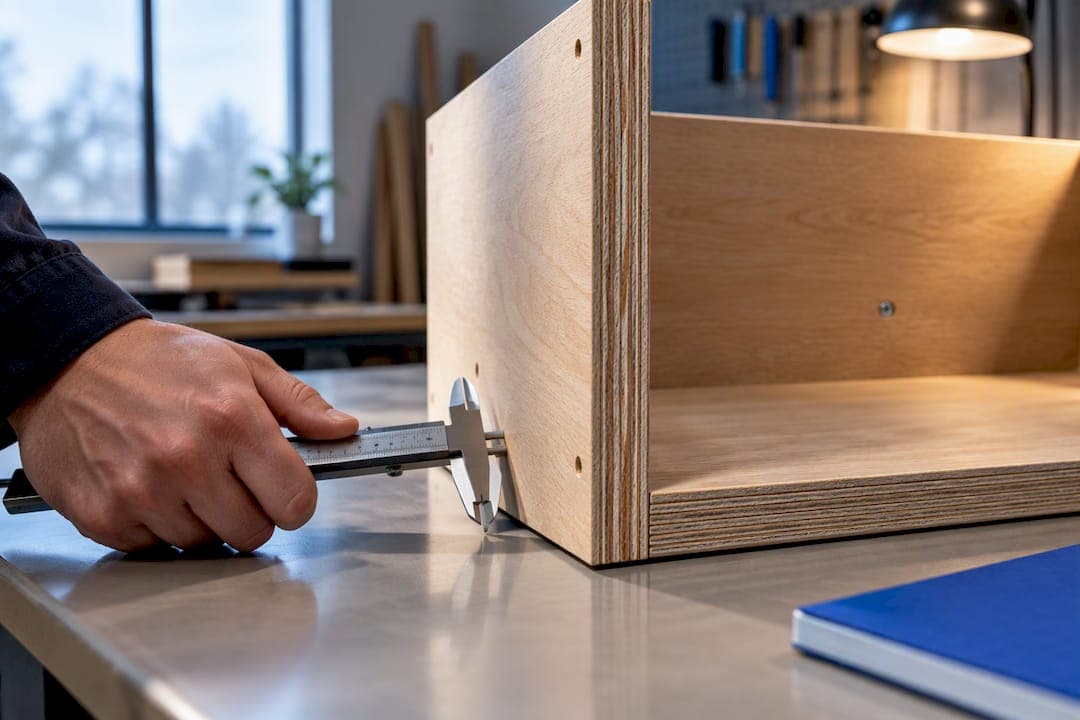
For RTA or assembled kitchen and bath cabinets, "plywood box construction" describes a family of panel builds, not one fixed material. Before you order, request the specific core, ply count, and certification details rather than trusting the word "plywood" alone. Two documents to check first: the KCMA A161.1 performance record and the TSCA Title VI emissions label.
TL;DR:
- Confirm the core type, ply count, and bond-line classification for each plywood panel, and request matching back panel specifications for durability.
- Ensure the manufacturer provides KCMA A161.1 certification and TSCA Title VI labels or third-party certifier references to verify safety and emissions compliance.
- Verify wall blocking, leveling, and fastening details before installation, as proper site preparation is critical for cabinet performance.
- Ask for detailed installation instructions, including blocking diagrams and fastening patterns, to reduce the risk of on-site errors.
- Seek suppliers with documented standards, quick shipping options, and readiness to provide compliance documents during quote requests.
Table of Contents
- What "plywood box" actually means
- Standards and emissions rules that actually protect your project
- How to evaluate an RTA or assembled cabinet quote
- Why installation determines how the box performs
- Where a supplier fits into this decision
- Getting a quote that answers every question above
- Official standards and EPA guidance
- Sources
- FAQ
What "plywood box" actually means
"Plywood" on a spec sheet can hide a lot of variation. ANSI/HPVA HP-1 lays out the vocabulary manufacturers use to describe panel builds, and it is worth learning before you sign off on a quote. A veneer-core panel stacks thin wood layers with the grain running in alternating directions, which gives it strength and screw-holding power. A lumber-core panel uses solid wood strips sandwiched between veneer faces. Combination cores blend veneer with particleboard or MDF layers, and bond lines are classified as Type I or Type II depending on moisture resistance.
Ply count and thickness matter just as much as core type. When you request a quote, ask for the nominal thickness of the sides, top, bottom, back, and shelves, plus the edge treatment used on exposed panels. A box built with a solid three-quarter-inch veneer-core side panel but a thin composite back will not rack or twist evenly, and that inconsistency is where cabinets start to fail years down the road.
- Ask for the core type (veneer, lumber, particleboard, MDF, or combination) for every structural panel, not just the door face.
- Request the ply count and bond-line type (Type I or Type II) for sides, top, bottom, and back.
- Confirm shelf thickness separately, since shelves see the most direct load over time.
- Get the edge-banding or edge-treatment spec for any exposed plywood edge.
A simple RFQ line does the job: "Side panels: 3/4-inch veneer-core plywood, minimum 7-ply, Type I bond, matching thickness on back and shelves." Our own budget buyer's guide to plywood kitchen cabinets breaks down how veneer-core and composite-core options compare in real project pricing.
Pro Tip: Ask for the same core spec on the back panel as the sides. A mismatched back is one of the most common ways a "plywood box" quietly becomes a mixed-material box.
Standards and emissions rules that actually protect your project
Two organizations do the heavy lifting on cabinet performance and air quality, and both are worth verifying before you buy. ANSI/KCMA A161.1 is a performance and construction standard for factory-built kitchen and vanity cabinets. It tests rigidity, door and drawer operation, joint strength, moisture response, and finish durability rather than dictating one specific material. A KCMA certification seal means a manufacturer's cabinets passed that testing battery, which tells you more about real-world durability than the word "plywood" ever will.
The Architectural Woodwork Institute ties acceptable materials and joinery methods to tested performance duty levels, and it requires manufacturers to supply documented installation instructions along with blocking and fastening details. For multifamily housing, rentals, or any heavy-use commercial space, ask specifically for AWI duty-level evidence rather than assuming a retail-grade cabinet will hold up the same way.
On the emissions side, TSCA Title VI requires composite wood products such as hardwood plywood, MDF, and particleboard sold in the United States to meet formaldehyde emission limits and carry third-party certification and labeling.
A composite panel sold as hardwood plywood must meet a formaldehyde emission limit of 0.05 ppm, verified by an EPA-recognized third-party certifier. That number is the baseline every legitimate supplier should be able to point to.
Because Title VI covers component panels rather than finished goods, a finished cabinet may not carry its own visible label. Ask the seller to provide or retain the component panel labels, since the regulation requires that information to be available on request.
Document checklist to request from any manufacturer:
- A KCMA certificate or test-report excerpt for the cabinet line.
- The TSCA Title VI label or third-party certifier (TPC) reference number for the plywood used.
- AWI duty-level documentation if the project is multifamily, rental, or heavy commercial use.
How to evaluate an RTA or assembled cabinet quote
Before you request a quote, verify your site conditions: exact wall and opening measurements, appliance opening sizes, plumbing rough-in locations, wall blocking, and delivery access for large flat-packed or preassembled boxes. Skipping this step is the single most common reason a correctly built cabinet still does not fit right on installation day.
Once you have a quote in hand, work through it with a short list of questions:
- What core type is used in the plywood, and is it consistent across sides, back, and shelves?
- What is the TSCA Title VI or TPC reference number for the panels?
- What is the box wall thickness, and how thick is the back panel specifically?
- What material is the drawer box built from, and what are the tested slide and hinge capacities?
- What installation instructions come with the order, including blocking and fastening details?
Acceptable answers include a specific TPC number, a named core type with matching thickness across panels, and written installation instructions with blocking diagrams. Red flags include missing labels, a vague "low-VOC" claim with no Title VI reference, or a quote that specifies the door material but stays silent on the box itself.
Veneer-core plywood generally costs more than a plywood-faced composite core, but it holds screws and hardware better over time, which matters most for heavily used drawers and wall-mounted cabinets. A composite core can be acceptable for lighter-use cabinets like decorative uppers, as long as the emissions labeling and thickness are documented.

Pro Tip: Save every document a supplier sends with your quote. If a warranty claim comes up in five years, that paperwork is your proof of what you actually paid for.
Why installation determines how the box performs
Every performance standard on the market, including KCMA and AWI, assumes the cabinet is installed the way the manufacturer specifies. That means wall blocking in the right locations, a consistent fastening pattern into studs or blocking, and careful leveling before anything gets loaded. A cabinet that passed every lab test can still fail on-site if it is screwed into drywall alone or forced square against a bowed wall.

Common failure points trace directly back to box construction and installation together. A box hung against an out-of-plumb wall without shimming will stress its joints over time. Thin, unsupported shelves sag under everyday dish and cookware weight. Poorly sealed seams near sinks or dishwashers let moisture into the core, which swells composite panels faster than solid veneer-core stock.
Build these checks into your installer contract:
- Confirm wall blocking locations before delivery, not after.
- Require a written fastening pattern that matches the manufacturer's installation instructions.
- Check that walls are shimmed level before boxes are fastened and joined.
- Inspect drawer boxes and shelf supports for even, unstressed alignment once installed.
For frequent heavy use, larger households, or rental turnover, specify higher-duty construction upfront rather than upgrading after the first shelf sags. Our guide on RTA cabinet assembly covers the practical steps that keep a plywood box performing the way it was built to.
Where a supplier fits into this decision
Most of the risk in plywood box construction comes down to documentation you never see unless you ask for it. Some suppliers build their RTA and assembled cabinets around plywood boxes, back that documentation with the standards buyers should expect, and ship quickly enough to keep a renovation timeline on track. Some companies treat paperwork requests as a normal part of ordering, not a special favor.
If you are still working through measurements or how RTA assembly fits your timeline, our guides on DIY cabinet assembly and site prep cover the groundwork before you order. From there, requesting sample spec sheets or a project quote is the lowest-commitment next step.
— Nathan
Getting a quote that answers every question above
Once you know what to ask for, getting a real answer should not take a week of back-and-forth. Best Cabinet Specialist's RTA Cabinets and Assembled Cabinets pages list the Shaker, Classic, and Slim Series builds available in plywood box construction, so you can start with the style you want and request the documentation from there.
Before you contact sales, have ready a clear outdoor kitchen layout plan if your project includes exterior cabinetry, and prepare your measurements and specifications.
- Your measurements, appliance opening sizes, and any plumbing or electrical constraints.
- Delivery access details, including stairs, elevators, or loading dock restrictions.
- The ply spec, TSCA Title VI reference, and installation instructions you want included with the quote.
For larger projects, inquire about trade pricing and bulk ordering. Some suppliers offer rapid shipping to help keep orders moving without the long lead times common elsewhere in the cabinetry market. Visit Cabinet-specialist to browse kitchen and bathroom lines or start a quote.
Official standards and EPA guidance
- EPA formaldehyde standards FAQ (TSCA Title VI)
- KCMA A161.1-2022
- ANSI/HPVA HP-1-2024
- Architectural Woodwork Institute standards
- KCMA: ROI of cabinet durability
Sources
- KCMA A161.1-2022
- Frequent questions for consumers about the Formaldehyde Standards for Composite Wood Products Act | US EPA
- Architectural Woodwork Institute (AWI) standards and casework guidance
- ROI of cabinet durability: reducing project risk with A161.1 | KCMA
FAQ
What does "plywood cabinet box construction" mean?
It refers to a cabinet carcass built from plywood panels rather than a specific single material, since plywood itself comes in several core types and ply counts. Buyers should request the exact core type, thickness, and bond-line class rather than relying on the word "plywood" alone, using ANSI/HPVA HP-1 vocabulary to compare quotes accurately.
How do I know a plywood cabinet meets safety standards?
Check for a KCMA A161.1 certification, which confirms the cabinet passed structural and performance testing, and ask for the TSCA Title VI or third-party certifier reference tied to the plywood panels. Both documents should be available from the manufacturer on request, even if the finished cabinet itself is not individually labeled.
Is plywood always better than MDF or particleboard for cabinet boxes?
Plywood generally holds screws and hardware better over time, which matters most for drawers, hinges, and wall-mounted cabinets, but a well-built composite core can suit lighter-use applications like decorative uppers. Our MDF vs. plywood guide walks through where each material makes sense for a kitchen project.
What should I confirm before installing new cabinet boxes?
Verify wall blocking locations, confirm the manufacturer's fastening pattern, and make sure walls are shimmed level before the boxes go in, since AWI and KCMA performance standards assume installation follows the manufacturer's written instructions. Skipping site verification is one of the most common reasons a properly built cabinet still does not fit or perform as expected.
Does Best Cabinet Specialist provide the documentation buyers need to verify compliance?
Some manufacturers build their RTA and assembled cabinets with plywood boxes and can provide the specification and compliance documentation buyers request as part of a quote. Reach out through the RTA Cabinets or Assembled Cabinets pages to request specifics for your project.