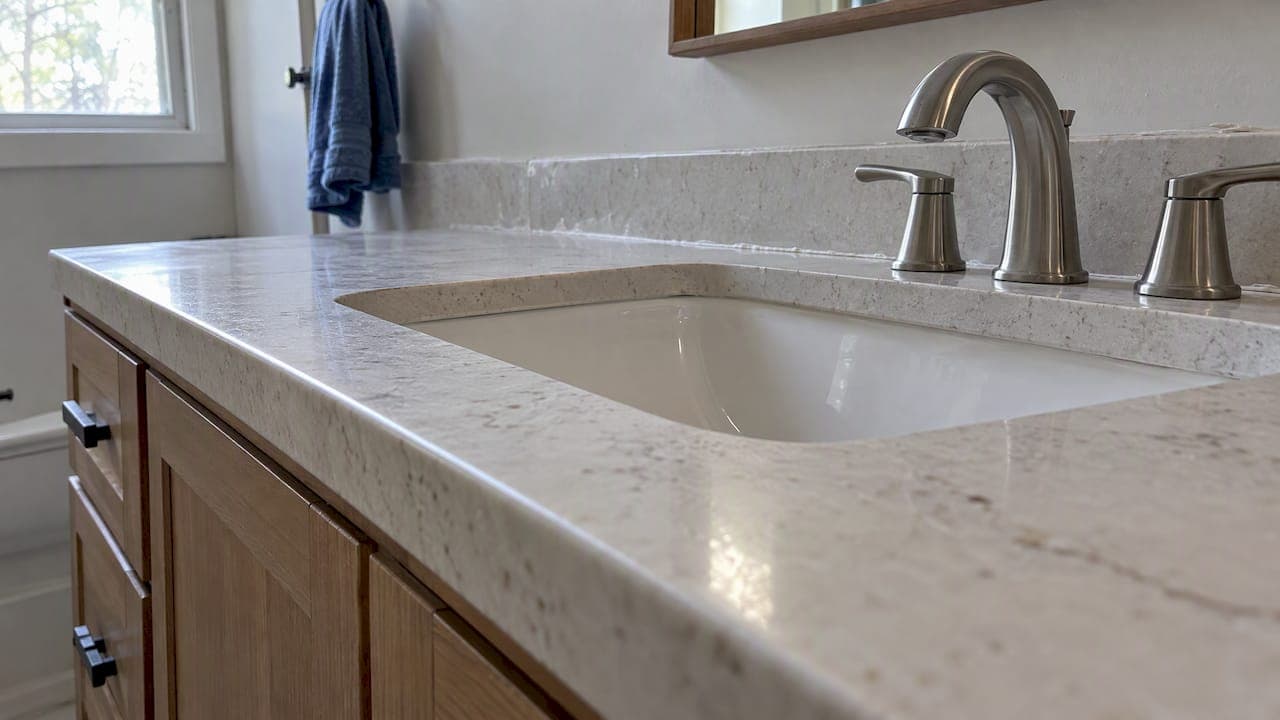
For most vanity projects, an undermount sink wins on looks and easy wipe-down cleaning, while a drop-in sink wins on budget and do-it-yourself installation. The right pick really comes down to your countertop material and how much cleaning effort you want to deal with. Undermount sinks are generally suited to solid-surface counters, a detail we keep in mind when matching vanity cabinets to sinks.
TL;DR:
- Top mount sinks suit laminate, tile, and stone counters, while undermounts need quartz or another solid surface and a precisely fabricated opening.
- Top mount installations are generally manageable for do it yourselfers and easier to replace, while undermounts require support brackets, careful sealing, and professional installation.
- Undermount sinks simplify daily counter cleaning, while top mount rims and caulk lines collect residue and need regular attention; both styles need seal checks.
- Before ordering a replacement or conversion, confirm cabinet width, faucet hole placement, cutout dimensions, countertop edge condition, and fit with your fabricator.
Table of Contents
- Quick at-a-glance comparison of undermount vs drop-in
- Undermount sinks: how they mount, look, and what they require
- Drop-in (top-mount) sinks: how they work and where they shine
- How to choose by countertop material, cabinet size, and cleaning habits
- Installation steps and what homeowners pay for each mounting type
- Daily cleaning tips and longer-term maintenance homeowners should plan for
- Practical checklist for replacing or converting sink mount styles
- Author perspective: coordinating sink mount choice with vanity selection
- Optional next step: bathroom cabinets and vanity bases that fit common sink setups
- FAQ
- Sources
Quick at-a-glance comparison of undermount vs drop-in
Before you commit to either style, it helps to see the two side by side on the factors that actually affect daily life in your bathroom.
- Appearance: Undermounts create a clean, seamless edge that shows off the countertop; drop-ins leave a visible rim that becomes part of the visual design.
- Cleaning: Undermounts let you wipe counter debris straight into the bowl; drop-ins need regular attention to the rim and caulk line where grime collects.
- Countertop needs: Undermounts require stone, quartz, or solid-surface counters; drop-ins work with laminate, tile, and solid surfaces alike.
- Installation effort: Undermounts need a precise fabricator cut and professional mounting; drop-ins are simple enough for a confident DIYer.
- Typical fit: A powder room with a laminate counter usually suits a drop-in, while a family bath with a stone counter is a natural fit for an undermount.
Undermount sinks: how they mount, look, and what they require
Undermount sinks attach from beneath the counter, with the rim hidden below the surface. That construction is what gives the countertop a continuous, uninterrupted edge right into the basin, which is why so many homeowners choose this style for a cleaner, more modern bathroom look. The seamless line also makes wiping spills easy: water and toothpaste debris go straight into the bowl without catching on a raised lip, a point PlumbingLab confirms when comparing the two mounting styles.
Undermount sinks depend on a solid countertop. They pair best with stone or solid-surface counters, while drop-in sinks are more forgiving of countertop materials such as laminate. BobVila notes that undermount installation calls for mounting clips or brackets secured to the underside of the counter, along with a precise cut from a fabricator, which is why professional installation is the standard recommendation rather than a weekend project. Once it's in place, the hidden seam needs a proper seal.
Drop-in (top-mount) sinks: how they work and where they shine
A drop-in sink, also called a top-mount or self-rimming sink, rests on a rim that sits flush on top of the counter and covers the edges of the cutout. That rim is what makes this style so flexible: it works on laminate, tile, and stone counters alike, since the sink doesn't depend on the countertop's edge finish the way an undermount does, according to PlumbingLab.
Some drop-in models come with predrilled faucet holes, which can make installation more straightforward. That same simplicity makes drop-ins easier and cheaper to replace down the road, since BobVila points out that swapping one typically just means breaking the old caulk seal and lifting the sink out, rather than working underneath the counter.
The trade-off shows up in daily cleaning. The rim and the caulk line around it can trap toothpaste residue, soap scum, and hair, so that seam needs more regular attention than an undermount's hidden edge. Homeowners who want the budget and convenience of a drop-in but dislike the visible lip can look for low-profile rim variants, which sit closer to the counter surface and are easier to wipe clean.

How to choose by countertop material, cabinet size, and cleaning habits
Picking a mount style gets simpler when you work through it in order, starting with what's already on your counter or what you're planning to install.
- Identify your countertop type. Laminate counters generally call for a drop-in sink, while stone, quartz, or solid-surface counters open the door to an undermount, as Horow notes when comparing pairings for each style.
- Check cabinet and faucet hole needs. Confirm whether your cabinet width supports the sink's footprint, and decide if you need predrilled faucet holes in the sink itself or in the countertop, since that detail varies by mount style.
- Match the choice to how you actually clean. If wiping counters straight into the sink matters to you, lean undermount; if you'd rather deal with occasional rim cleaning in exchange for easier replacement, a drop-in makes more sense.
Our guide to bathroom vanity sizes can help you confirm minimum cabinet widths before you order a sink or counter.
Pro Tip: Always verify fabricator recommendations and minimum cabinet dimensions with your countertop supplier before you place a sink order, since cutout tolerances vary by material and brand.
Installation steps and what homeowners pay for each mounting type
A drop-in installation typically follows a simple sequence: run a bead of plumber's putty or caulk around the underside of the rim, lower the sink into the cutout, secure it with the included clips. Many confident DIYers handle this without hiring help.
An undermount installation looks different from the start. A fabricator cuts the countertop opening to exact specifications, mounting brackets or clips get attached beneath the counter to hold the sink in place, and a bead of silicone seals the connection between sink and stone. BobVila recommends professional installation for this style, since the fabrication and sealing steps leave little room for error.

Costs vary by region and material, but a few factors reliably push the price up: adding new faucet holes to an existing counter, replacing the countertop entirely to accommodate a different mount style, or installing heavier sink supports for larger basins. If your project involves rerouting supply lines or fixing an existing leak, a licensed plumber like the team at AG-Plumbing can walk through what the job needs before you commit to a sink style.
Daily cleaning tips and longer-term maintenance homeowners should plan for
Undermount owners get the easiest daily routine: a quick wipe of the counter pushes crumbs, toothpaste, and water spots straight into the bowl with no rim to catch debris. Drop-in owners need to spend a little more time on the rim itself, running a cloth along the caulk line where grime and soap scum tend to build up.
For longer-term care, Insideast points to the no-rim design as the reason undermounts are considered easiest to keep clean, but that hidden seam still needs periodic inspection. For either style, keep a soft brush and a mild bathroom cleaner on hand, and check the caulk or silicone line for cracking or discoloration. An undermount seam may need resealing over time, depending on how the original installation holds up.
Practical checklist for replacing or converting sink mount styles
Switching from one mount style to the other is possible, but it depends on your countertop's condition. Converting to an undermount generally requires a solid counter edge with no chips or damage, matching cutout measurements, and sometimes a full refabrication if the existing opening doesn't suit the new sink's profile.
Before ordering anything, check the current cutout size, inspect the countertop edge for damage, and confirm you have underside access for mounting brackets. If a conversion looks feasible, the basic order of operations is: measure carefully, consult your countertop fabricator, order the new sink, then schedule a plumber or fabricator for the swap. For smaller repair jobs along the way, a guide like Tri-County Electric Service's homeowner guide covers what to expect before calling in help.
Author perspective: coordinating sink mount choice with vanity selection
We've found that the smartest move is picking your sink mount before you finalize a vanity cabinet, not after. Our bathroom vanity lines include accessory options. Check a vanity sizing guide before you lock in a sink type.
— Nathan
Optional next step: bathroom cabinets and vanity bases that fit common sink setups
Once you've settled on undermount or drop-in, a cabinet that's ready for either one saves you a return trip to the hardware store. Our RTA and assembled bathroom cabinet lines offer a range of options.

Whether you're outfitting a powder room or a family bath, explore our bathroom cabinets. You can also explore the White Slim Shaker vanity drawer base cabinet.
FAQ
Can an undermount sink be installed as a drop-in?
No, the two styles use different mounting hardware and countertop cutouts, so an undermount sink cannot simply be swapped in as a drop-in. Converting between the styles usually means a new countertop cutout or a full countertop replacement to match the sink's mounting requirements.
Should I get an undermount sink?
An undermount sink makes sense if your counter is stone, quartz, or another solid-surface material and you want a seamless look with easier wipe-down cleaning. If your counter is laminate or you want a lower-cost, DIY-friendly install, a drop-in is the more practical choice.
Are drop-in and top-mount sinks the same?
Yes, drop-in and top-mount sinks are the same product, also sometimes called self-rimming sinks. Both terms describe a sink that rests on a rim sitting flush on top of the countertop.
What is the main difference between an inset sink and an undermount sink?
An inset sink, more commonly called a drop-in sink, rests on top of the counter with a visible rim covering the cutout edges. An undermount sink attaches beneath the counter so the rim is hidden, creating a flush, continuous surface from counter to basin.
Sources
- Undermount vs. Drop-in Sink: Which Is Best for Your Reno?
- Undermount Vs Overmount (Top Mount) Sinks Compared 2025
- Home Bath Room Sink Guide: Best Undermount & Drop-In Picks