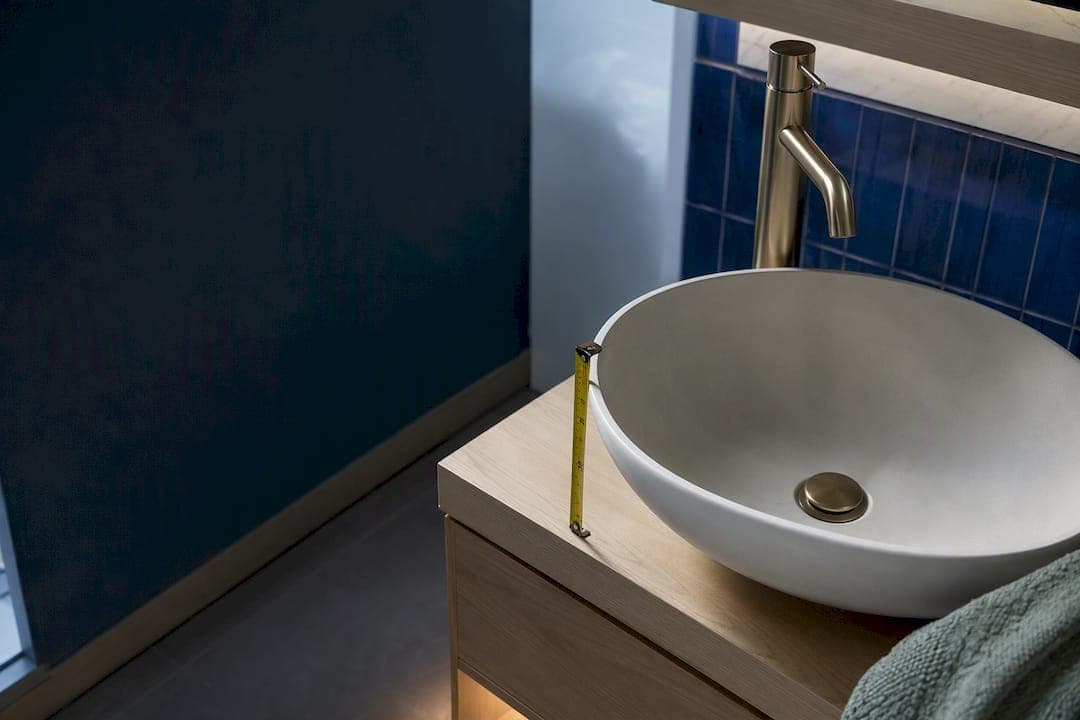
Aim for a final rim height of 34 to 36 inches above the finished floor, the same comfort range that plumbers and cabinetmakers use for any bathroom sink. Since a vessel bowl adds height on top of the cabinet and countertop, you need a shorter cabinet, typically 28 to 32 inches, to land there. The formula involves subtracting the vessel bowl height and countertop thickness from the target rim height to determine the cabinet height.
TL;DR:
- The ideal cabinet height for vessel sinks generally ranges from 28 to 32 inches, depending on the vessel bowl height, countertop thickness, and user measurements.
- Use a target rim height of 34 to 36 inches or measure from elbow to floor and subtract 2 inches for a personalized fit.
- Confirm faucet clearance of about 6 inches below the sink and select a faucet height of 12 to 17 inches to avoid splashing.
- Ensure the countertop material and substrate can support heavy stone bowls up to 60 pounds, especially with solid or natural stone.
- Avoid installing standard 34 to 36 inch cabinets with tall bowls, as the finished rim will become uncomfortable for daily use unless modifying with semi-recessed options or custom work.
Table of Contents
- Finding the Right Vessel Sink Vanity Height for Your Household
- How to Calculate the Cabinet Height for a Vessel Sink
- Getting Faucet Height and Clearance Right
- Countertop Materials and Weight Considerations
- Common Vessel Sink Height Mistakes and How to Fix Them
- Accessibility and Household-Specific Height Adjustments
- What to Check Before You Order a Vessel-Ready Cabinet
- An Editorial Take on Getting Vessel Sink Height Right
- Order a Vessel-Ready Vanity Base Sized to Your Numbers
- Sources
Finding the Right Vessel Sink Vanity Height for Your Household
The 34 to 36 inch comfort band exists because that range keeps your shoulders relaxed and your elbows bent close to 90 degrees while you're brushing your teeth or washing your face. Go higher than that consistently, and you'll feel it in your shoulders after a few weeks. Go much lower, and you're hunching over the bowl.
Not every household lands in the same spot within that range, though. A family with kids or a shorter primary user often does better at 34 inches. A household of taller adults might push toward 36 inches or slightly beyond. If someone in the home uses a wheelchair or has limited mobility, a vessel sink may not be the right call at all, which we'll get into later.
A quick way to personalize your target: stand naturally, let your arm hang, and measure from the floor to your elbow. Subtract about 2 inches, and that's a reasonable working target rim height for you specifically.
Before finalizing a number, run through this:
- Who uses this bathroom most often, and how tall are they?
- Does anyone in the household need a lower or ADA-compliant setup?
- Have you measured elbow height rather than guessing based on your current vanity?
- Does the number you landed on fall inside 34 to 36 inches, per ergonomic guidance for vessel sink vanities?
How to Calculate the Cabinet Height for a Vessel Sink
Once you know your target rim height, the rest is subtraction. Here's the process, start to finish.
- Set your target rim height. Use 34 to 36 inches as your baseline, or your elbow-height calculation if you did one.
- Get the vessel bowl height from the manufacturer. Most vessel bowls run 4 to 6 inches, though some run as high as 7, according to vanity height diagrams for vessel sinks. Don't eyeball this. Pull the spec sheet or measure the bowl yourself.
- Account for countertop thickness. Most countertops run 1 to 1.5 inches thick. Confirm yours before you calculate.
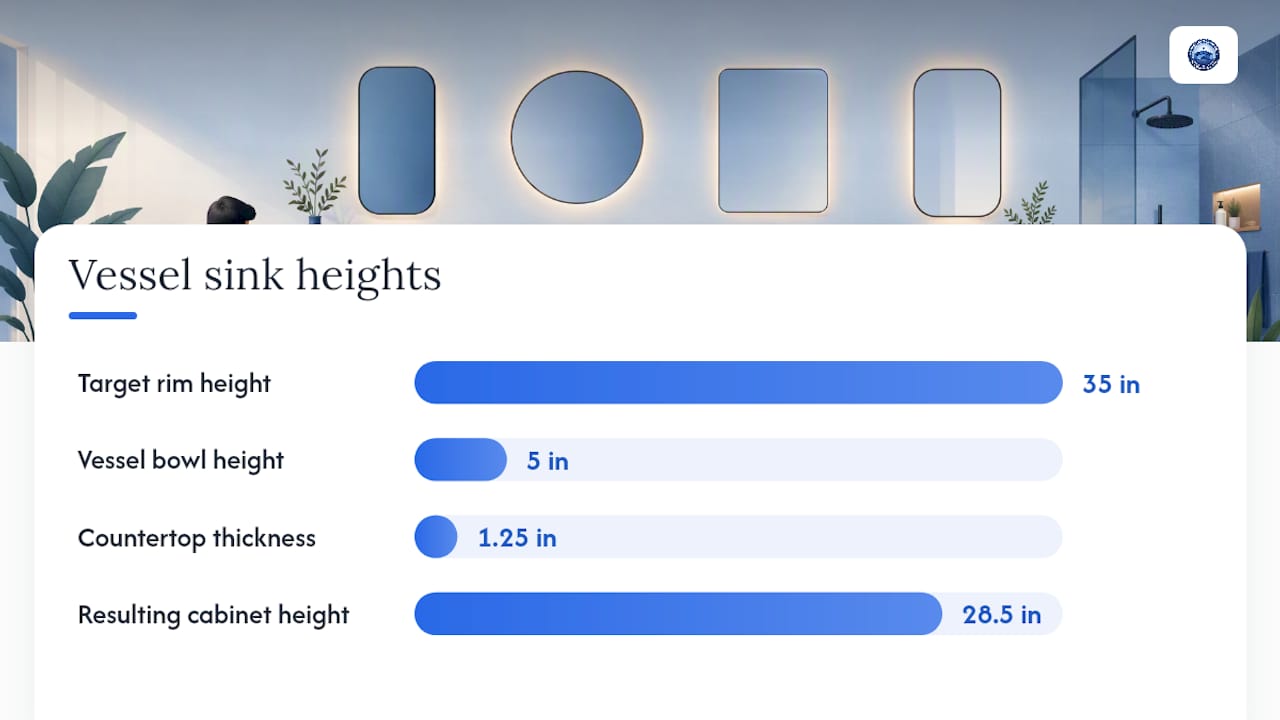
- Run the formula. Cabinet height = target rim height − vessel bowl height − countertop thickness. A 35 inch target with a 5 inch bowl and 1.5 inch countertop gives you a 28.5 inch cabinet.
Build in about an inch of tolerance either direction. Cabinets ship in standard increments, and a small variance won't wreck the ergonomics.
Pro Tip: Before you order anything, stack boxes or clamp a scrap board at your calculated cabinet height, set a bowl (or a similar-sized container) on top, and stand at it like you're washing your hands. Five minutes of mockup saves you from a $600 mistake.
For the full measuring process on width and depth too, our guide on how to measure vanity dimensions walks through it step by step.
Getting Faucet Height and Clearance Right
Picking the sink and cabinet height is only half the job. The faucet has to reach the bowl without splashing water everywhere, and it has to physically clear the rim.
Deck-mounted faucets, installed directly on the countertop next to the bowl, are the most common choice for vessel sinks and generally the easier install. Wall-mounted faucets skip the countertop entirely and mount into the wall above the bowl, which frees up counter space but requires rough-in plumbing before the wall closes up, so plan that early if you're going that route.
A few clearance numbers to work from:
- Aim for roughly 6 inches of clearance between the faucet spout and the bottom of the sink basin, per fitting guidance for vessel sink faucets.
- Vessel-specific faucets commonly run 12 to 17 inches tall to bridge that gap.
- Position the spout so water lands near the bowl's center, not near the rim edge.
- Lock in your faucet spec before you buy anything else. It has to match the final rim height you calculated, not the other way around.
Countertop Materials and Weight Considerations
Vessel bowls sit on top of the counter instead of dropping into it, which changes what the countertop needs to handle. Solid wood, quartz, and natural stone all work well, provided the substrate underneath is solid, ideally plywood rather than particleboard.
Weight matters more than most people expect. Stone vessel bowls can weigh 25 to 60 pounds before you've added water, according to guidance on vessel sink weight and support, and that load sits concentrated in one spot rather than spread across the counter.
A short checklist before you commit:
- Confirm the substrate can handle the bowl's weight, especially with stone.
- Know whether your countertop needs a drain hole (for vessel and semi-recessed styles) or a full cutout (for undermount), since they aren't interchangeable.
- Check that cabinet depth and width leave room for the bowl without overhanging the edge or crowding the drain and supply lines.
Common Vessel Sink Height Mistakes and How to Fix Them
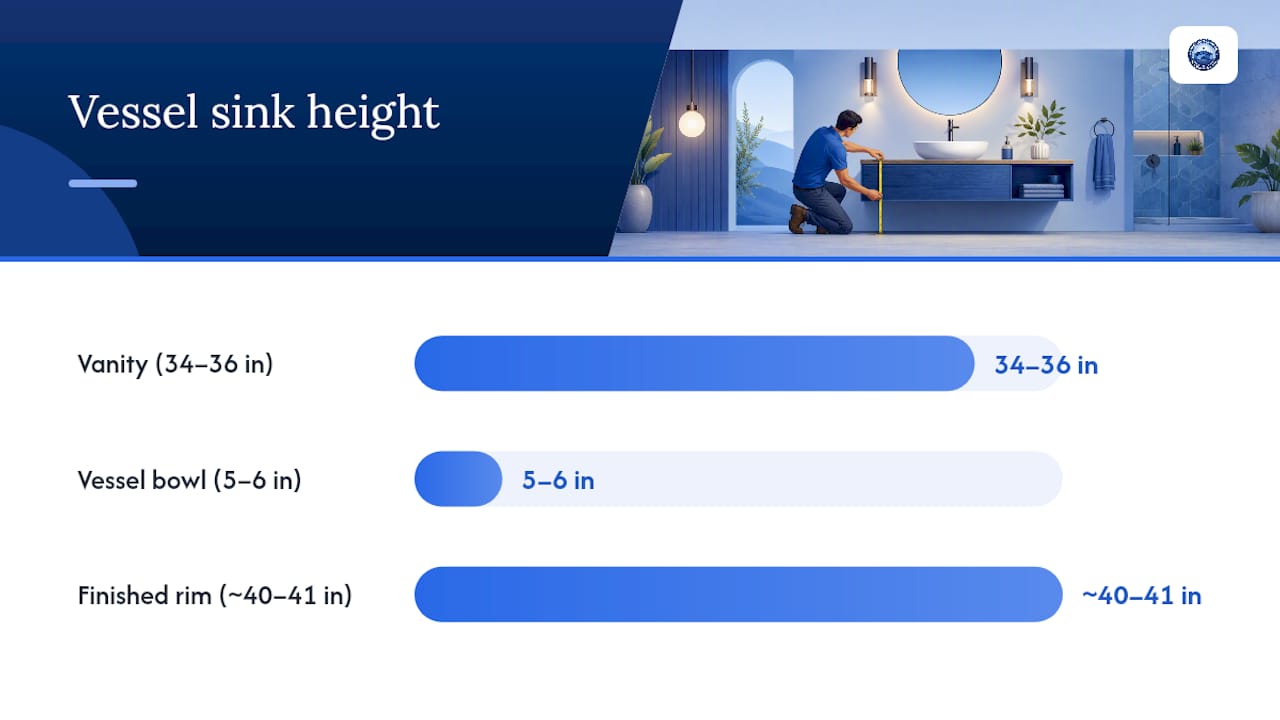
The single most common mistake: bolting a vessel bowl onto a standard 34 to 36 inch vanity. Add a 5 or 6 inch bowl to a 35 inch cabinet, and the finished rim lands at 40 or 41 inches, well past what's comfortable for daily use, and a documented source of buyer complaints across vessel sink design guides.
If you're stuck with an existing standard-height cabinet, you have options short of replacing it. A semi-recessed bowl sits partially inside the counter rather than fully on top, cutting several inches off the final height, a workaround confirmed in compatibility guidance for vessel sinks. A lower-profile bowl helps too.
Before you order anything:
- Measure floor to your target rim height, then work backward.
- Confirm faucet reach and drain alignment against your actual bowl.
- Verify the countertop can support the bowl's weight.
- Map out plumbing routing, especially for wall-mounted faucets.
Pro Tip: If you're dealing with a heavy stone bowl, a wall-mount faucet, or plumbing that isn't already roughed in for a vessel setup, bring in a licensed plumber or contractor. The cabinet math is DIY-friendly; structural and plumbing work often isn't.
Accessibility and Household-Specific Height Adjustments
ADA guidelines cap accessible lavatory rim height at roughly 34 inches above the floor, with knee clearance underneath for a wheelchair user, according to ADA-focused vanity height references. A vessel bowl sitting on top of the counter often eats into that knee clearance and complicates meeting the standard without a custom build.
If accessibility is a priority in your home, an undermount, semi-recessed, or wall-hung lavatory usually serves better than a true vessel bowl. Our ADA bathroom vanity height guide breaks down the specific clearances.
For households without accessibility needs, adjusting for kids or unusually tall adults is simpler: shift your target rim height a couple of inches in either direction and recalculate the cabinet height using the same formula.
What to Check Before You Order a Vessel-Ready Cabinet
Before you commit to a cabinet, confirm four things: the calculated height, the internal depth needed to clear the plumbing, the weight capacity if you're using a stone bowl, and whether the recommended countertop material matches what your cabinet can support. Skipping any one of these is how homeowners end up with a rim height that's technically correct on paper but wrong in the bathroom.
Best Cabinet Specialist builds bathroom cabinets with plywood box construction and solid wood doors, both of which matter when you're supporting a heavy vessel bowl on a smaller footprint. Fast shipping also means you're not stuck waiting weeks between finalizing your measurements and getting a cabinet in hand to test fit.
If you want to go deeper on sizing before you buy, our guides on bathroom vanity depth and 36 inch sink base cabinets cover the width and depth side of this decision, which matters just as much as height once the bowl and faucet are in place.
An Editorial Take on Getting Vessel Sink Height Right
Most of what gets written about vessel sinks focuses on how they look. That's backwards. The bowl sits in plain view, so of course people obsess over the finish and shape, but the number that actually determines whether you like using your bathroom every morning for the next ten years is the rim height, and that gets treated as an afterthought.
The conventional advice, "just use a vanity a few inches shorter," isn't wrong, but it skips the part that matters: measuring your own household first. A family of five-foot-two adults and a family of six-foot-two adults should not land on the same cabinet height, even with an identical bowl. Work backward from a real measurement, not a generic range.
If you're not confident running the calculation yourself, a vessel-ready cabinet package that's already sized correctly removes the guesswork entirely. That's a legitimate shortcut, not a compromise. Prioritize the measurement first. Everything else, the faucet, the countertop material, the finish, is easier to get right once the height is settled.
— Nathan
Order a Vessel-Ready Vanity Base Sized to Your Numbers
Once you've run the formula and landed on a target cabinet height, the next step is finding a base built to that spec without waiting weeks for a custom order. Best Cabinet Specialist stocks bathroom vanity bases with plywood box construction and solid wood doors, sized to fit vessel sink setups in the 28 to 32 inch range most homeowners land on.

Take your calculated height, your bowl dimensions, and your countertop thickness, then check them against the specs on each cabinet before you order. That five-minute cross-check is the difference between a vanity that fits and one that gets returned. Browse the current lineup and check sizing at Best Cabinet Specialist to find a base that matches the numbers you just worked out.
Sources
- Vessel Sink Vanity Guide (2026): Pros, Cons & What to Know
- Vanity height by sink type — Diagram
- Choosing a vanity top and cabinet for a vessel sink — Hunker
- Engineerskill