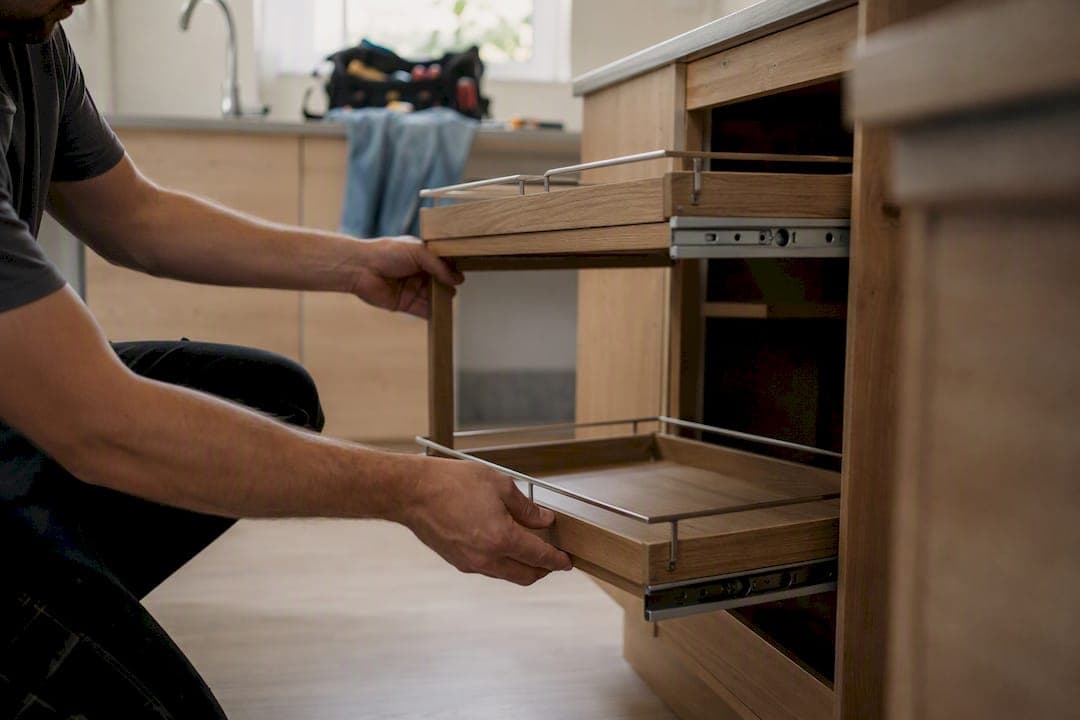
For most kitchens, the best corner cabinet solutions come down to five options: lazy Susans, blind-corner pullouts (also called magic corners or LeMans systems), corner drawers, diagonal cabinets, and corner pantries. A lazy Susan is your budget-friendly, easy-retrofit pick. A blind-corner pullout reclaims space a standard cabinet buries and hides completely. Corner drawers suit cooks who want quick-grab access without spinning anything. Diagonal cabinets and corner pantries work best when you're building from scratch or replacing boxes entirely.
Before you buy any of it, grab a tape measure. You need three numbers:
- Opening width, measured inside the cabinet door frame
- Internal depth, from the back wall to the front edge
- Internal height, from the cabinet floor to the underside of the countertop or shelf above
Get those three right, and you'll know within minutes which corner cabinet solutions will actually fit your kitchen.
TL;DR:
- Measure the inside opening width, internal depth, and internal height accurately before selecting a corner cabinet solution to ensure proper fit.
- Lazy Susans are budget-friendly and quick to install, but blind-corner pullouts significantly increase accessible storage space behind the corner.
- Heavy cookware benefits from steel-frame systems with soft-close slides that have higher load ratings than lightweight polymer baskets.
- Pair one accessible mechanism with a blind-corner organizer in U-shaped kitchens to optimize both quick access and maximum storage recovery.
- Replacing the cabinet box with a custom plywood unit designed for standard hardware offers a reliable retrofit when existing cabinets are too small or structurally compromised.
Table of Contents
- What Are the Best Corner Cabinet Organizers for Each Layout?
- How Do You Measure a Corner Cabinet for Retrofit Hardware?
- What Do Corner Cabinet Solutions Cost, and What Should You Buy for Heavy Loads?
- Which Corner Solution Fits Your Kitchen Layout?
- What the Research Actually Tells You to Prioritize
- Getting the Right Cabinet Box for Your Corner Fix
- Key Takeaways
- Sources
What Are the Best Corner Cabinet Organizers for Each Layout?
Corner cabinets waste more usable space than any other spot in a kitchen, which is exactly why so much hardware exists to fix them. Here's how the major options actually work.
Lazy Susans remain the most recognizable corner storage ideas because they're simple and affordable. A full-circle turntable rotates 360 degrees and works well in cabinets with a single door opening onto the corner. A half-moon (or kidney-shaped) version fits two-door corner cabinets and is common in older homes. Most turntables handle a moderate load per shelf depending on material, so check the weight rating before loading it with cast iron. Bi-fold door lazy Susans, where the doors fold back as the shelf spins out, solve the classic problem of contents getting stuck behind a stationary door frame. Upper-cabinet lazy Susans exist too, though they carry lighter loads and smaller diameters than base cabinet versions.
Blind-corner pullouts solve a different problem: the dead zone behind an adjacent cabinet that a lazy Susan can't reach. Modern blind-corner organizers like LeMans-style units and Girasolo systems use pivoting or sliding hardware to swing shelving out from that hidden space and into full view. A "magic corner" system typically uses two articulated wire baskets that unfold in sequence as you pull the door open, exposing nearly the entire depth of the cabinet. These systems cost more than a turntable, but they recover square footage that would otherwise sit empty behind a wall of cabinetry.
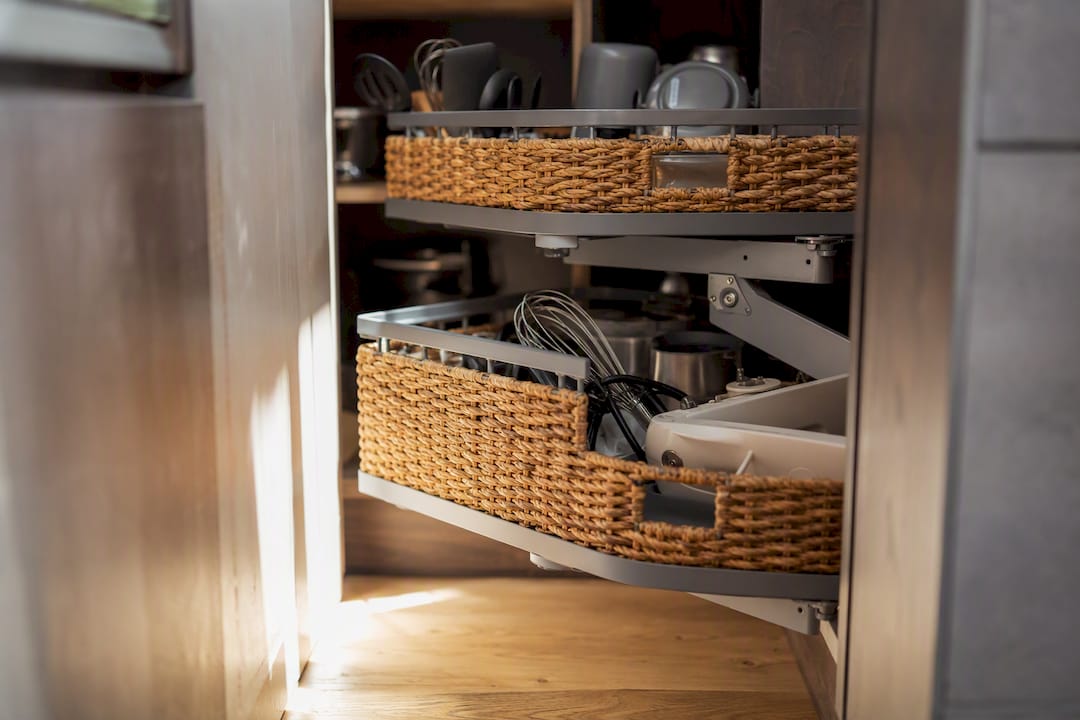
Corner drawers skip rotation entirely. Instead, the drawer box is custom-shaped to follow the corner's angle, giving you a shallow but wide storage sweet spot for cutting boards, trays, or pot lids. They're a strong choice if you dislike spinning mechanisms or want faster access without reaching into a cabinet's depths.
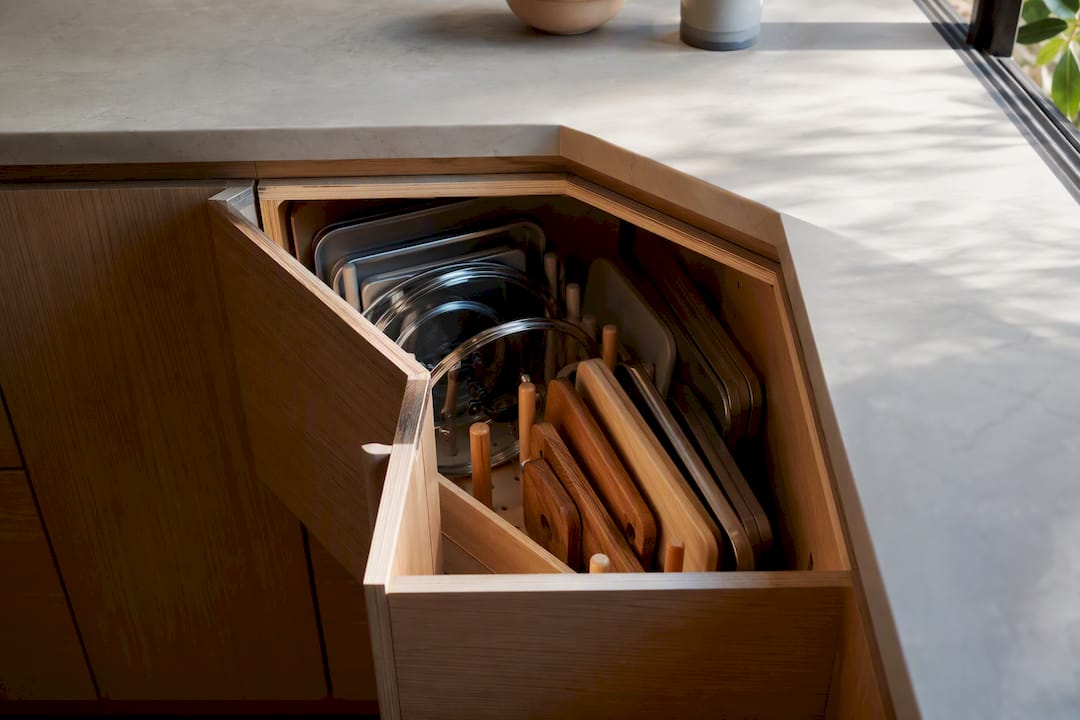
Diagonal cabinets (also called angled-front cabinets) present a single door at 45 degrees across the corner. They eat more floor footprint than a square cabinet but offer a deep, walk-up storage area, and they pair naturally with a corner pantry conversion if you want floor-to-ceiling storage instead of base cabinet drawers.
Upper corner cabinets deserve their own thought. Rather than force a mechanism into a shallow, hard-to-reach space, many kitchens use open shelving or an appliance garage up top, or convert the base corner into a sink cabinet where plumbing already dictates the layout.
Pro Tip: Skip the elaborate mechanism for upper cabinets. Simple adjustable shelving often works better than a rotating unit up there, since the shallow depth limits how much a lazy Susan can hold anyway.
How Do You Measure a Corner Cabinet for Retrofit Hardware?
Retrofitting is often possible without tearing out your existing cabinets, but only if the box behind the door can actually accept the hardware you want. Here's the sequence to follow before you order anything.
- Measure the opening width inside the door jamb, not the outside face frame. Corner-cabinet hardware is typically sold by opening size, like a 15 inch or 18 inch unit, and a mismatch here is the most common return reason.
- Measure internal depth, back wall to front edge, on both sides of the corner since older cabinets aren't always square.
- Measure internal height, from the cabinet floor to the underside of the countertop or the bottom of the shelf above, to confirm a multi-tier pullout has room to clear.
- Check for interference points: sink plumbing, garbage disposal, drawer slides in an adjacent cabinet, and especially the swing radius of nearby appliance doors and handles.
- Confirm handedness and mounting type. Some pullouts mount to the door itself; others mount to the cabinet floor or side panel independently of the door. Getting this backward means the mechanism won't move with the door as intended.
Adjacent clearance trips up more DIY installs than any other single factor. Appliance doors and cabinet handles that sit near the corner frequently block full extension, so measure with those doors open, not closed, before you commit to a purchase.
If your internal box comes up short, obstructed by framing, or too shallow for any standard system, that's your signal to stop chasing retrofit hardware and start pricing a new cabinet. Our step-by-step measuring guide walks through the full-kitchen version of this same process.
What Do Corner Cabinet Solutions Cost, and What Should You Buy for Heavy Loads?
Budget depends heavily on mechanism complexity. A basic wire turntable runs on the low end and installs in under an hour. A soft-close blind-corner pullout with articulated baskets sits in the midrange. Fully custom articulated systems with premium hardware and matched finishes land at the top of the price range, largely because of the engineering needed to make two or three shelves unfold in sequence without jamming.
Material matters as much as mechanism type:
- Polymer or wire baskets are lightweight and affordable but rated for lighter loads, fine for boxed goods and lightweight cookware.
- Solid wood shelving carries heavier loads and matches cabinet interiors better, at a higher price point.
- Steel-frame systems with soft-close slides hold up best under repeated daily use and heavy cast iron, and hardware with a documented load rating and soft-close slides tends to deliver the best long-term value for kitchens that see real cooking traffic.
DIY installation needs a drill, a level, a stud finder if you're mounting to the wall side, and basic hand tools. Most turntables install in an afternoon. Articulated pullouts take longer and reward careful measurement over speed. Whatever you buy, check the warranty terms and whether replacement parts are sold separately. That's often the clearest signal of hardware built to last versus hardware built to a price point.
Which Corner Solution Fits Your Kitchen Layout?
Layout decides more of this than personal preference does. Here's how it typically breaks down.
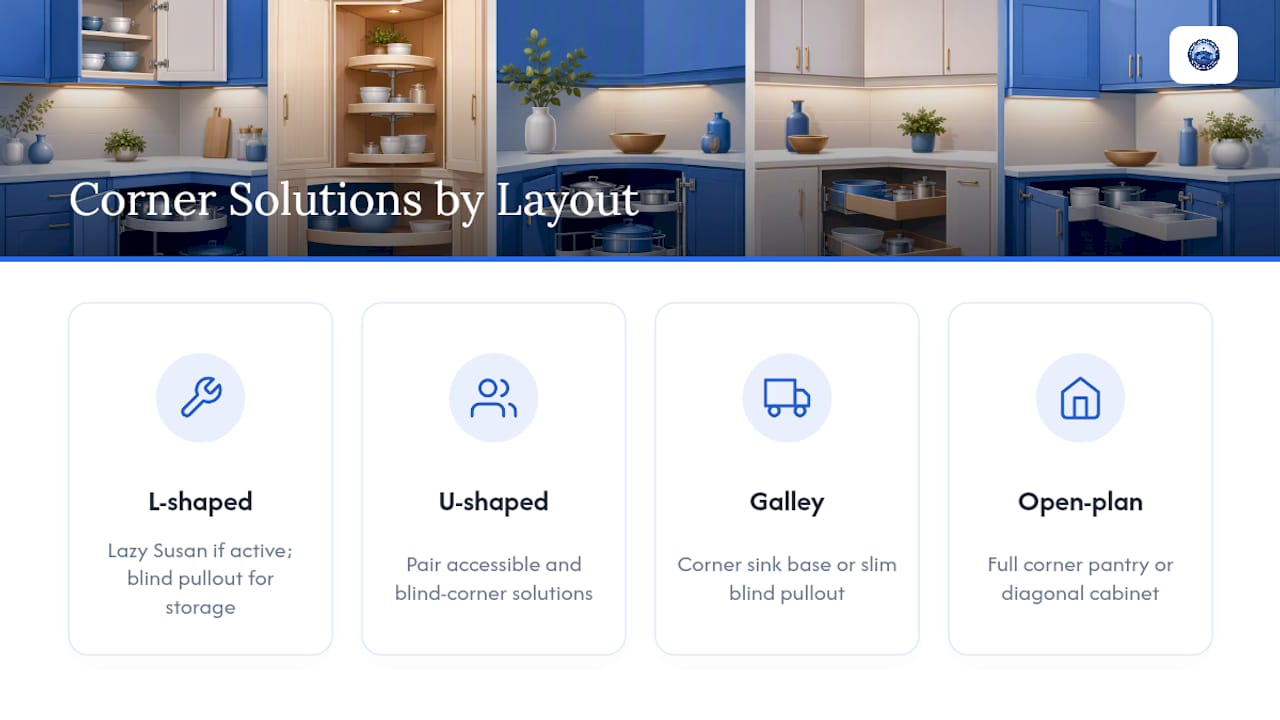
L-shaped kitchens usually have one corner to solve, and the right call depends on your workflow. If you're often reaching into that corner while cooking, a lazy Susan keeps access fast. If the corner is more storage than active workspace, a blind-corner pullout recovers more usable volume.
U-shaped kitchens often have two corners, and design guidance favors pairing one accessible solution with one blind-corner optimizer rather than installing the same mechanism twice. That balances quick access on one side with maximum storage recovery on the other.
Galley kitchens rarely have room for an angled cabinet without breaking up a linear run of counter space, so a corner sink base or a slim blind-corner pullout usually beats a diagonal cabinet here.
Open-plan kitchens and island-heavy layouts often have more forgiving corner geometry, which makes a full corner pantry or an angled diagonal cabinet more practical than a complex pullout mechanism. If you're weighing a pantry conversion, it's worth thinking through door style and swing clearance the same way you would a pantry door for the rest of your kitchen.
What the Research Actually Tells You to Prioritize
Most corner cabinet advice online treats every solution as interchangeable, as if a lazy Susan and a blind-corner pullout solve the same problem. They don't. One is about speed of access. The other is about recovering space you're currently losing entirely. Conflating them leads homeowners to buy the wrong hardware and blame the product instead of the mismatch.
The bigger gap in conventional advice is that it skips measurement almost entirely, jumping straight to product recommendations. That's backward. A gorgeous articulated pullout system is worthless if your box depth is two inches short or an appliance handle blocks full extension. Measure first, every time, with doors and handles open.
My honest read: retrofitting is worth trying before you assume you need new cabinets, but don't get precious about saving an undersized or damaged box. If your internal dimensions genuinely can't accommodate the hardware you want, or the cabinet itself is failing structurally, replacing it with a properly sized corner-friendly cabinet is the faster, more reliable fix. Measure twice. Then decide honestly whether you're retrofitting or rebuilding.
— Nathan
Getting the Right Cabinet Box for Your Corner Fix
Sometimes the honest answer to a corner storage problem isn't new hardware. It's a new box. Best Cabinet Specialist builds plywood cabinet boxes with solid wood doors designed to accept standard lazy Susans, blind-corner pullouts, and corner drawer inserts without the fitting headaches that come with an undersized or out-of-square older cabinet.

Because Best Cabinet Specialist ships fast and sells both individual units and bulk packages, homeowners tackling one corner and contractors outfitting a full kitchen get the same reliable turnaround. As a women-owned and veteran-owned business, the company builds every order to be genuinely project-ready, not just factory-standard. If your measurements show your current corner cabinet can't take the hardware you want, browse ready-to-assemble cabinet options built to accept modern organizers from day one, then head to the Best Cabinet Specialist homepage to compare styles and get a quote for your corner.
Key Takeaways
Measuring opening width, internal depth, and internal height before buying determines whether a corner cabinet retrofit succeeds or wastes money on hardware that doesn't fit.
| Point | Details |
|---|---|
| Measure before buying | Confirm opening width, internal depth, and internal height, plus door and appliance clearance. |
| Match mechanism to goal | Lazy Susans favor speed of access; blind-corner pullouts recover hidden storage volume. |
| Pair solutions in U-shapes | Combine one accessible corner with one blind-corner optimizer for balanced storage. |
| Check load ratings | Steel-frame, soft-close hardware holds up better than lightweight polymer for heavy cookware. |
| Replace when undersized | Best Cabinet Specialist's plywood boxes with solid wood doors accept standard corner organizers when retrofitting isn't viable. |
Sources
- Blind corner solutions — Rev-A-Shelf
- Rev-A-Shelf chrome pull-out corner cabinet organizer — Home Depot
- Omega National corner appliance garage — WW Hardware