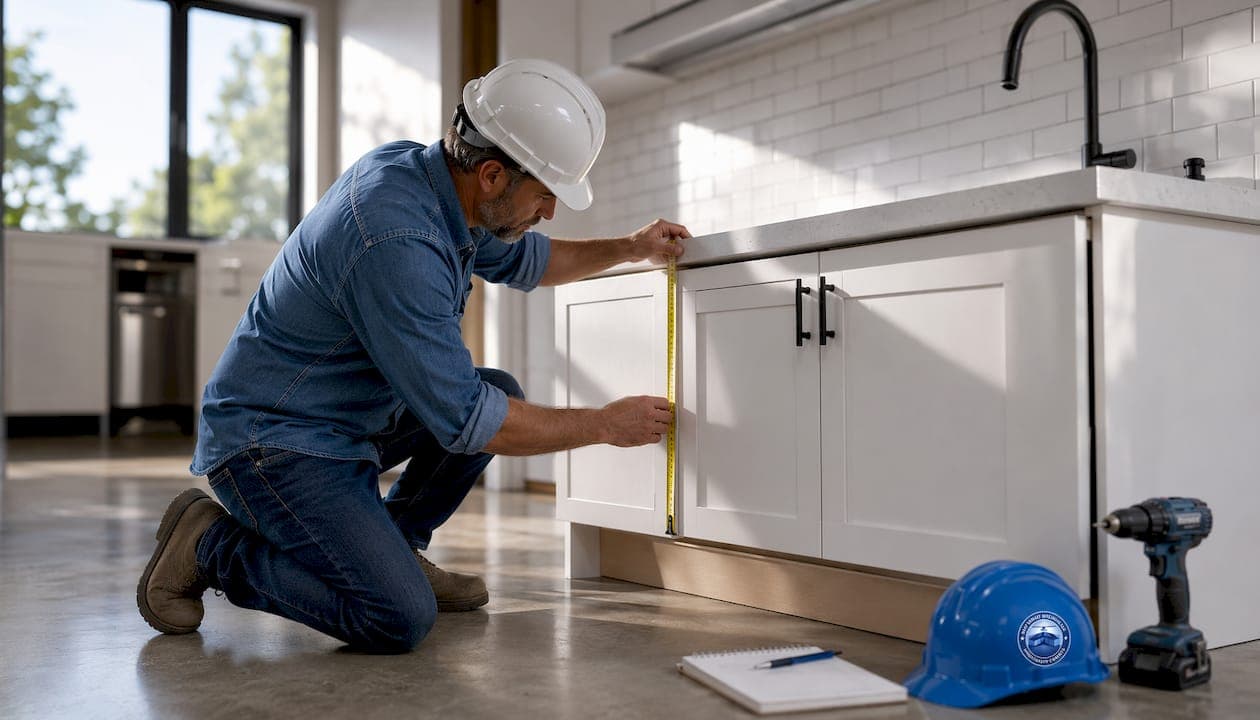
For most U.S. kitchens, the right choice is a 30" plywood base cabinet with a solid-wood door from Best Cabinet Specialist. It ships fast, carries a limited lifetime warranty on the cabinet structure, and arrives with soft-close hardware already included. Here is what you need to confirm before you order:
- Standard exterior dimensions: standard exterior dimensions (the industry default, often listed as B30 or FH30)
- Box construction: plywood, not particleboard, for moisture resistance and long-term screw-holding
- Door material: solid wood, refinishable and durable for daily use
- Hardware: soft-close hinges and drawer guides included
- Compliance label to check: CARB2 certification on the box or product page confirms low-formaldehyde composite materials
- Warranty: limited lifetime on cabinet structure; confirm hardware warranty term separately
- Next step: visit Best Cabinet Specialist to select your configuration, finish, and delivery option
Table of Contents
- What does "30 inch base cabinet" actually mean?
- Which 30" configuration fits your storage needs?
- What materials and construction tell you about durability
- Assembled vs. RTA: which option makes sense for you?
- How to measure and verify a 30" base cabinet will fit
- What does a 30" base cabinet typically cost in the U.S.?
- Warranties, arrival inspection, and what to do before installation
- Best Cabinet Specialist's 30" base cabinet options
- Why 30" is the practical maximum for a single base cabinet bay
- Key Takeaways
- What the team at Best Cabinet Specialist sees buyers choose most often
- Ready to order your 30" base cabinet?
- Useful sources for specification verification
What does "30 inch base cabinet" actually mean?
The phrase refers to the exterior width of the cabinet box. Standard exterior dimensions for a 30" base are standard width by standard depth and height dimensions designed to fit just below a typical countertop.
Depth is the most flexible variable. While 24" is the stock standard, depth options of 18", 21", 27", and 30" exist for special applications. A deeper cabinet adds usable storage and accommodates larger pull-out systems without changing the kitchen's horizontal rhythm. Height variants are less common but do appear, including some designed for wall applications or ADA-compliant layouts.
Model codes on listings follow a simple pattern. B30 typically means "base, 30 inches wide." FH30 means "full-height door, 30 inches wide." A sink base at 30" might appear as SB30. Knowing the code helps you cross-reference specs quickly across listings.
| Dimension | Standard | Common Variants |
|---|---|---|
| Width | standard for this category | |
| Depth | standard | common variants exist |
| Height | standard | some variants exist |
| Model code examples | B30, FH30 | SB30 (sink base), DB30 (drawer base) |
Common 30" configuration types:
- Single full-height door with one adjustable shelf
- Two-door with one or two adjustable shelves
- Two-drawer-over-door (top drawers, lower door with shelf)
- Three- or four-drawer stack (no door)
- Sink base with center or offset opening, no shelf
- Waste pull-out with door panel
Which 30" configuration fits your storage needs?
Choosing the right layout depends on what you plan to store and whether plumbing runs through that cabinet. A two-door-with-shelf unit works well for pots and pans. A drawer stack is the most efficient option for utensils, linens, and small items because drawers give you full access without crouching. Sink bases are designed around plumbing, with a wide open interior and no shelf to clear the P-trap and garbage disposer.
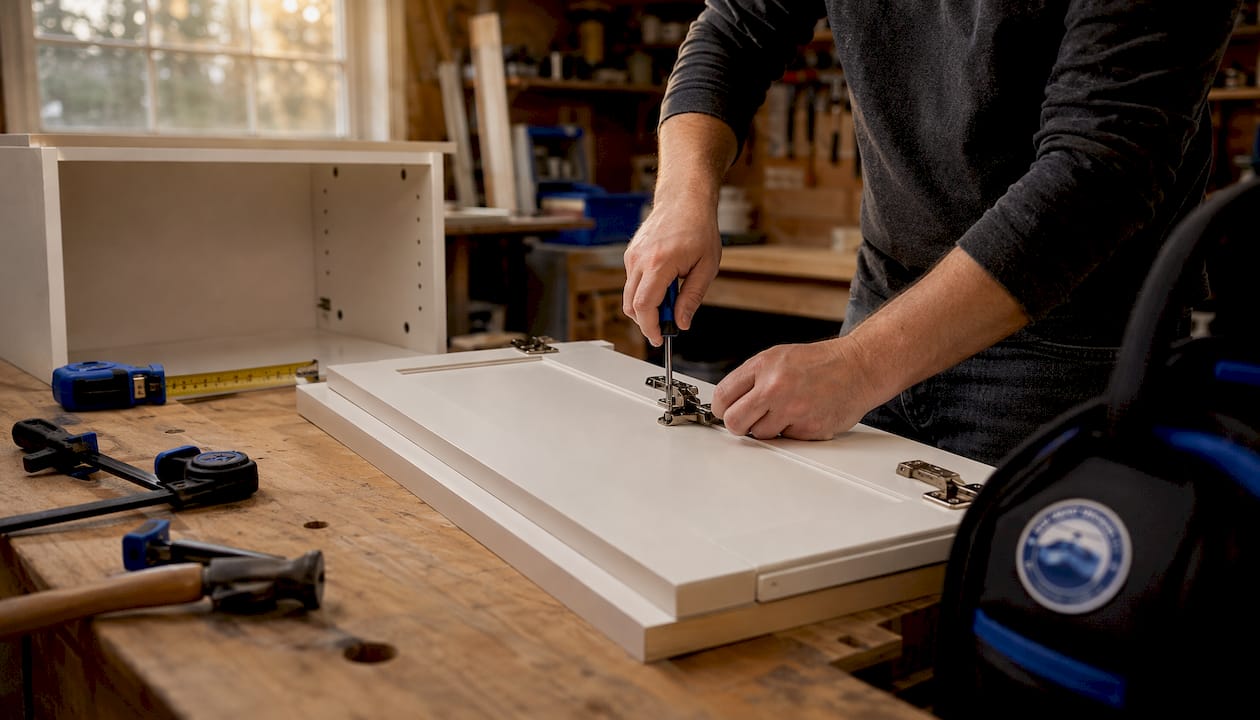
Internal organizers that fit a 30" width include pull-out shelves, pot-and-pan drawers, spice pull-outs, and trash or recycling pull-outs. Most standard pull-out systems are designed for 24" or 27" interior widths, so a 30" exterior cabinet (with a typical 27"–28" interior width after face frame and box walls) accommodates them without modification.
Internal clearance guidance:
- Interior width is normally slightly less than the exterior width due to frame and wall thickness
- Interior depth in standard cabinets is somewhat less than the exterior depth due to construction
- Pull-out trash units require adequate interior width per bin, so standard cabinets can accommodate double-bin units
- Lazy Susans are not typically used in base runs; they are a corner solution
Pro Tip: On a sink base, leave at least 6" of framing height above the cabinet floor for P-trap clearance, and verify the disposer mounting ring clears the cabinet top rail before ordering. Offset-opening sink bases give you more room on one side for the disposer and supply lines.
What materials and construction tell you about durability
Plywood box construction is the standard for long-lived cabinetry in residential kitchens. Plywood holds screws better than particleboard, resists moisture swelling, and does not delaminate when exposed to steam or minor leaks. Particleboard and MDF boxes cost less upfront but are more vulnerable to water damage and lose screw-holding strength over time, especially at hinge and slide mounting points.

Door material is a separate decision from box material. Solid-wood doors can be sanded and refinished if they chip or fade. MDF and HDF doors take paint well and resist warping better than solid wood in high-humidity environments, but they cannot be refinished once the surface is damaged. Thermofoil doors are the most affordable option and clean easily, but the film can peel near heat sources like dishwashers.
| Material | Durability | Moisture resistance | Refinishable | Typical warranty |
|---|---|---|---|---|
| Plywood box | High | High | N/A (box) | Limited lifetime common |
| Particleboard/MDF box | Moderate | Low | N/A (box) | 1–5 years typical |
| Solid-wood door | High | Moderate | Yes | Limited lifetime common |
| MDF/HDF door | Moderate–High | Moderate | No | Varies |
| Thermofoil door | Moderate | Moderate | No | 1–3 years typical |
Construction details worth checking on any listing:
- Dovetailed drawer boxes (stronger joint than stapled or doweled)
- Full-extension undermount slides (access the full drawer depth)
- Heavy-duty corner brackets inside the box
- 3/4" plywood box walls and bottom
- Solid wood or plywood face frame, not MDF
For buyers planning to stay in their home five or more years, plywood construction with solid-wood doors consistently offers the best balance of upfront cost and long-term durability.
Assembled vs. RTA: which option makes sense for you?
Ready-to-assemble (RTA) cabinets ship flat-packed, which lowers freight costs and reduces the risk of damage in transit. Assembled units ship fully built, which means faster installation but higher shipping weight and, in some cases, longer lead times for freight scheduling. Neither is universally better. The right choice depends on your timeline, skill level, and total budget including delivery.
Assembled pros and cons:
- Faster to install on-site, no assembly labor required
- Higher shipping cost due to weight and volume
- Risk of finish damage in transit is slightly higher
- Lead times may be longer for freight scheduling
RTA pros and cons:
- Lower per-unit price and shipping cost
- Assembly adds time on-site, requiring moderate effort with basic tools
- Flat-pack ships more safely in most cases
- Easier to carry through narrow doorways and up stairs
For RTA kitchen cabinet options and what to expect in the box, confirm the following before installation:
- Count all panels, hardware bags, and shelves against the packing list
- Check all panels for finish damage before assembly
- Confirm cam lock or dado joint type matches the assembly instructions
- Have a rubber mallet, drill, and level ready before you start
- Assemble on a flat surface, not the kitchen floor
Custom depths or non-standard heights are typically produced on a separate lead-time schedule and may carry an additional charge. If your project requires a non-standard size, confirm the lead time in writing before placing the order.
How to measure and verify a 30" base cabinet will fit
Measuring before you order prevents the most common installation problems: cabinets that are too tall for the countertop, too deep for the appliance clearance, or misaligned with adjacent runs. Follow these steps in order.
- Measure floor to countertop underside. The finished height should be 36". Subtract your countertop thickness (typically 1.5" for quartz or granite) to confirm the cabinet height needed.
- Check the floor for level. Use a 4-foot level across the full run. Note the high point — all cabinets are shimmed up to that point.
- Measure the wall for plumb. A wall that bows more than 1/4" over 8 feet will require scribing or filler strips.
- Measure the opening width. Confirm 30" of clear space between adjacent cabinets, appliances, or walls, including any door swing overlap.
- Check appliance clearances. Dishwashers and ranges require standard clearance sizes often around 24" and 30" ranges respectively
- Verify sink cutout compatibility. Measure the sink's minimum cabinet width requirement (usually 30" or 33") and confirm the sink base opening matches.
| Clearance type | Minimum | Notes |
|---|---|---|
| Toe kick height typical for standard cabinets; ADA-compliant designs have taller toe kicks | ||
| Door swing clearance | — | Confirm no appliance overlap |
| Dishwasher opening | 24" wide | Adjacent cabinet must not block |
| Countertop overhang (front) | 1" | Standard for most slabs |
| Countertop overhang (side) | — | Depends on layout |
For heavy stone countertops on a 30" span, add a center support leg or blocking between the cabinet and the countertop underside. This prevents sagging at the seam over time, particularly with slabs over 2 cm thick. A detailed walkthrough of how to measure a kitchen for new cabinets covers the full room layout process.
What does a 30" base cabinet typically cost in the U.S.?
Price varies significantly based on construction, finish, and whether the unit ships assembled or RTA. The main cost drivers are:
- Box material: plywood boxes cost more than particleboard but last longer
- Door style and finish: painted or stained solid-wood doors carry a premium over thermofoil
- Hardware quality: soft-close undermount slides and concealed hinges add cost but are worth it
- Assembled vs. RTA: assembled units typically cost more per unit before shipping
- Color and paint options: custom colors or glazed finishes add to the price
- Custom dimensions: non-standard depths or heights move to a different price tier
Bulk and package pricing changes the per-unit math for contractors and builders. Ordering a full kitchen package rather than individual cabinets typically reduces the per-cabinet cost. Trade accounts with volume discounts are available from suppliers like Best Cabinet Specialist for qualifying professionals.
Shipping, returns, and restocking fees are often overlooked when comparing low per-unit prices on RTA listings. Curbside delivery, threshold delivery, and white-glove setup are priced differently by each seller. Return restocking fees vary widely, and some sellers charge a percentage of the order value. Factor total landed cost, not just the listed price, into any comparison.
Warranties, arrival inspection, and what to do before installation
Most professional-grade RTA and assembled cabinets carry a limited lifetime warranty on the cabinet structure and a separate multi-year warranty on hardware like drawer guides and hinges. "Limited lifetime" typically means the warranty covers the original purchaser for the life of the product, with exclusions for misuse, water damage from external sources, and normal wear. Hardware warranties are usually shorter, often one to five years.
Run through this checklist on delivery before signing the carrier paperwork:
- Count all boxes against the packing list
- Inspect every box exterior for crush damage or punctures
- Open and check panels for finish chips, cracks, or delamination
- Test soft-close operation on all hinges and drawer slides
- Check drawer dovetailing for tight, gap-free joints
- Confirm box squareness by measuring diagonals (they should match within 1/8")
- Photograph any damage with a timestamp before moving cabinets inside
Pro Tip: Note any damage directly on the carrier's delivery receipt before the driver leaves. Documenting delivery problems with photos and timestamps is the most reliable way to preserve your warranty or carrier claim rights. Most sellers require documented proof within a specific window, often 48–72 hours of delivery.
If a box is visibly crushed or a panel is cracked, refuse that item and note it on the paperwork. Do not install a damaged cabinet and then attempt a warranty claim — most sellers require pre-installation documentation for structural replacements.
Best Cabinet Specialist's 30" base cabinet options
Best Cabinet Specialist offers 30" base cabinets built with plywood boxes, solid-wood doors, and soft-close hardware as standard. The lineup covers the most common configurations for residential and commercial projects, with fast shipping and trade ordering available.
| Spec | Details |
|---|---|
| Width | 30" |
| Depth | 24" (standard) |
| Box construction | Plywood |
| Door material | Solid wood |
| Hardware | Soft-close hinges and drawer guides |
| Finish options | Multiple colors and styles available |
| Assembly | RTA and assembled options |
| Warranty | Limited lifetime on cabinet structure, separate multi-year on hardware |
| Availability | Ships to U.S. addresses |
Ordering and shipping details:
- RTA units ship flat-packed with faster freight and lower shipping cost
- Assembled units are available with confirmed lead times at order
- Trade accounts and bulk package pricing available for contractors and builders
- Customer support available for measurement questions, design help, and trade orders
For finish coordination across your kitchen, consider how your cabinet color ties into adjacent materials. Matching interior door trim and millwork finishes to your cabinet style creates a cohesive look throughout the space.
To register a warranty claim, document the issue with photos, note the order number, and contact Best Cabinet Specialist's customer support within the seller's stated claim window. Keep your original order confirmation as proof of purchase.
Why 30" is the practical maximum for a single base cabinet bay
Trade practice treats 30" as the widest standard single-bay cabinet before countertop support and organizer fit become concerns. Beyond 30", a single bay starts to require additional internal support, and the countertop span above it may need blocking or a center leg to prevent flex under heavy stone.
A 30" cabinet also supports the largest standard pull-out organizer systems. Most heavy-duty pull-out shelves, pot drawers, and trash units are sized for interior widths up to 28", which fits cleanly inside a 30" exterior box. Narrower bays (18" or 24") limit organizer options and reduce load capacity for heavy items.
Practical notes for installers:
- If a project requires a wider opening than 30", split the span into two 15" or 18" bays, or use reinforced face-framed construction with internal support
- Splitting affects finish trim placement and countertop seam location, so plan that before ordering
- A deeper cabinet (27"–30" depth) adds more usable storage than going wider, without changing the kitchen's horizontal layout
Pro Tip: When storage is the priority and floor space allows, a 27" or 30" deep cabinet gives you significantly more usable volume than a wider cabinet at standard 24" depth. Pair it with full-extension slides to access the full depth without reaching.
For buyers comparing different base widths, the 18 inch base cabinet guide covers how narrower bays fit into layouts where a 30" unit would be too wide.
Key Takeaways
A 30" plywood base cabinet with solid-wood doors and soft-close hardware is the most durable, versatile single-bay option for U.S. kitchen renovations, and Best Cabinet Specialist offers it with fast shipping and a limited lifetime warranty on the cabinet structure and a separate multi-year hardware warranty.
| Point | Details |
|---|---|
| Confirm exact dimensions | Verify 30" W × 24" D × — H on the listing before ordering; check depth variants if needed. |
| Prioritize plywood construction | Plywood boxes outperform particleboard on moisture resistance and screw-holding for long-term durability. |
| Match configuration to use | Choose sink base, drawer stack, or door-and-shelf layout based on plumbing, appliances, and storage needs. |
| Inspect on delivery | Photograph damage before signing carrier paperwork; most sellers require documentation within 48–72 hours. |
| Best Cabinet Specialist | Offers 30" plywood base cabinets with solid-wood doors, soft-close hardware, and a limited lifetime warranty. |
What the team at Best Cabinet Specialist sees buyers choose most often
The buyers who end up happiest with their 30" base cabinet purchase are the ones who confirmed two things before ordering: the exact interior dimensions against their organizer specs, and the box material against their timeline. Plywood with solid-wood doors is the combination we see chosen most often by homeowners doing a full kitchen renovation, and for good reason. It holds up to daily use, refinishes well if the style changes, and the soft-close hardware holds up over years of use without adjustment.
Contractors and builders ordering in volume tend to go straight to trade accounts for package pricing, which changes the per-unit cost significantly. If you are managing a multi-unit project or a full kitchen build, that conversation is worth having before you place a single-unit order.
For measurement questions, configuration advice, or trade order details, Best Cabinet Specialist's customer support team is available to help you get the right spec the first time.
Ready to order your 30" base cabinet?
Best Cabinet Specialist gives you plywood-box quality and solid-wood craftsmanship at a price that makes sense for homeowners and contractors alike — without the long lead times that slow down most renovation projects.

Here is how to move forward:
- Choose your configuration (door, drawer, sink base, or pull-out)
- Select your finish and color from the available options
- Confirm assembled or RTA based on your timeline and installation plan
- Add your delivery address and review the shipping method
- Contact the trade team for bulk pricing or design support
Visit Best Cabinet Specialist to browse the full 30" base cabinet lineup, request a quote, or reach the trade team for volume orders. Fast shipping and project-ready quality are standard on every order.
Useful sources for specification verification
These pages are useful for cross-checking dimensions, materials, and warranty language as you compare listings:
- Best Cabinet Specialist: Primary source for plywood base cabinet specs, finish options, warranty details, and trade ordering; use this to confirm current availability and pricing.
- Smart Buy Cabinetry FH30 listing: Good reference for standard 30" full-height door base cabinet dimensions and how model codes map to specs.
- Home Depot Hampton Bay B30 listing: Useful for confirming assembled base cabinet dimensions and finish options at a major U.S. retailer.
- IKEA SEKTION base cabinet: Reference for RTA base cabinet assembly expectations and interior dimension specs.
- Casainc wall cabinet listing: Useful for reviewing typical warranty language on plywood RTA cabinets, including structure and hardware warranty terms.
- Industrial4less shelving depth reference: Helpful for understanding depth variants and how deeper units affect organizer compatibility and countertop overhang.