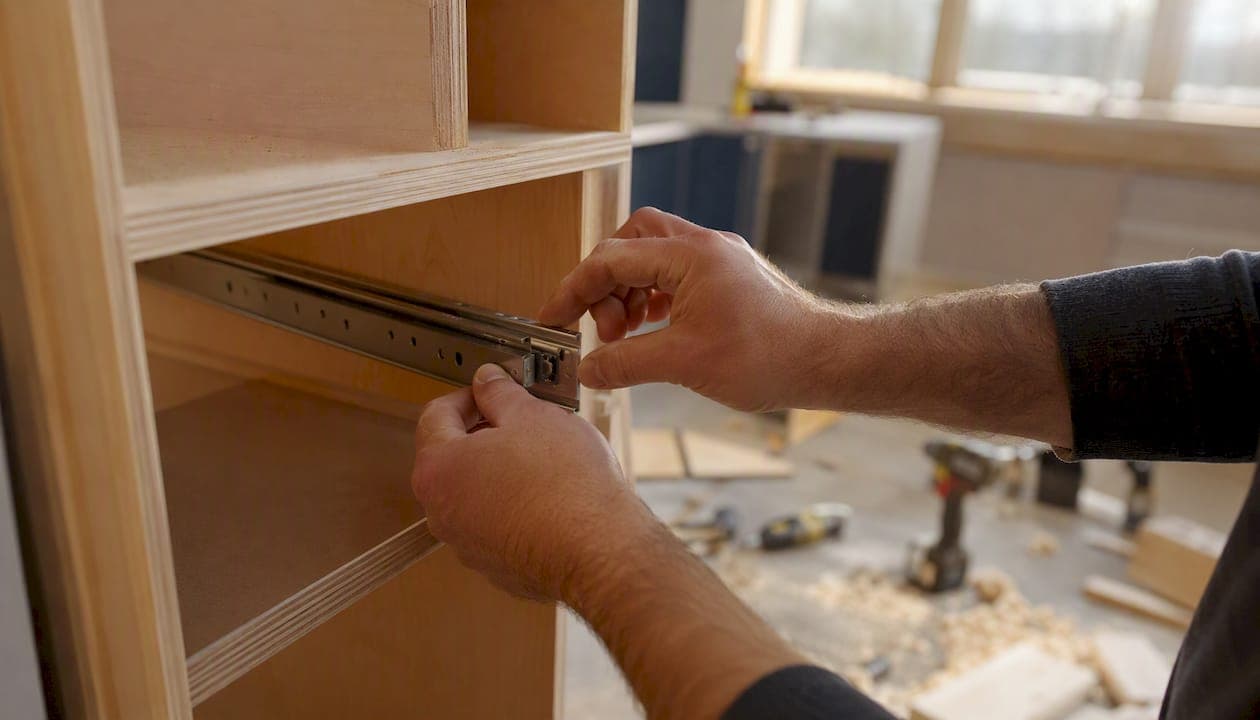
Drawer slides fall into three mounting types, side-mount, undermount, and center or bottom-mount, and each pairs with motion features like roller action, ball-bearing action, soft-close, self-close, and push-to-open. Kitchens generally do best with soft-close undermount slides for a clean look and quiet close, heavy tool drawers need side-mount ball-bearing slides rated for real weight, shallow or low-profile drawers usually call for center-mount or compact side-mount options, and handle-free cabinetry needs push-to-open hardware paired with a compatible mount like those detailed by One Day Doors & Closets.
That's the short version. Picking the right slide for your project means matching mount type, motion feature, extension length, and load rating to what the drawer will actually hold and how it will look once installed.
| Project Type | Recommended Slide |
|---|---|
| Kitchen cabinets | Undermount, soft-close, full extension |
| Heavy-duty tool drawers | Side-mount ball-bearing, over-travel |
| Shallow/low-profile drawers | Center-mount or compact side-mount |
| Handle-free cabinetry | Push-to-open, undermount or side-mount |
Pro Tip: A cheaper slide isn't a bad slide, it just trades some durability and smoothness for a lower price. Budget epoxy roller slides are fine for a linen closet drawer that opens twice a week. They are the wrong call for a silverware drawer your family opens 20 times a day.
Key Takeaways
Matching mount type, motion feature, extension length, and load rating to your drawer's actual contents is the single most reliable way to choose the right slide.
| Point | Details |
|---|---|
| Match mount to visibility needs | Undermount hides the slide, side-mount is easiest to repair, bottom-mount saves money. |
| Round up on load rating | Choose a slide rated above your heaviest expected drawer contents, not exactly at it. |
| Measure before you order | Confirm cabinet depth, drawer box depth, and side clearance to avoid a mismatched slide. |
| Upgrade for daily-use drawers | Soft-close ball-bearing or undermount slides pay off in kitchens and high-traffic drawers. |
| Consider pre-installed hardware | Best Cabinet Specialist ships cabinets with soft-close slides already in place for faster remodels. |
Table of Contents
- What Are the Main Drawer Slide Mounting Types?
- How Do Roller and Ball-Bearing Slides Differ?
- What Do 3/4, Full, and Over-Travel Extension Mean?
- How Much Weight Should a Drawer Slide Hold?
- What Measurements Do You Need Before Buying Slides?
- Which Slides Handle Special or Unusual Drawers?
- How Should You Decide Which Slide to Buy?
- Which Brands Signal Quality in Drawer Hardware?
- Why Do Better Drawer Slides Cost More?
- How Do You Maintain and Troubleshoot Drawer Slides?
- What Do Drawer Slides Typically Cost?
- Does Climate Affect Which Drawer Slides You Should Choose?
- A Cabinetmaker's Field Notes on Slide Selection
- Where to Find Cabinets With Slides Already Installed
- Where to Learn More About Drawer Slide Specs
- Sources
What Are the Main Drawer Slide Mounting Types?
The mounting method determines where the slide sits relative to the drawer box and how much of it you'll actually see once the drawer is installed. Three formats cover nearly every residential and commercial application: bottom-mount (also called epoxy or center-mount), side-mount, and undermount. Each one solves the same basic problem, holding a drawer and letting it glide, but the tradeoffs in cost, visibility, and weight capacity are significant enough to change which one belongs in your project.
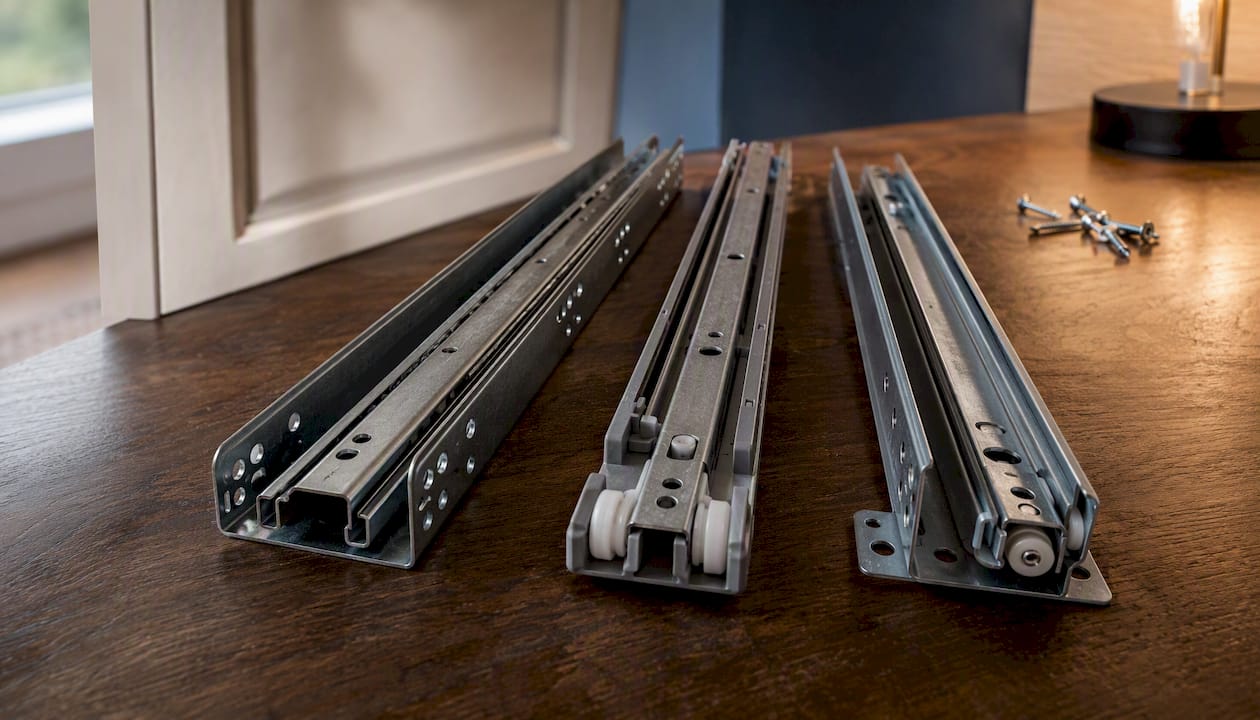
Bottom-mount (epoxy/center-mount) slides run down the center underside of the drawer on a single track. They're the least visible from the side, cheap to install, and forgiving of minor drawer-box imperfections. Trade pricing on an 18 inch pair typically runs $8 to $15, making this the budget default for builder-grade cabinetry and furniture kits.
Side-mount slides attach to the drawer box sides and the cabinet interior walls, visible when the drawer opens. They come in ball-bearing or epoxy roller versions, handle heavier loads than center-mount, and are the easiest type to service or replace because the mechanism is fully exposed. Expect to pay $15 to $40 per 18 inch pair depending on load rating and motion features.
Undermount slides tuck beneath the drawer box, completely hidden when the drawer is open or closed. This is the format most homeowners picture when they think of a high-end kitchen drawer that closes itself with a whisper. Undermounts run $25 to $45 per 18 inch pair and typically require a specific drawer bottom thickness or notch pattern, so retrofitting an older cabinet can mean rebuilding the drawer box rather than just swapping hardware.
- Bottom-mount: cheapest, least visible, easiest for DIY builds, lower load capacity.
- Side-mount: most versatile, easiest to repair, visible hardware, wide load range.
- Undermount: cleanest look, self-centering in most designs, highest cost, stricter drawer-box requirements.
Choosing between these three often comes down to one question: do you care more about what the drawer looks like when it's open, or about not having to rebuild your drawer boxes to get there?
Pro Tip: If you're retrofitting existing cabinets, stick with the mounting type already in place unless you're prepared to rebuild the drawer boxes. Undermount slides in particular often demand a specific setback and thickness that older, shop-built drawers rarely have.
How Do Roller and Ball-Bearing Slides Differ?
Roller slides use a plastic or nylon wheel riding in a track, while ball-bearing slides use rows of steel or nylon ball bearings for smoother, quieter, and more durable motion. Ball-bearing slides cost more but hold heavier loads and resist the wobble that develops in roller slides after a few years of daily use. If you've ever opened a kitchen drawer and felt it sag or catch partway through its travel, that's usually a roller slide reaching the end of its service life.
Beyond the bearing type, four motion features shape how a drawer actually behaves day to day:
- Soft-close uses a hydraulic or pneumatic damper that engages roughly 2 inches before full closure, slowing the drawer so it settles shut instead of slamming.
- Self-close relies on a spring or gravity-assist mechanism that pulls the drawer the rest of the way shut once it's within a few inches of the closed position, with no damping.
- Push-to-open eliminates the handle entirely; a light push releases a latch and the slide's spring mechanism pops the drawer open slightly for you to grab.
- Locking mechanisms hold the drawer in an extended position or prevent it from opening at all, common in RV cabinetry, mobile equipment, and childproofing applications.
Premium undermount systems, Blum's Tandem line with Blumotion being the example most cabinetmakers point to, pair ball-bearing action with soft-close damping in a single hidden unit. That combination is why higher-end kitchens feel so different from a builder-grade box store cabinet the moment you open a drawer.
| Motion Feature | Works With | Typical Feel | Best For |
|---|---|---|---|
| Roller | Bottom-mount, budget side-mount | Functional, some play | Closets, garages, light-use storage |
| Ball-bearing | Side-mount, undermount | Smooth, minimal wobble | Kitchens, offices, daily-use drawers |
| Soft-close | Side-mount, undermount | Slow, cushioned close | Kitchens, bathrooms, family homes |
| Push-to-open | Undermount, some side-mount | Handle-free operation | Modern/minimalist cabinetry |
If you're also weighing hinge upgrades for the same project, our breakdown of soft-close cabinet hinge options covers the door-side equivalent of this same decision.
Pro Tip: Don't mix motion features within the same run of cabinets. A kitchen with soft-close drawers next to self-close ones feels inconsistent every time you use it, and it's one of the fastest ways to make a fresh renovation feel unfinished.
What Do 3/4, Full, and Over-Travel Extension Mean?
Extension type describes how much of the drawer box actually clears the cabinet face when fully open, and it directly affects how easily you can reach the back of the drawer. 3/4 extension slides let the drawer travel about three-quarters of its total depth out of the cabinet, leaving the back few inches inaccessible. Full extension slides let the entire drawer clear the cabinet opening, so you can see and reach every corner. Over-travel slides push the drawer even further, extending it beyond the cabinet face for situations where you need extra reach, like pulling a heavy stand mixer fully into view.
Side-mount ball-bearing slides are usually available in all three extension types, which is one reason they remain the workhorse choice in cabinet shops. Center-mount and most epoxy bottom-mount slides, by contrast, are typically limited to 3/4 extension, which is fine for shallow storage but frustrating for anything you need to dig through regularly.
A quick way to think through the choice on your own project:
- Measure how deep the drawer box actually is, front to back.
- Decide whether you need to see and reach the entire drawer, or just the front three-quarters (silverware trays, for example, rarely need full extension).
- Check whether your cabinet has a face frame, which can reduce usable opening width and affect which extension types will clear it properly.
- Confirm the slide length matches drawer depth closely. Undersized slides leave dead space at the back of the drawer; oversized slides can bind against the cabinet back.
- For deep pull-outs, like pantry drawers or file drawers, lean toward full extension or over-travel so nothing gets lost at the rear.
- 3/4 extension: lowest cost, fine for closets, linen storage, and shallow trays.
- Full extension: the standard choice for kitchen and bath drawers where full access matters.
- Over-travel: worth the extra cost for pantry pull-outs, appliance garages, or anything you need to see the back of at a glance.
How Much Weight Should a Drawer Slide Hold?
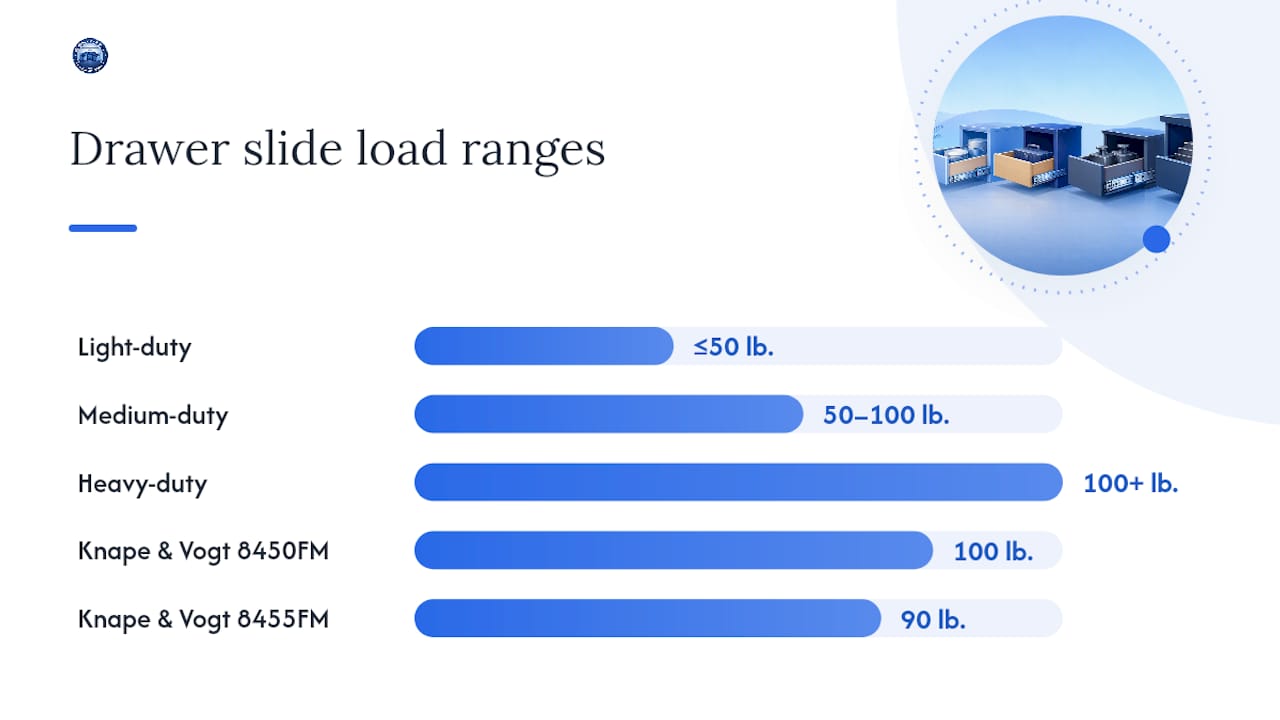
Trade guidance generally splits load capacity into three bands: light-duty slides top out around 50 pounds, medium-duty slides handle roughly 50 to 100 pounds, and heavy-duty slides are rated above 100 pounds. A kitchen junk drawer rarely tests those limits, but a pot-and-pan drawer, a file drawer packed with folders, or a tool chest drawer loaded with wrenches can climb into medium or heavy-duty territory faster than most people expect.
Load rating reality check: Manufacturer spec sheets show real examples of this range in action. Knape & Vogt's soft-close sidemount line lists an 8450FM model rated for a 100 pound class and an 8455FM rated for 90 pounds, depending on which lever-disconnect version you choose.
Material matters as much as the rating printed on the box. Steel ball-bearing slides hold up best under repeated heavy loads and resist the flex that causes binding over time. Aluminum components shave weight and resist corrosion, which matters in humid climates or boat and RV builds, but they generally carry lower load ratings than steel. Plastic rollers and end caps are common in budget bottom-mount slides. They work fine under light loads but wear faster and are the first part to crack or deform under sustained heavy use.
- Light-duty (up to 50 lb.): linen closets, bedroom dressers, shallow accessory drawers.
- Medium-duty (50 to 100 lb.): standard kitchen drawers, bathroom vanities, home office files.
- Heavy-duty (100+ lb.): tool chests, large file drawers, pantry pull-outs, commercial kitchen equipment.
When comparing slides, look for ANSI/BHMA Grade 1 certification on the packaging or spec sheet. It's the industry standard signal for high-performance reliability, and while the exact load capacity still varies by model and application, Grade 1 tells you the slide has been tested against a recognized performance benchmark rather than just marketed as "heavy-duty" with no backing data.
Pro Tip: When in doubt, round up on load rating. A slide rated for 100 pounds handling a 60 pound drawer will outlast one rated for exactly 60 pounds handling that same load, because you're not running it at the edge of its capacity every day.
What Measurements Do You Need Before Buying Slides?
Getting the wrong slide length or clearance is the single most common and most avoidable mistake in a drawer hardware project. A short checklist before you order anything saves a return trip to the store, or worse, a drawer that binds the moment you install it.
- Measure the full depth of the cabinet opening, front to back, at the location where the drawer will sit.
- Measure the drawer box depth itself, not including any face or handle overhang.
- Check available side clearance between the drawer box and the cabinet wall. Standard side-mount ball-bearing slides need about 1/2 inch of clearance per side.
- Note whether the cabinet has a face frame, since it can shrink your usable opening compared to a frameless cabinet of the same width.
- Account for drawer bottom thickness, especially if you're planning to install undermount slides, which often require a specific bottom-panel thickness or a notched profile to seat correctly.
- Match slide length to drawer depth as closely as possible. Oversized slides waste space at the back of the drawer and can affect stability; undersized slides leave a visible gap and reduce load support.
Practitioners consistently emphasize matching slide length closely to drawer box depth to minimize dead space and keep the drawer stable when fully loaded and extended.
- Retrofit projects: measure the existing slide's mounting holes and travel length before assuming a direct swap will work.
- New builds: design the drawer box depth around a standard slide length first, rather than building the box and hoping a slide fits.
- Always double-check spec sheets for travel length, clearance requirements, and disconnect type before ordering in bulk for a multi-cabinet project.
| Situation | What to Measure First | Common Mistake |
|---|---|---|
| Retrofitting old cabinets | Existing slide length and hole pattern | Assuming new slide matches old mounting holes |
| New cabinet build | Drawer box depth vs. standard slide lengths | Building the box before selecting the slide |
| ADA-compliant projects | Reach depth and required clearance | Skipping accessibility clearance standards |
If you're working through a full kitchen layout rather than a single drawer swap, our guide to cabinet configuration and layout walks through how drawer placement affects these measurements at a room-wide scale. For accessibility-driven projects, the reach and clearance rules in our ADA compliant kitchen cabinets guide apply directly to slide selection too.
Which Slides Handle Special or Unusual Drawers?
Standard kitchen and bath applications cover most projects, but plenty of drawers need something the basic catalog doesn't offer. Heavy-duty and extra-long slides are built for tool chests, workshop cabinets, and file storage where standard load ratings fall short; these often push well past the 100 pound heavy-duty threshold and come in lengths up to 28 to 30 inches for deep industrial or garage cabinetry.
Low-profile slides solve a different problem: shallow drawers, like a spice drawer or a knife tray, where a standard side-mount bracket would eat up too much usable interior height. These slides use a slimmer track profile and are common in keyboard trays and thin storage drawers built into desks or built-in furniture.
Specialty applications worth knowing about:
- Pantry pull-outs often use full-extension or over-travel side-mount slides rated for the combined weight of shelving hardware plus groceries, which adds up faster than most people estimate.
- Tool drawers call for heavy-duty ball-bearing side-mount slides, sometimes with a locking feature to keep the drawer secure during transport in a mobile toolbox.
- Mobile and RV cabinetry frequently uses locking slides that hold the drawer shut during transit, a feature rarely needed in a stationary home kitchen.
Pro Tip: When you're not sure a slide fits a specialty use, ask the seller directly for the rated load capacity, the exact extension type, and whether a locking version exists. A vague answer to any of those three questions is a sign to look elsewhere.
Budget roller and epoxy slides still have a place even among these specialty categories. They remain durable and inexpensive, and current versions sometimes include soft-close add-ons, making them a reasonable choice for light-use specialty drawers where cost matters more than a flawless glide.
- Keyboard trays: low-profile side-mount, usually 3/4 extension, rated light-duty.
- Pantry pull-outs: full-extension or over-travel side-mount, medium to heavy-duty.
- Mobile/locking applications: side-mount with a lock feature, rated to the specific equipment's weight.
How Should You Decide Which Slide to Buy?
Run through mounting type, motion feature, extension, and load rating in that order, and you'll land on the right slide for almost any drawer in your home or shop. Start with how the drawer needs to look and function, then work down to the technical specs that make it perform reliably for years.
- Decide if visibility matters. Choose undermount if you want a hidden mechanism, side-mount if you want easy access for repairs, bottom-mount if budget is the priority.
- Choose your motion feature based on how the drawer gets used daily. Soft-close for kitchens and family spaces, push-to-open for handle-free cabinetry, plain ball-bearing for workshops where quiet closing isn't the priority.
- Pick extension type based on how much of the drawer you need to reach. Full extension is the safe default for most kitchen and bath applications.
- Match load rating to actual contents, rounding up rather than down.
- Confirm clearance and drawer-box compatibility before ordering, especially for undermount slides.
- Ask retailers or check spec sheets for exact clearance requirements, not just "standard installation."
- Confirm the disconnect type (lever, button, or tool-free release) so servicing the drawer later doesn't require disassembling the whole cabinet.
- Check warranty length. A short or vague warranty is often a sign of lower build quality even if the price looks competitive.
- Look for a listed hole pattern if you're replacing existing hardware rather than building new.
A slide with no published load rating, no warranty information, and vague installation instructions is telling you something about how it was made, even if the price tag looks appealing.
Red flags worth walking away from: missing ANSI/BHMA certification on a product marketed as "commercial grade," warranties under a few years on anything marketed as premium, and spec sheets that don't list travel length or clearance at all. If your project involves building the cabinets from scratch, our step-by-step DIY cabinet guide covers drawer box sizing decisions that pair directly with this checklist.
Which Brands Signal Quality in Drawer Hardware?
Brand names aren't the whole story on quality, but they're a useful shortcut when you're standing in an aisle or scrolling a spec sheet trying to judge build quality fast. Two names come up constantly in professional cabinet shops and trade publications: Blum and Knape & Vogt (KV).
Blum, an Austrian manufacturer, is best known for its Tandem undermount slide line, frequently paired with the Blumotion soft-close module. This combination is the benchmark most cabinetmakers compare other undermount systems against, known for a smooth, self-centering close with minimal side-to-side play even after years of daily use.
Knape & Vogt covers a broader range, from basic epoxy slides to soft-close side-mount families like the 8450FM and 8455FM models, which list load classes of 100 and 90 pounds respectively along with details like lever disconnects and polymer stop cushions. KV's published spec sheets are a good model for what any manufacturer's documentation should include.
The manufacturers worth buying from are the ones publishing exact numbers, load class, disconnect type, clearance requirements, rather than vague marketing language like "heavy-duty" with nothing to back it up.
Approximate price ranges by type, based on 18 inch pairs in the U.S. market: bottom-mount epoxy slides run $8 to $15, side-mount slides run $15 to $40, and undermount soft-close slides run $25 to $45. Premium undermount systems from top-tier brands can run higher, particularly in longer lengths or heavier load classes. Before ordering in volume for a kitchen remodel or a multi-unit build, always pull the manufacturer's actual spec sheet to confirm drawer thickness requirements and hole patterns match your cabinets.
- Blum: known for Tandem and Blumotion undermount systems, a common benchmark in cabinet shops.
- Knape & Vogt: broad product range from budget to soft-close side-mount, with detailed published spec sheets.
- Always verify current pricing and availability directly with the manufacturer or a cabinet hardware supplier, since both shift with load class and length.
Why Do Better Drawer Slides Cost More?
The price gap between a $10 epoxy slide and a $40 soft-close undermount isn't marketing markup, it reflects real differences in cycle life, materials, and how often the drawer will need service down the road. A ball-bearing mechanism distributes load across dozens of steel bearings instead of a single plastic wheel, which is the physical reason it resists the sag and misalignment that eventually plagues cheaper roller slides.
The durability tradeoff: Higher-quality ball-bearing and soft-close undermount slides cost more upfront, but they resist misalignment, slamming damage, and general wear well enough that professional installers often prefer them specifically to avoid callback visits.
That preference isn't sentimental. A contractor who installs budget slides in a kitchen full of daily-use drawers is more likely to get a call in two years about a sagging or sticking drawer than one who specified ball-bearing or soft-close hardware from the start. The math works out in the installer's favor even though the initial material cost is higher, because a callback visit eats into the margin on the original job far more than the hardware upgrade would have.
- Higher-quality slides reduce misalignment and binding, the two most common causes of a "broken drawer" service call.
- ANSI/BHMA Grade 1 certification signals the slide has been tested to a recognized cycle-life standard rather than just described as durable.
- A meaningful manufacturer warranty is itself a signal. Companies rarely back a mediocre product with a long warranty period, since they'd be absorbing the replacement cost themselves.
For a kitchen renovation or a rental property where drawers see heavy daily use, paying up for soft-close ball-bearing or undermount slides is usually the more economical choice over a 10 to 15 year horizon, even though the shelf price looks higher on day one. For a rarely used linen closet or a one-off storage bin, a budget epoxy slide remains a perfectly reasonable choice.
How Do You Maintain and Troubleshoot Drawer Slides?
Most drawer slide problems trace back to one of three causes: dust and debris in the track, a loose mounting screw, or a slide that was slightly misaligned during installation and has been fighting itself ever since. A drawer that drags or sticks usually just needs the track cleaned out and a light coating of a dry lubricant like silicone spray, not a full hardware replacement.
Noisy bearings are another common complaint, especially in older side-mount ball-bearing slides that have gone years without any lubrication. A few drops of silicone-based lubricant on the ball-bearing channel usually quiets things down within a day or two of use. Avoid petroleum-based lubricants like WD-40 on plastic components, since they can cause the material to degrade over time.
If a drawer feels loose or wobbles side to side, check the mounting screws first. Wood screws in particleboard or MDF drawer boxes can work loose gradually, especially in humid climates, and re-tightening or moving to a slightly larger screw often solves the problem without replacing anything. If the slide itself has developed a permanent bend or the ball-bearing carriage has visibly worn grooves into the track, that's a sign the slide has reached the end of its service life and needs replacing rather than servicing.
- Dragging or sticking: clean the track and apply a dry silicone lubricant.
- Noisy operation: lubricate the ball-bearing channel, avoid petroleum-based products on plastic parts.
- Wobble or looseness: check and tighten mounting screws before assuming the slide has failed.
- Uneven closing: confirm both slides are mounted level and at the same height on each side of the drawer.
What Do Drawer Slides Typically Cost?
Cost scales predictably with mounting type, motion feature, and load rating, so it's worth budgeting by category rather than shopping one pair at a time. Bottom-mount epoxy slides remain the cheapest option at $8 to $15 per 18 inch pair, appropriate for closets and light-use storage where visible hardware and modest load capacity aren't a concern.
Side-mount slides span a wider range, from $15 to $40 per pair, with the low end covering basic epoxy roller versions and the high end covering heavy-duty ball-bearing slides with soft-close add-ons. Undermount slides sit at the top of the standard range, $25 to $45 per pair, reflecting the more complex mechanism and self-centering hardware required to make a hidden slide work smoothly.
For a full kitchen remodel involving 15 to 20 drawers, the difference between outfitting every drawer with budget bottom-mount slides versus premium soft-close undermounts can run into several hundred dollars in hardware alone. That's real money, but spread across the total cost of a renovation, it's often a smaller line item than homeowners expect relative to the daily improvement in how the kitchen feels to use.
Does Climate Affect Which Drawer Slides You Should Choose?
Humidity and temperature swings affect drawer hardware more than most people realize, particularly in coastal regions, bathrooms, and kitchens near dishwashers or ranges that generate steam. Wood drawer boxes expand and contract with moisture, which can throw off the tight clearances that side-mount and undermount slides depend on for smooth operation.
In consistently humid climates, steel slides with a corrosion-resistant coating or aluminum components hold up better over time than uncoated steel, which can develop surface rust on the bearing channels. This matters most in bathroom vanities, laundry rooms, and any kitchen drawer positioned close to a dishwasher's steam vent.
Temperature swings matter more for plastic components than metal ones. Plastic rollers and stop cushions can become brittle in cold garage or basement installations and softer in hot attic-adjacent spaces, which is part of why heavy-duty steel and ball-bearing slides are the safer choice for unconditioned spaces like garages, workshops, and outdoor kitchens. If you're building drawer boxes yourself for one of these environments, our guide on solid wood cabinet doors and materials covers how wood movement interacts with hardware fit in more demanding conditions.
A Cabinetmaker's Field Notes on Slide Selection
Every experienced installer has a mental shortcut for slide selection, and it usually comes down to this: undermount for anything that needs to look like furniture, side-mount for anything that needs to survive abuse, and epoxy bottom-mount for anything on a tight budget where nobody's going to be staring at the hardware anyway. That framework holds up because it maps directly to what each mount type is actually good at, rather than what looks impressive on a spec sheet.
On the job site, the fine-tuning happens during installation, not before it. Shimming a slightly out-of-square cabinet opening before mounting the slide brackets prevents the drag and binding that shows up weeks later once the wood settles. Checking gap tolerances on both sides of the drawer, not just one, catches the uneven reveal that makes a whole row of drawers look sloppy even when each individual drawer works fine on its own.
A short troubleshooting sequence worth running before blaming the slide itself: check for square first, since a racked cabinet opening will bind even a perfect slide; check screw tightness second, since loose mounting hardware causes more "defective slide" complaints than actual manufacturing defects; and check for debris in the track third, since sawdust and drywall grit from a fresh renovation are surprisingly common culprits behind a sticky new drawer.
Misalignment, drag, and noisy bearings almost always trace back to one of those three causes rather than a genuine hardware failure. Treating the symptom, forcing the drawer or adding lubricant without addressing square and clearance, tends to mask the problem for a few weeks before it resurfaces.
Where to Find Cabinets With Slides Already Installed
If everything in this guide has you thinking "I'd rather just buy cabinets with the right slides already in place," that option exists, and it's a reasonable one for a lot of homeowners and contractors on a timeline. Best Cabinet Specialist ships ready-to-assemble and fully assembled kitchen and bathroom cabinets with soft-close hardware pre-installed, so you skip the mounting-type comparison entirely and get plywood box construction with solid wood doors delivered fast.

This isn't a substitute for understanding slide types if you're repairing or upgrading hardware in cabinets you already own, that's still a hands-on hardware decision best made using the mounting, motion, and load guidance above. But for a full kitchen or bathroom remodel where you're replacing cabinets outright, ordering them with soft-close slides built in from the start removes one more variable from the project. Browse the full cabinet catalog to see current styles and finishes, or check the ready-to-assemble options if fast shipping and easy installation matter most for your timeline.
Where to Learn More About Drawer Slide Specs
For readers who want to go deeper into manufacturer numbers and installation diagrams before making a final decision, a few sources stand out for detail and reliability.
- FineWoodworking's guide to mechanical drawer slides covers the three main mounting formats with real trade pricing.
- Woodworking Network's guide to choosing the right drawer slide breaks down extension types in practical terms.
- Rockler's drawer slide guide has specific clearance measurements for DIY installation.
- Knape & Vogt's product brochures show exactly how a manufacturer documents load class, disconnect type, and installation specs.
- Salice's product pages explain what ANSI/BHMA Grade 1 certification actually signals.
Always pull the current spec sheet directly from the manufacturer before finalizing an order, since hole patterns, exact clearances, and load ratings can shift between model revisions.
Sources
- Mechanical drawer slides (FineWoodworking)
- How to choose the right drawer slide (Woodworking Network)
- Salice - Progressa Plus Smove USA
- Best push-to-open & soft-close drawer slides (Woodworker Express blog)
- Knape & Vogt 8450FM / 8455FM brochure